
The Inquisitor
Season 27 Episode 6 | 1h 25m 31sVideo has Audio Description
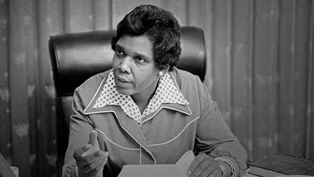
Meet Barbara Jordan: a civil rights icon whose powerful voice masked a complex private life.
Explore the life and legacy of Barbara Jordan in The Inquisitor. Jordan was a groundbreaking Texas congresswoman whose sharp intellect and moral clarity transformed U.S. politics. From Nixon’s impeachment to civil rights battles, her voice demanded accountability, while she privately faced struggles few ever knew of.
See all videos with Audio DescriptionADProblems playing video? | Closed Captioning Feedback
Problems playing video? | Closed Captioning Feedback
The Inquisitor
Season 27 Episode 6 | 1h 25m 31sVideo has Audio Description
Explore the life and legacy of Barbara Jordan in The Inquisitor. Jordan was a groundbreaking Texas congresswoman whose sharp intellect and moral clarity transformed U.S. politics. From Nixon’s impeachment to civil rights battles, her voice demanded accountability, while she privately faced struggles few ever knew of.
See all videos with Audio DescriptionADProblems playing video? | Closed Captioning Feedback
How to Watch Independent Lens
Independent Lens is available to stream on pbs.org and the free PBS App, available on iPhone, Apple TV, Android TV, Android smartphones, Amazon Fire TV, Amazon Fire Tablet, Roku, Samsung Smart TV, and Vizio.
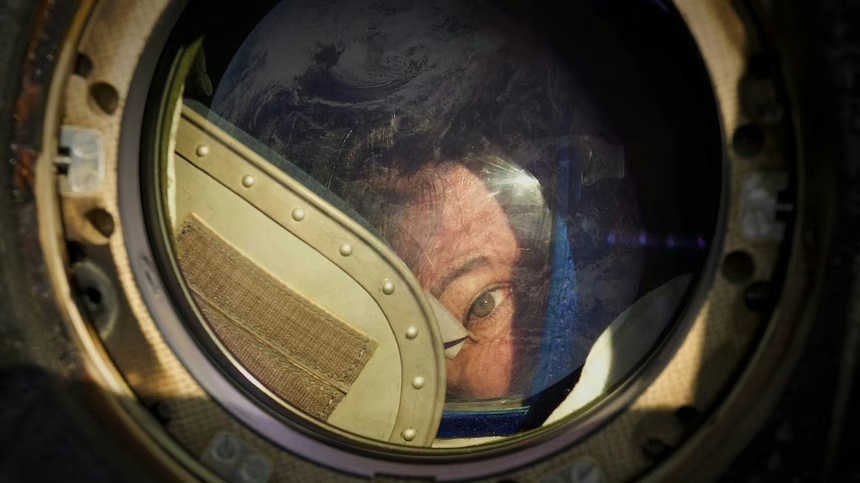
Sci-Fi's Take on Real Space Isolation
From 2001: A Space Odyssey to Moon, Project Hail Mary and Star Trek's holodeck, explore the psychological challenges of astronaut loneliness found in sci-fi, drawing parallels to real-life ISS experiences and proposing solutions like virtual reality companionship and induced hibernation.Providing Support for PBS.org
Learn Moreabout PBS online sponsorshipPart of These Collections
Providing Support for PBS.org
Learn Moreabout PBS online sponsorship♪ Jordan: What the people want is very simple.
They want an America as good as its promise.
♪ Richards: When you were with Barbara, you could never quite shake the feeling that you were in the presence of somebody that was truly great.
[Applause] Woman: Barbara Jordan blazed a trail.
She was the first Black woman to serve in the Texas State Senate.
The first Black woman elected to Congress from the Deep South.
Barbara Jordan was a champion of our freedom, our Constitution, and our laws.
Woman 2: She could walk into all white male spaces and be respected.
Man: She reached into the heart of people whose hearts didn't want to be reached into.
Woman 3: She was someone who was respected across party lines.
When Barbara Jordan spoke, you just sat up and listened.
We are trying to spark the consciousness in-depth of everybody in this country, and we feel that we have the capacity to do it.
Man 2: Barbara Jordan's got the voice of God.
Jordan: When people are eroding the foundation of the country, don't be silent.
Don't be quiet.
Woman 4: I see the conviction and honesty that she had, something that is absent from politics today.
I think this mood that we're in now is cyclical.
I think people are basically good and honest and that they care, and I think we will return to that posture.
Man 3: She carried the fire.
She carried the flame at a very critical time in American history.
Today, I am an inquisitor.
My faith in the Constitution is whole.
It is complete.
It is total.
And I am not going to sit here and be an idle spectator to the diminution, the subversion, the destruction of the Constitution.
[Gavel hammering] [Projector slide rattling] Rather: It would be difficult to understand and recognize from where Barbara Jordan came to what she became.
It's a great story.
It's a great American story.
[Projector slide rattling] [Engine roaring] [Speaking indistinctly] [Man shouts] [Explosion] Jordan: You have the freedom to choose the kind of future you want.
You denied the luxury of opting out.
You can't opt out.
You're already in.
How can you opt out where you are?
You are involved in life.
You make the choice to leave.
But, if you choose to leave, you must be sure you have the capability, the capacity, the competence to do the job.
[Slide projector rattling] ♪ Myself and my two sisters grew up in the 5th Ward of Houston.
We didn't know that we were in a deprived sector of the city.
When everybody's poor, you don't ever think about poverty.
We thought we'd just play in our gravel streets and eat the dust which the cars would stir up.
We didn't worry about it too much.
[Screaming] Singer: ♪ I don't know what you gonna do ♪ McGowan: Barbara had a beautiful alto voice.
We started singing together at the church to where we belonged, at Good Hope Missionary Baptist Church.
And we even gave little mini recitals.
Grandpa Patton showed favoritism to Barbara.
When we would go sometimes back to evening church, she would stay there with him.
Jordan: Grandpa Patton was a junkman.
He would weigh that paper and weigh the rags, hitch up his mules, and go sell them.
I say "we" because I was my grandpa Patton's partner in business, and we had more money than anybody we encountered.
♪ My father wanted excellence in his children.
I was very proud of a report card.
I had five A's and one B. My father, he looked at it and then, with a scowl, "Why do you have this B?"
So I was reverent toward him.
He taught me to love, to do the best that I could do.
I didn't want to be run of the mill.
I don't want to be just same old, same old.
I want to be a little bit different and superior, to tell the truth.
[Birds chirping] King: Barbara and I were students together in high school, and we went on to Texas Southern University together.
We were partners as members of the Texas Southern University debate team under the direction of Dr.
Thomas Freeman.
Aghahowa: Dr.
Thomas Freeman was a well-known, renowned debate coach, and he taught Martin Luther King and some others.
Under him, she learned about cadence and the importance of research, of enunciation, pacing.
Ellis: Everybody loved Dr.
Freeman.
All of us on the debate team did as much as we could to please him.
He told me a good speaker accomplishes 3 things.
You make people laugh.
You make people cry.
And you make sense.
And if you can only do one, make sense and sit your boring self down.
♪ Jordan: We would drive into a city.
The signs are up.
"White."
"Colored."
Thomas Freeman would refuse to go in the back door.
He said, "We'll get a sandwich and eat it "by the side of the road "before I take you through a back door."
That certainly made an impression on me.
[Door opening, bell ringing] King: The final event for Barbara and me was a debate against a team from Harvard University.
Something akin to being in the World Series, I guess.
Ellis: It was a first.
A Black university in the South as deep in the heart of Dixie as you could get with an all-Black debate team against Harvard University.
Jordan: The judges of the debate said it ended in a tie.
People were shocked.
Jordan: Harvard is supposed to be so high and sharp and smart that debating a little group like TSU to call it a tie, we must have won.
King: It just really told us personally that we could leave Texas Southern University and go on to do anything that we wanted to do.
Jordan: I was a sophomore at Texas Southern University.
I can remember reading this big headline.
"Segregation ends."
And I said, "Hot dog."
In my naiveti, I thought tomorrow morning it was going to happen.
When I say it was a miracle for her to come out of the 5th Ward of that era, I mean you were not permitted to leave 5th Ward.
We're right in the shadow of downtown Houston.
But you couldn't go downtown Houston.
♪ Jordan: Before I went to law school, my world had been all Black.
And then I arrived to attend law school at Boston University.
In our entering class, there were about 300 people.
Of the 300, there were 3 or 4 Blacks.
♪ Woodard: I knew that if I worked harder and studied longer, I'd survive it.
But one thing I discovered by observing is that young white people love to stop whatever they're doing and have a cup of coffee.
I would just go around and say, "You need to take a break.
"Let's have a cup of coffee."
That always worked.
I formed many friendships over a cup of coffee.
[Camera rattling] Jordan: The first thing I did when I got my law degree was to take the red ribbon off and make sure that my name was on it.
And then I cried because of what had gone into it.
♪ ♪ Jordan: I had the notion that I'd like to do something to affect the way masses of people live.
I became very interested in politics, working first in the Kennedy-Johnson campaign.
[Applause] Let us move toward the unified goal of an America where every man will be free to live and be whatever he desires to be.
Rogers: She started speaking at some events and began to come to public attention.
Jordan: The Democrats around there said you ought to run for the Texas House of Representatives.
Rogers: They saw Barbara as a person around whom the Black community could coalesce.
Jordan: I ran twice for the Texas legislation and was defeated.
[Thunder] Why could I not win?
[Knocking] It was a time when cities like Houston were gerrymandered in a different way because they stacked the deck.
People had to run in these county-wide districts.
So that meant that in Houston, in Austin, Dallas, Black voters never could get a majority of anything.
Farmer: The districts were discriminatory in how their lines were outlined in order to divide the Black voting bloc.
Sherman: She got more votes not to be elected to the Texas House than I got to be elected to the Texas Senate.
Jordan: The disappointment was especially bitter because I was playing by the rules, but the rules were not fair.
Then the Supreme Court established the principle of one person, one vote.
Farmer: That opened up the door for districts to be redrawn in ways where Black people could represent Black people.
Jordan: The Texas legislature was required to reapportion itself.
So in 1966, I ran again, this time in one of those newly created state senatorial districts.
[Knocking] I won.
And my political career got started.
Crockett: It speaks to why it is important that we have people who accurately interpret these constitutional amendments.
This is how we ended up with seats where Black folk could have a voice.
Thompson: At that particular time, Black people only could be on the Capitol grounds if you were cutting the grass, polishing the statues, or cleaning the building.
On her first day, she was like an unknown person from outer space coming into the Texas Senate.
They didn't even have a restroom that she could use.
And they had to build a bathroom specifically for her to use.
The good thing about that is they let her design it.
Everybody's going down to see what she looks like.
To see someone come back to the Senate after Reconstruction, an African American and a woman.
It made Black people feel like they had a say and help to shape their government.
Brailey: Barbara Jordan carried with her, at all times, the Constitution and a photo of her grandfather.
[Camera rattling] Woodard: My grandpa was always saying that you couldn't trust the world out there, so you had to figure things out for yourself.
But you had to love humanity, even if you couldn't trust it.
[Camera rattling] Ellis: Barbara Jordan came along in an era in which you had a very conservative group of men who ran the Texas Senate.
Many of the older white men who were in that had probably never had any kind of relationship with a Black woman unless she was a maid in his house.
Barnes: I was Speaker of the House.
And I went over to the Senate to see the Senate sworn in.
There were a lot of older men that had reservations about what kind of Senator Barbara was going to be.
[Camera rattling] The Senate would go on hunts.
There were some reservations at first on the part of the Senators.
"Well, are we going to ask Barbara?
"We're all men."
No one really hunted.
They played cards and drank whiskey and sang songs.
Could Barbara fit in?
We asked Barbara to go and not only did she fit in, she brought her guitar.
She was one of the first ones down around the fire and had a glass of scotch in her hand.
And she was one of the last ones to go to bed.
Barbara Jordan was really a good ole boy.
And everybody realized that.
Crockett: She walked in with a certain level of credentials.
And she was able to demand a level of respect that they probably didn't even know that they would be giving to a Black woman.
Jordan: Once I cut through the maleness of the Texas State Senate and their view that I was going to be a disruptive force rather than a helping force, I enjoyed being in the Senate.
Ellis: The Texas Senate, you have to persuade people.
So even if you shoot down that argument in debate, you've got to do it in such a way you don't anger them because you may need their vote 10 minutes later.
Rogers: Barbara learned a whole lot about political power.
Barnes: Barbara did some things that some of her liberal friends would have been disappointed if they'd have known that she did that.
Jordan: We didn't agree politically on practically anything.
But I got along with them and formed genuine friendships.
We sat by each other over and over.
We began to talk about ourselves, tell our history, and became close, close friends, almost brother and sister.
Farmer: At the time, there was a really vibrant civil rights and Black power movement going on.
[Film rewinding] I tell you I got to change my life because I'm choking to death.
[Protesting] ♪ That came by the water ♪ Newton: The party is one with the people because we struggle with all oppressed people.
We struggle against the international bourgeoisie.
Hamer: I went down the 31st of August to try to register.
They wasn't ready for that in Mississippi.
They shot in the house 15 times thinking that I was there.
[Guitar playing "The Star-Spangled Banner"] Jordan: You, my friends, can help somehow tear down these walls that divides people into groups and separates them.
The people of this country, I ask you, what about the basic and fundamental problem of human understanding, of a human care for human beings?
[Camera rattling] ♪ Thompson: There was an upswing of women being energized politically.
Ellis: Most of the more progressive issues that Barbara Jordan wanted to pass were not going to pass the Texas Senate.
Jordan: It's not an anti-male chauvinistic movement and I know, men, that there are some of you who remain reluctant to embrace the cause of the equality of women.
We want to help you.
You need help.
[People laughing] ♪ Woman: In Texas, it was not until 73 that a woman was able to have a credit card in her name, or buy property.
Barnes: Barbara wanted the Equal Rights Constitutional Amendment for Women to pass and wanted Texas to be one of the early states to do it.
Sherman: She was able to reach out to people on all sides and pull them together.
Barnes: She got to be the author of the Equal Rights Constitutional Amendment for Women, one of the first legislative branches of any state that passed in the United States.
♪ Simmons: Keep in mind that, in the days when she grew up, the goal for girls at the time was to find a marriage as soon as possible and to be rescued from your situation as a woman.
[Laughs] And that meant that, you know, boys had to like you.
And, if they didn't, well, gee, I mean, what was wrong with you and what was going to happen to you?
♪ Woodard: One thing I learned early on was that you can't work all the time.
You need people around you who don't care about titles or status.
One night, after wrapping up a long day, some friends invited me out.
That's where I met Nancy Earl.
She worked at the university, and from the moment we started talking, it felt easy.
We played music, sang together, and just enjoyed the night.
Nancy had this way of making people feel at ease.
I remember thinking, "This is something I'd love to do again."
She enjoyed being with Nancy Earl.
She finally felt she could relax and be herself.
Jordan: SCR number... Man: 14.
Jordan: 14.
All those in favor of adoption of the resolution, vote aye.
People: Aye.
Jordan: Those opposed, vote no.
Ayes have it.
[Gavel bangs] Resolution is adopted.
Man: Barbara was an independent person who had an agenda to represent her district.
Jordan: Our Urban Affairs Committee devoted specifically and entirely to the solutions of problems of the cities.
I'm frankly very disappointed in the work of the constitutional commission.
You don't have any daycare center here?
Woman: No, they don't.
I wish they had one, but I go to school.
Jordan: You go to school?
I'm taking high school now, two nights of the week.
So, if you can find someone who can take care of the two youngest children... I would be able to work.
You would be able to work?
Yes, ma'am.
Man: And she had agenda way beyond the borders of Texas.
She wanted to go to Washington.
Pratka: A group of us found the empty building and we set up the headquarters.
We literally would stuff envelopes and lick stamps.
McGowan: We spent a lot of time in the headquarters helping in whatever way we could to boost the campaign for her.
[Phones ringing] [Indistinct voices] [Applause] Rogers: Her main opponent in the Democratic primary was Curtis Graves.
Graves: You hear candidates now talking about law and order.
They don't mean the kind of law and order that we mean.
We mean law that isn't necessarily looking for order as an end result, but rather law which is looking for justice as an end result.
[Applause] I represent the real Democrats of Texas who have always supported the traditional philosophy of liberalism.
Ellis: Curtis Graves had been a bomb-throwing, very progressive, outspoken member of the House.
And so you had a lot of angst out there in the Black community.
Graves: I served in the Texas legislature at the same time that Barbara Jordan did.
I guess she chose not to be affiliated with the causes that I was involved in because they were a little too liberal for her politics.
Barbara Jordan looked really good in terms of this being her time.
He had also still put in the time.
Pratka: He was a firebrand who liked to be confrontational.
He tried to make it look like Barbara Jordan was kowtowing to the old white guys.
Rogers: And, well, he started circulating rumors that Barbara was gay.
Curtis Graves is a light, light complexion African-American guy running against a dark complexion woman.
[Film rewinding] Woodard: The press seldom presented me in a favorable light.
♪ The world had decided that we were all Negro, but some of us were more Negro than others.
You went further, you got the awards if you were not Black-Black with kinky hair.
Black was bad.
You didn't want to be Black.
♪ Jordan: Everything is on the table when you're out there running for public office.
It is a requirement of the person who puts themself out there.
You're going to feel that kind of pain that comes from that kind of scrutiny.
And, if you don't want that kind of scrutiny, don't seek the office.
By that time, Barbara Jordan was able to have the relationships with both the Black community and the union community, which crossed racial lines.
Woodard: I was trying to get the hard-nosed, trusty business establishment in the city of Houston to come to the fundraising rally for me and endorse my candidacy for Congress.
Well, they said, "We might come."
"We," "I guess..." But then the word got out.
Lyndon Johnson is coming.
Lyndon Johnson came to the first reception that we had at the Rice Hotel in Houston when Barbara Jordan was going to run for Congress.
Jordan: And of course, that guaranteed the success of the rally.
And anybody who thought they were somebody came to the Rice Hotel.
Rogers: And, of course, she adored him for that.
Jordan: Lyndon Johnson held my hand in both of his as only he could do, and said, "If ever you need anything from me, "just call."
He looked at her as the future of the New South.
We gave you Lyndon Johnson, and now we're giving you Barbara Jordan.
[People laughing] [Applause] Rogers: He saw in her the potential.
And that was a friendship that lasted until Johnson died.
Ellis: That picture was on the front page of the newspapers throughout Texas.
♪ Curtis Graves just didn't have what Barbara Jordan had.
Graves: Once she was elected, she moved away from the liberal wing and into the Lyndon Johnson wing of the party by doing their bidding in many cases.
And that may have been a wise decision.
It eventually got her elected to the Congress of the United States.
I promised you that you would have a clear, sound, effective, clarion voice on the floor of the United States House of Representatives if you elected me, and I guarantee you, you have that.
[Applause] I would only hope that in these next 4 years we can so conduct ourselves in this country that, years from now, people will look back to the generation of the 1970s and they will say, "God bless America."
♪ Rogers: Nancy came to Washington with Barbara.
When you look back, yes, it's easy to see that they were a couple.
They shared a house together.
They shared a life together.
And publicly, that was all there was to it.
♪ Nancy cared for Barbara Jordan, respected her, gave her her space.
Nancy understood that Barbara Jordan's love in life was politics.
Jordan: The civil rights movement is still alive and well.
Its methodology has perhaps changed.
The political arena, that's where the Black radicals have gone.
[Cheering] The Congressional Black Caucus started in 1971.
Black people are in that space in a way that we never have been before.
Crockett: The difference in state and federal, there's a lot more eyes on you.
And cameras rolling.
♪ Reporter: You've made history in the Texas Senate and now being the first Black woman elected to the U.S.
Congress from the South.
How do you feel about all this?
Well, I'm often asked whether I feel historical, and I... I really don't.
♪ Holtzman: Barbara Jordan wanted to be on the House Judiciary Committee.
There were very few women, but there we were together.
It was a hard slog.
You get there and, all of a sudden, you're voting on agricultural appropriations... Well, I'm from Brooklyn, I don't know too much about farming.
But, of course, what I didn't know was that, when impeachments come up, the House Judiciary Committee plays the key role.
Reporter: The Democratic National Committee is trying to solve a spy mystery.
Five intruders were captured by police inside the offices of the committee in Washington.
The 5 men carried cameras and apparently had planted electronic bugs.
Mr.
Nixon says emphatically that the White House is in no way involved in the burglary and bugging of the Democratic headquarters.
You had this slow drip of information coming out that it was possible that the president of the United States was involved in bribing burglars to keep quiet about a break-in that affected the election.
And, of course, Nixon said this was completely untrue.
Nixon: I welcome this kind of examination because people have got to know whether or not their president's a crook.
Well, I'm not a crook.
Jordan: There were rumblings about impeaching the president, but no serious rumblings.
I had always had the highest respect possible for the Presidency, and I could not imagine that I would be engaged in a process which could lead to the end of the Presidency.
It was only last week that the Senate Watergate Committee learned of the existence of tape recordings of President Nixon's conversations.
The tapes would tell the truth, and Nixon didn't want the tapes to come out.
This administration has, I think, gone further in terms of waiving executive privilege than any administration in my memory.
On the question of impeachment of the president, a matter now being examined by the House Judiciary Committee, is whether he illegally... Jordan: I not only did a lot of homework and study, I lived the impeachment matter.
It was a 24-hour-a-day engagement.
Could I ask any of you to say what your own definition of impeachable offense is?
I have no difficulty saying that.
I do not feel that an impeachable offense has to be an indictable offense.
I do not think it has to be one which shows criminality.
Pratka: You wouldn't say "I'm not a crook" if you weren't a crook.
That was enough for the rest of us.
But she needed the facts.
Jordan: The great disservice to the country would be to react emotionally.
Some of my colleagues on the Judiciary Committee said, "He's guilty, I'm ready to vote."
I said, "But I am not."
And I will not be ready until I have satisfied my own mind that reason, reason tells me that this process has to be worked now.
Holtzman: The Nixon tapes were finally released by the Supreme Court.
One of the tapes showed that Nixon had ordered the cover-up from the beginning.
Jordan: The committee will view to determine why the president of the United States felt it necessary to spy on citizens of this country, tampering with the evidence.
It's a long list.
Holtzman: I felt as though there was no bottom to the misconduct, abuses of power of Nixon and of his team.
There was so much criminal... [Laughs] Let's be honest about it, criminal stuff going on.
George, on that thing that we're discussing... Aghahowa: It was 3 evenings that the 38 members of the U.S.
House Judiciary Committee each had 15 minutes to say something about the matter of impeachment.
Kirk: 1970s, we didn't have social media, we didn't have all these distractions.
We actually all watched the news.
Everybody was glued to what was happening in these proceedings.
Barbara was always a little bit of a perfectionist.
She told me that on the way down to the hearing she made some revisions to the text.
Jordan: If I can get into the vernacular, I had to have my stuff together.
I felt that I was participating in a very important historical event.
Rather: What was at stake?
We were talking about a widespread criminal conspiracy led by the president of the United States.
And the question was, what are we, the people, going to do about it?
Barbara Jordan's address sharply focused on that question.
Chairman: I recognize the gentlelady from Texas, Miss Jordan, purpose of general debate, not to exceed a period of 15 minutes.
Thank you, Mr.
Chairman.
Earlier today, we heard the beginning of the preamble to the Constitution of the United States.
"We, the people."
It's a very eloquent beginning.
But when that document was completed on the 17th of September in 1787, I was not included in that "We, the people."
I felt, somehow, for many years that George Washington and Alexander Hamilton just left me out by mistake.
But through the process of amendment, interpretation and court decision, I have finally been included in "We, the people."
Today I am an inquisitor.
And hyperbole would not be fictional and would not overstate the solemnness that I feel right now.
My faith in the Constitution is whole, it is complete, it is total.
And I am not going to sit here and be an idle spectator to the diminution, the subversion, the destruction of the Constitution.
When I watch this Black woman, so articulate, so engaging, she becomes me.
She becomes my mother and grandmother and every woman that I know, and every African-American woman that was privileged to be born African-American in this country.
We know the nature of impeachment.
We've been talking about it a while now.
It is chiefly designed for the president and his high ministers to somehow be called into account.
It is designed to bridle the Executive if he engages in excesses.
It is designed as a method of national inquest into the conduct of public men.
Framers confided in the Congress the power, if need be, to remove the president in order to strike a delicate balance between a president swollen with power and grown tyrannical and preservation of the independence of the Executive.
But impeachment must proceed within the confines of the constitutional terms "high crime" and "misdemeanors."
If the impeachment provision in the Constitution of the United States will not reach the offenses charged here, then perhaps that 18th century Constitution should be abandoned to a 20th century paper shredder.
Barbara Jordan built the case that, "We're not doing this.
"The Framers envisioned this.
"And they didn't envision it for something trivial.
"They envisioned it for something serious."
She essentially walked America through the Constitution, the amendments, the debate over the impeachment articles... Garcia: With Nixon, it was all about whether he had violated the Constitution.
If you're following the Constitution, then you're doing the right thing and you have parameters.
It is reason and not passion which must guide our deliberations, guide our debate, and guide our decision.
I yield back the balance of my time, Mr.
Chairman.
I recognize the... Rather: Barbara Jordan was looking the camera right straight in the eye, looked down the throat of the camera, and said, "America, "this is what's on the table.
"This is what we have to decide.
"See it clearly.
"Have no confusion about it.
"This, my friends, is what it's about."
No question, it was an emotional time because so much was at stake.
Chairman: Mr.
Seiberling.
Seiberling: Aye.
Chairman: Mr.
Danielson.
Danielson: Aye.
Chairman: Mr.
Drinan.
Drinan: Aye.
Chairman: Ms.
Holtzman.
Aye.
Man: Mr.
Rangel.
Aye.
Chairman: Ms.
Jordan.
Aye.
Jordan: Behind the committee hearing room, several of us cried.
Absolutely shed tears.
For Richard Nixon?
No.
But that the country had come to this.
The House Judiciary Committee today recommended formally the impeachment of President Richard Nixon.
Chairman: ...demands a call to the roll... Holtzman: Republican leaders, seeing that the midterm elections were about to come up, knew that, if Nixon were going to fight this, that no Republicans would have been elected.
Therefore, I shall resign the presidency effective at noon tomorrow.
♪ Rogers: When she left the Capitol that night, there were people waiting outside as she got in her car to leave.
She couldn't believe it.
And then, in the days following that, the outpouring... Jordan: I'd say I got maybe a dozen letters from people who didn't agree with me, but you contrast that to the hundreds upon hundreds who said, "That did it for me."
It's no small thing to be socialized in the state of Texas as a Black woman being pushed down the way she was.
How do you come through that and then present yourself to the nation in such a forceful way?
Cavett: Did any of your Black friends say to you, "How could you get up there in front of the country "and say you had faith in the Constitution "and the law of this country "when you are a descendant of slaves undoubtedly?
"And look what the country's done to us, "etcetera, etcetera."
Well, certainly some, a few, will say, "How can you say that?"
and, "You're just... you're lying to people.
"You can't really believe that.
"You said it because it sounds pretty to feel that way".
Well, Dick, if... and I do believe in the basic fundamental ideas on which this country was founded, what if I checked out, checked out on the country, checked out on the Constitution, decided it really doesn't have anything to do with the inclusion of me now or ever?
Then what do I do?
Pack up my bags and go to sea?
Thompson: I think for the first time she may not have been looked upon as a Black person, but as an American.
Journalist: Barbara Jordan became a media personage, a household name.
Her speaking calendar booked solid a year in advance.
The fact that she's the first this or the first that isn't what's kept her at the top.
It's a keen intelligence, a voice, a presence.
Let's talk about the mystery of Barbara Jordan.
Is marriage anything that comes into your thinking?
Oh, from time to time, it comes into my thinking.
What do you do when it does?
I look around and see who's available, and I usually come up with a blank, and so... and so then I don't get married.
Would you mind if it didn't happen?
I don't think I'd take to my bed over it.
As a matter of fact, I think I could survive it.
The press was pretty gentle about people's sexuality if they didn't come out of the closet.
I don't remember her discussing it.
Thompson: If Barbara Jordan was in office, and she had even indicated that she was a gay person and tried to come out, she would have been ostracized, first of all, by the Black community.
She would have been driven out of office.
She would have lost all of her credibility, all of her fame.
It just would have gone down the drain.
You compound homophobia and racism.
It is a toxic combination.
Moore: She had really good reasons for keeping her relationship quiet.
At the same time, her friends always said, you know, she never denied it in personal relationships.
It wasn't a case of internalized homophobia that she pretended to the people that she trusted that she wasn't gay.
But it wasn't information that the public was ready to hear from someone who was going to represent them.
[Applause] [Indistinct speech] Rogers: Shortly after the Watergate hearings, she noticed some changes in her vision and some weakness in her muscles.
So she went in for some tests.
The initial tests came back as multiple sclerosis.
The type of MS that Barbara Jordan had, you'd have an attack and then remission.
And each attack would leave a portion of your body further damaged.
But she kept it secret.
The family seemed to have been the last to know specifically what the illness was.
She did not discuss it with us.
We noticed the deterioration and knew that she was doing all that was possible to improve it.
Rogers: So little was known about the disease at the time or potential cures.
There was an uncertainty within her about her own life and well-being.
But, like so many things in Barbara's life, she put it aside because she was going to go do what she was going to go do.
Right now, I'm just very pleased that I've won re-election to represent the 18th congressional district of Congress.
A political office isn't a destination, it's a tool.
She was there to do things.
And she had a very impressive list of Congressional accomplishments.
She helped shape hundreds of bills.
Congratulations.
Thank you, Mr.
President.
I watch your commentaries.
Do you now?
I hope that they meet with your approval from time to time.
[Laughing] From time to time.
From time to time.
[Laughing] Rogers: In 75, Barbara worked to ensure that the Voting Rights Act extension also included Hispanic groups.
[Applause] Ford: The bill that I will sign today broadens the provisions to bar discrimination against Spanish-speaking Americans, American Indians, Alaskan Natives, and Asian Americans.
There you are.
Man: Thank you.
Okay, all right, good.
We will be here 7 years from now, and if the act needs to be extended again, we'll do that.
♪ Man: Among your detractors, you're known as having an impatience with those not as smart as you.
An impatience bordering on arrogance.
Would you say that's fair?
Oh, I think that's unfair.
It is just my desire to see things move along expeditiously without too many missed steps.
Man: The key to moving ahead has been understanding power.
That includes knowing the rules.
It also includes guarding her independence, avoiding labels, making alliances all right, but not risking too much on them.
Burke: She was not really very active in the Black Caucus.
She was just overcome with the responsibilities of her district.
Blacks are concerned about heat, hot water, getting jobs, unemployment, and the Nixon administration.
Jordan: The politician who is Black will be successful in the larger arena when he can show and demonstrate flexibility on a broad spectrum of issues and not be a knee-jerk Black.
Rangel: I would gamble that, if you would attempt to ask her what did it mean to you being a Black American, that she'll find some way of telling you that she was just an American who happened to be Black.
Jordan: There is no law which says all Black people who are elected to Congress must agree with each other on every point.
Man: And you don't?
And I don't.
What about women?
Other women members of Congress?
This is the time that we will make women and men share equally in the greatness of America.
Man: She told legislative assistant Bob Alcock of a conversation she had with New York's militant Congresswoman Bella Abzug.
Did you know that Bella wanted all the women to sit together on the floor today while they considered the women's rights bill?
Alcock: No, I didn't know that.
It's very interesting.
[Laughs] And I said I wouldn't sit with them.
So she said, well, they would all come over and sit with me.
And I told them I'd move.
McCabe: She would not call herself a feminist because it was considered a white woman's domain.
That is how the National Organization of Women were unofficially identified.
And Barbara Jordan was not going to be pigeonholed.
Walters: You've been criticized from time to time by both Blacks and women for not being more part of their team.
I think I am contributing to the work of the team every time I get out of bed and go to work.
There's a Black and there's a woman on the job doing things hopefully beneficial to the interests of Black people and of women.
[Applause] The very first man to die for the War of Independence in this country was a Black man named Crispus Attucks.
Crispus Attucks.
[Applause] He was a fool.
[People cheering] Oh, but we wanted to prove what great Americans we were.
We begged the white folk to let us fight in the War of Independence.
And they had us fighting the Indians like fools.
We should have teamed up with the Indians and take down you know who.
[People cheering] Jordan: I am militant in my insides.
All power to the people!
Jordan: I know that there are problems which Black people face which must be solved.
And even though you see underneath and you want to break out in some kind of a display of aggressiveness, the truth of the matter is that in the back of your mind you know that in the long run that display of aggressiveness is going to retard the cause that you're trying to fulfill or to bring about.
So you suppress.
You suppress.
♪ The last 8 years we have seen the employment suffer a recession induced by the combination of Mr.
Nixon and Mr.
Ford.
It's time that people found out that when God put us here He said we were equal.
You know, it's time to start thinking about that.
Ford: I, Gerald R. Ford, do grant a full, free and absolute pardon unto Richard Nixon for all offenses against the United States.
Jordan: For the past 8 years, Washington D.C.
has been under a pollution alert because of the stench of Republicanism accompanied by some other foul odors.
[People laughing] And those other foul odors may be labeled dishonor, disgrace, betrayal of trust.
The only way that we are going to be able to purify the air is to elect that rational, compassionate, depth of intellect man by the name of Jimmy Carter.
[Applause] My name is Jimmy Carter and I'm running for president.
Woodard: I made a decision to help Carter get elected because the two terms I served in Congress I had Richard Nixon and Gerald Ford, and I thought one experience that you've got to have is to serve in Congress with a Democratic president.
♪ ♪ [Applause] I was going to get a chance to hear Barbara Jordan speak, and that was a big deal for her being the first African-American speaking there.
Strauss: Ladies and gentlemen... [Cheering] Strauss: Ladies and gentlemen... [Applause] Ellis: When Bob Strauss introduced her, he didn't go through a litany of firsts, he just said, "The honorable congresswoman Barbara Jordan from Houston".
...of Houston, Texas.
[Audience cheering] Jordan: Thank you, ladies and gentlemen.
144 years ago, members of the Democratic Party first met in convention to select a presidential candidate.
And our meeting is a continuation of that tradition.
But there is something different about tonight.
There is something special about tonight.
What is different?
What is special?
I, Barbara Jordan, am a keynote speaker.
[Cheering] My presence here is one additional bit of evidence that the American dream need not forever be deferred.
[Cheering] We have a positive vision of the future founded on the belief that the gap between the promise and reality of America can one day be finally closed.
We believe that.
[Applause] Let there be no illusions about the difficulty of forming this kind of a national community.
It's tough, but a spirit of harmony will survive in America only if each of us remembers, when self-interest and bitterness seem to prevail, that we share a common destiny.
I have confidence that we can form this kind of national community.
I am going to close my speech by quoting a Republican president and I ask you that, as you listen to these words of Abraham Lincoln, relate them to the concept of a national community in which every last one of us participates.
"As I would not be a slave, "so I would not be a master."
This... [Applause] This... This expresses my idea of democracy.
Whatever differs from this to the extent of the difference is no democracy.
Thank you.
[Cheering] ♪ ♪ Rather: After Jimmy Carter was elected, there was all this speculation of who was going to be appointed what.
Rogers: Barbara had one spot she wanted.
She wanted to be attorney general of the United States.
Kirk: She could do a lot on the issue she cares about.
Anti-discriminating, voting rights, civil rights.
McCabe: Was it possible for Barbara Jordan to become attorney general under Jimmy Carter in 1976?
No.
Society was not prepared.
We were still gathered around the television set if a Black person was on television in the 70s.
I don't think that I'm trapped in representing the 18th congressional district for the rest of my life.
I may want to do something else.
One of your colleagues said Barbara Jordan has a gothic preoccupation with power.
Politics, Paul, is about power, and to say that it's not I think is to deny the reality of... of politics.
I don't yearn for power for myself, but I certainly yearn for power to get things done for the people I represent.
Tonight Carter interviews representative Barbara Jordan, who is in the running for attorney general.
Rogers: Barbara was excited to go to the meeting with Carter.
Journalist: On her way into Blair House, Representative Jordan said she hadn't the faintest idea what post she was being considered for, but sources said that it was indeed attorney general.
The Texas congresswoman left 45 minutes later before the hour allotted for the interview had ended.
Rather: I, personally, as a reporter covering the story, thought that President Carter considered her seriously.
♪ Holtzman: He had his guy, Griffin Bell.
Because people put their guys in.
Woodard: I felt that the Black and the woman's stuff were just side issues and that people were going to ignore that.
Now, that was naiveti on my part.
Journalist: You were reported as being arrogant and saying that you would only consider a cabinet position of attorney general.
I suppose I was.
That is, I don't know that there is any sin to be attached to one being arrogant if one has a reason to be arrogant.
I do not apologize.
Rogers: Andrew Young ultimately got the appointment as ambassador to the United Nations and there were a number of key African-American leaders who also served in his administration, but Barbara was not one of them.
Jordan: We've got to take that risk, Senator.
In my judgment, the 14th and 15th amendments to the Constitution demand that we take that risk if those provisions of the Constitution are supposed to mean anything.
Politics is not easy for a woman and that is period, no semicolon.
There is a sense still that women are not quite up to the job when it comes to deciding on difficult issues.
That is perception, that is not reality.
I shall not seek elective office in 1978.
I am going to serve out my term.
I trust that there will be something for me to do with the rest of my life.
I believe that I... I have a contribution to continue to make in either the public or the private sector, but... I felt that I had made an impact and, frankly, I couldn't think of any way I could do more or get the attention of more people or command the attention of more people or get them to listen, that I had done that, and, given the structure of the body, as large and lumbersome and cumbersome as it is, in that setting I felt that I had run out my strength.
Ellis: If you think of that speech that Barbara Jordan gave at the Watergate impeachment proceedings, that was someone teaching a lesson.
And then what does she do?
She ends up becoming a teacher.
It's Professor Barbara Jordan now, not Congresswoman Jordan anymore.
Her audience now is 14 graduate students at the Lyndon B. Johnson School of Public Affairs at the University of Texas.
Well, we're in new quarters here today, and I hope that... Morning, Dan.
Morning.
I want to test your powers of concentration.
Ignore the lights, ignore the camera, ignore the star and just... that is, that star, not this one.
[Laughing] Woman: She loved to challenge those students.
Jordan: I no longer have any interest in elective office.
I think my future is in seeing to it that the next generation is ready to take over.
Parker: She had so much reach into places that desperately needed another image of someone.
As we went into the AIDS epidemic, the deaths and the isolation, we so much needed role models and heroes and heroines to step up, and the question was posed to her why she was so silent on LGBT issues, and she said there are only so many banners she can carry at one time.
And I understand and still makes me sad today.
A mystery disease known as the "gay plague" has become an epidemic unprecedented in the history of American medicine.
Man: Why haven't the bathhouses whose sole purpose is to provide a setting for casual promiscuous homosexual sex been closed down?
Reagan: To add the AIDS virus to the list of contagious diseases for which immigrants and aliens can be denied entry.
[People booing] We'll make America great again.
Hurray!
♪ It's like a jungle sometimes ♪ ♪ It makes me wonder how I keep from going under ♪ That disability does not negate our entitlement to the same constitutional rights.
ERA!
[Indistinct shouting] Jordan: We have failed.
People who come to power have been more concerned with exacerbating our divisions rather than healing our wounds.
If we are the inclusive society, the inclusive government we say we are, then everybody ought to have a say.
You're buying into the system and you used to be about something.
I am about something.
I am about studying this system, understanding it so I can change it.
Goodbye, Tracy Chapman.
Hello, Barbara Jordan.
[Audience laughing] [Birds chirping] Friedholm: Nancy and she designed their house that they wanted to have out in the country.
There's this huge public area for entertaining.
McGowan: She would have plenty of food and a lot of group singing.
♪ And, of course, Barbara would do solos every now and then.
It was just so special, and the older we got, the more special it became.
Of course there was food and there was fun, but she started to have an annual party for the team.
♪ Rogers: One of the pleasures that Barbara had as she came back to Austin was to go support the Lady Longhorns, the wonderful women's basketball team at the University of Texas.
She became an instant expert, so she gave a lot of coaching advice.
I asked her to refrain from berating the officials.
C. Richards: Barbara would yell at these young women, "Can we not shoot?"
It was like, "Oh, my God."
And Barbara never missed a game.
Richards: Barbara Jordan and I were good friends for many years.
We were friends other than being political friends.
We sat together at the Lady Longhorn basketball games at the University of Texas.
[Applause] And oftentimes you'd be frustrated with Barbara because you couldn't get her to relax.
You know, you couldn't... couldn't get her to not be Barbara Jordan.
[Laughter] Woman: And they'd like to tell dirty jokes to each other.
Richards: I'm delighted to be here with you this evening because, after listening to George Bush all these years, I figured you needed to know what a real Texas accent sounds like.
[Audience cheering] ♪ C. Richards: When Mom was elected governor, she was trying to change state government.
Barbara said, "Yeah, I'm... I'm there with you."
And Ann appointed Barbara as her ethics counsel.
I cannot tell you how intimidating it was to walk into that room and be with the voice of God and then immediately how warm and loving she was.
She said, "You can make money "or you can do public service, "but you're not going to intermingle the two."
She pretty much carved out that niche, America's ethics advisor.
It's with great pleasure that I today announce my intention to nominate United States Court of Appeals Judge Robert H. Bork to be an Associate Justice of the Supreme Court.
Robert Bork's America is a land in which women would be forced into back alley abortions, Blacks would sit at segregated lunch counters, rogue police could break down citizens' doors in midnight rage, and school children could not be taught about evolution.
Writers and artists would be censored at the whim of government.
You don't get converted... Reporter: Civil rights leaders who have been standing in line to denounce his nomination today got their chance.
[Gavel bangs] Hearing will come to order.
It's an honor to have you here, and I would ask you to raise your right hand if I may, Congresswoman, to be sworn.
Do you swear to tell the whole truth and nothing but the truth, so help you God?
I do, Mr.
Chairman, and thank you very much, Mr.
Chairman.
My opposition to this nomination is really a result of living 51 years as a Black American born in the South and determined to be heard by the majority community.
He has disagreed with the principle of "one person, one vote" many times.
This is what he said.
"I do not think "there is a theoretical basis "for it."
My word.
I'll tell you this much.
There is a common sense, natural, rational basis for all votes counting equally.
It would be very dangerous to have someone sitting on the Supreme Court who doesn't take individual rights seriously.
Jordan: The Supreme Court of the United States is the last bulwark of protection for our freedoms.
Senator Humphrey.
Which title do you prefer?
Jordan: Whichever is comfortable for you.
[Laughs] You throw it back every time, don't you?
Uh.
All right, Congresswoman Jordan, was the Senate wrong in confirming Robert Bork to the D.C.
Circuit Court of Appeals?
I don't know whether you were wrong.
You might have been.
Well, in your opinion, I'm asking in your opinion.
I know, I know, I know what you're asking.
The Senate, in its collective wisdom, apparently decided it was the correct thing for the Senate to do, and I would not second guess it.
Well, but really, you're evading the question outrageously.
First, you accuse Robert Bork of violating the law.
He did violate the law.
Humphrey: Very well, then, in your opinion, what possible reason could the Senate have for confirming unanimously someone you claim violated the law?
The Senate maybe felt that that was not a serious enough aberration for them to deny confirmation.
Humphrey: Oh, you really can't be serious.
[Laughs] You can't be serious on that.
Of course I can be.
I've never seen you humorous, I must say, so maybe this is the first time, tongue-in-cheek.
Um.
You're very good.
[Jordan laughs] Professor?
I believe I'll call you Professor.
All right.
I could get a lesser person really over a barrel.
I can't get you over that barrel.
Uh, let's talk about another point.
You said something about you personally saw the Supreme Court as the guardian of your rights.
I think here is the nub of this controversy.
I view the Constitution, and not judges, as the guardian of our freedom, our rights, our liberty.
You're right, this is the nub of the issue.
Finally, you're right.
[People laughing] The nub of the issue is this.
Many people, particularly weak people, underprivileged, unrepresented, underrepresented, minority people, particularly the outs, have looked to the Supreme Court... Humphrey: Yes.
...as the rescuer.
The Supreme Court will throw out a lifeline when the legislators and the governors and everybody else refuses to do so.
Farmer: I think Jordan can see down the road how Supreme Court appointments can not only roll back some of those measures that helped catapult her, but also concerns about the punitive nature of lawmaking.
We do not want to see an articulate and persuasive voice on the Supreme Court saying, "That's not your function."
Congress suffered when you left us, but it's a delight to have you back here.
Jordan: Thank you, Senator.
I remember when you were a member of Congress, you were one of the most articulate members.
I had the pleasure of sitting on the conference committee with you, and I knew you in other ways.
Of course, I differ with you on this nomination, but I hope you're getting along nice in Texas and enjoying your work at the Lyndon Johnson School of Government.
I am.
There's an old English expression that says, "Character brings forth character."
You brought forth in this body, when you were here, and hopefully in this committee.
♪ There was a long time for me, 15 years, with Barbara, where we didn't know what was going on with her health.
Garcia: I never heard exactly what it was.
We were just shocked when she had a cane, and then were shocked more when she had her wheelchair.
I think we all just hoped that there was nothing wrong.
Friedholm: Barbara and Nancy were deeply devoted to each other.
As Barbara needed more and more help physically, that was a test.
Because anytime a relationship changes from being partners/friends to caretaker, that was some rough years.
And all of us tried to help.
I watched her becoming more and more disabled, but it didn't affect her mind.
She was still blowing and going and making speeches.
The American dream is not dead.
It is not dead.
It is gasping for breath, but it is not dead.
[Audience cheering] The things that I was part of didn't change.
And not one time ever did I hear Barbara complain.
There was no self-pity.
Jerry, if you play, I'll sing.
Jerry: OK.
[Laughing] ♪ Let him go, let him go, God will bless him ♪ ♪ Wherever he may be ♪ ♪ They searched this whole world over ♪ ♪ They'll never find a gal as sweet as me ♪ ♪ Barbara Jordan, the former congresswoman and memorable political orator, died today at the age of 59.
Today Texas lost a pioneer.
I had this morning asked that the state flags be lowered to half-staff in memory of a great Texan.
Life is not always fair.
And the people who have the most to contribute, why, I don't know why, they are the ones we lose.
Tyson: My dear Barbara Jordan, if I were sitting on a porch across from God, I would thank Him for sending you to us.
Well, Nancy, the truth is I'd counted on Barbara preaching my funeral.
She always could make things sound a lot better than they were.
[Laughing] Clinton: Last time I saw Barbara Jordan was when Liz Carpenter talked me into going to the University of Texas to give a speech on race relations on the day of the Million Man March.
I was nervous enough as it was.
[People laughing] And I walked out into that vast arena.
And there were 17,000 people there, but I could only see one, Barbara Jordan, smiling at me.
And there I was about to give a speech to her about race and the Constitution.
[Laughing] [Applause] It was the nearest experience on this earth to the pastor's giving a sermon with God in the audience.
[Laughing] When Barbara Jordan talked, we listened.
She took to heart what her grandpa Patton told her when she was a little girl.
"You just trot your own horse "and don't get into the same rut as everyone else."
Well, she sure trotted her own horse and she made her own path wide and deep.
[Horse neighing] ♪ Friedholm: Barbara's death and her wishes for her death came up fairly often because she wanted everyone to understand that she wanted to be buried on the highest hill in the state cemetery next to Stephen F. Austin, who's the father of Texas.
Man: So where's Barbara Jordan buried?
On top of the highest hill, on the corner of Stephen F. Austin.
And there's only one word on the backside of that gravestone.
She wanted to be remembered as a teacher.
♪ Jordan: I'm a patriot and I don't feel that I need to apologize for that.
I'm not willing to abandon patriotism to what is called the right wing.
It sounds so old-fashioned for a representative to say, "I am going to protect the rights "and secure the liberties of the American people," but that's what we're going to have to become, old-fashioned watchdogs of the civil liberties of American citizens.
♪ ♪ Growing up in Houston, Texas, I feel like I've always known the name.
I found more about her once I joined the Texas Southern University debate team.
Woman: Her voice, the way she speak, her speeches are something you can get drawn into.
It's kind of like hearing the voice of God speaking.
Earlier today, we heard the beginning of the Preamble to the Constitution of the United States.
We, the people... We, the people... We, the people... It's a very eloquent beginning, but when that document was completed on the 17th of September in 1787... I was not included in that "we, the people."
I felt somehow for many years that George Washington and Alexander Hamilton had just left me out by mistake.
But through the process of amendment, interpretation and court decision... All: I have finally been included in "we, the people."
Today I am an inquisitor.
Today I am an inquisitor.
Today I'm an inquisitor.
All: Today... I am an inquisitor.
I am an inquisitor.
Today I am an inquisitor.
I am an inquisitor.
♪ Woman: We thank you for joining us as we dedicate the first building in the Texas Capitol Complex to bear the name of a Black woman, Barbara Jordan.
[People cheering] Singer: ♪ We will never walk alone ♪ ♪ Voices echo like thunder ♪ ♪ As we break the chains ♪ ♪ Can't hurt us anymore ♪ ♪ Gotten used to the pain ♪ ♪ And when we stand ♪ ♪ We're unstoppable ♪ ♪ When we stand ♪ ♪ Nothing's impossible ♪ - [Narrator] Independent Lens is made possible by the Action Circle for Independent Lens, with major funding from the John D. and Catherine T. MacArthur Foundation, Acton Family Giving, the Ford Foundation, the Jonathan Logan Family Foundation and contributions from the following.
Support for this Independent Lens presentation was provided by... - [Narrator] Additional support for this series has been provided by the Corporation for Public Broadcasting and by contributions to your PBS station from viewers like you.
Thank you.
(soft music) ♪ ♪
Video has Closed Captions
Preview: S27 Ep6 | 30s | Barbara Jordan’s voice shook the nation. Discover her story in The Inquisitor. (30s)
Providing Support for PBS.org
Learn Moreabout PBS online sponsorship













Support for PBS provided by: