
Mike Wallace reflects on the 60 Minutes tobacco story controversy
Special | 13m 45sVideo has Closed Captions
Mike Wallace discusses the groundbreaking “60 Minutes” story on tobacco.
On December 9, 1997, Mike Wallace sat down with director Susan Steinberg to discuss the groundbreaking “60 Minutes” story on tobacco. In 1995, Wallace and producer Lowell Bergman conducted an interview with Jeffrey Wigand, chief scientist at Brown & Williamson, one of the largest tobacco companies at the time, in which Wigand shared what B&W had covered up about nicotine addiction.
Problems playing video? | Closed Captioning Feedback
Problems playing video? | Closed Captioning Feedback
Support for American Masters is provided by AARP, The Rosalind P. Walter Foundation, Thea Petschek Iervolino Foundation, Burton P. and Judith B. Resnick Foundation, The Philip and Janice Levin Foundation,...
Support provided by:

Mike Wallace reflects on the 60 Minutes tobacco story controversy
Special | 13m 45sVideo has Closed Captions
On December 9, 1997, Mike Wallace sat down with director Susan Steinberg to discuss the groundbreaking “60 Minutes” story on tobacco. In 1995, Wallace and producer Lowell Bergman conducted an interview with Jeffrey Wigand, chief scientist at Brown & Williamson, one of the largest tobacco companies at the time, in which Wigand shared what B&W had covered up about nicotine addiction.
Problems playing video? | Closed Captioning Feedback
Where to Watch American Masters
American Masters is available to stream on pbs.org and the PBS app.
Buy Now
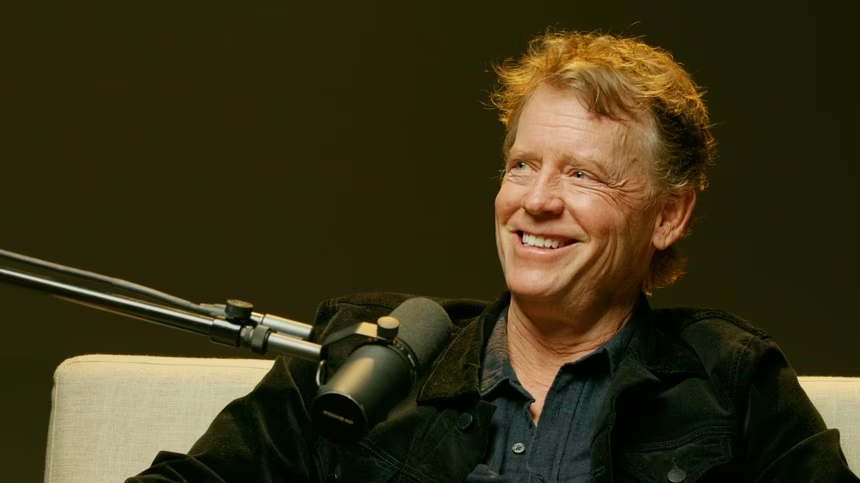
A front row seat to the creative process
How do today’s masters create their art? Each episode an artist reveals how they brought their creative work to life. Hear from artists across disciplines, like comedian Chris Fleming, actor Greg Kinnear, sports journalist Taylor Rooks, and more on our video podcast "American Masters: Creative Spark."Providing Support for PBS.org
Learn Moreabout PBS online sponsorshipMore from This Collection
Watch curated interviews from The American Masters Digital Archive. The full collection includes over 1,000 hours of never-before-seen, raw interviews: a treasure trove of the movers and shakers of American culture, including Maya Angelou, Patti Smith, Mel Brooks, Carol Burnett, Matthew Broderick, Carl Reiner, Joan Rivers, Dionne Warwick, Lee Grant, Sidney Lumet, Betty White and many others.
Brooke Shields' early career with Bob Hope and performing for the troops
Video has Closed Captions
Brooke Shields on her work with Bob Hope and performing for the troops. (13m 21s)
How Clive Davis became a titan of the music industry
Video has Closed Captions
Clive Davis on his journey in the music industry. (29m 7s)
Olivia Wilde on making “Tron: Legacy” with Jeff Bridges
Video has Closed Captions
Olivia Wilde on working with Jeff Bridges on “Tron: Legacy.” (13m 57s)
John Goodman on "The Big Lebowski" and Jeff Bridges
Video has Closed Captions
Actor John Goodman talks about his work on the film, "The Big Lebowski." (12m)
Harvey Fierstein on gay representation on Broadway and its deep history
Video has Closed Captions
Harvey Fierstein talks to director Michael Kantor backstage during the production of "Hairspray." (13m 8s)

Video has Closed Captions
Ringo Starr describes his friendship with Mae West. (10m)
Mel Brooks' wild ride to his first Broadway show ever
Video has Closed Captions
Mel Brooks talks about the first Broadway show he ever saw—Cole Porter's "Anything Goes." (5m 44s)
John Kander and Fred Ebb on “Cabaret,” creativity and collaboration
Video has Closed Captions
Composer John Kander and lyricist Fred Ebb talk about how they have worked together. (5m 56s)
Isabella Rossellini compares her acting and modeling
Video has Closed Captions
Isabella Rossellini discusses her acting versus modeling career. (28m 24s)

Quincy Jones explains how he got started in music
Video has Closed Captions
Quincy Jones discusses his early career, friendships and how he defines himself. (15m)
Paul Mooney on his career and relationship with Richard Pryor
Video has Closed Captions
Paul Mooney reflects on the mechanics of stand-up and his role as Richard Pryor's best friend. (10m 39s)
How Phyllis Diller broke down the doors for female comics
Video has Closed Captions
Phyllis Diller reflects on how her comedy was a response to years of “take my wife” jokes. (11m 35s)
Providing Support for PBS.org
Learn Moreabout PBS online sponsorship- Why did "60 Minutes" go so hard at the tobacco industry?
Because the tobacco industry had lied to the American public for such a long time, and we had the goods on them.
And that's what we do best.
That's what a reporter likes to do best.
When he has a story like the one that we had with Jeff Wigand, my Lord, that was an important story.
- [Interviewer] And unfortunately, one of the biggest scandals, shall we say, to hit "60 Minutes" over the 30 years that you all have been in business.
It was the case of Jeffrey Wigand, the show not airing in its entirety at the beginning.
- It was inexcusable for the case.
It was inexcusable for CBS to decline and to put this piece on the air to begin with Jeffrey Wigand and Brown and Williamson Tobacco Company, because we had the story cold.
And the only reason that it was not broadcast was pure and simple, money.
Well, it's CBS money, and I can understand that, but that had never come up in any way in the 30, 35 years that I've been at CBS News.
All of a sudden what happened was that we were told by our lawyers over in BlackRock that we had induced the breaking of a confidentiality agreement.
We had induced the breaking of the agreement between Jeff Wigand and the Brown and Williamson Tobacco Company, or at least that that would be the accusation that it would go into a courtroom in Kentucky because that's where the headquarters were and that chances are, we were going to lose in Kentucky because that's a big tobacco state.
And in order to appeal, you gotta put up under Kentucky law.
We were told, you gotta put up 1/10th of the body of the suit.
And our chief counsel said that she believed that it could go to $10 or $15 billion, the body of the suit, therefore, we would have to put up, CBS would, $1 billion or $1.5 billion in bond.
Well, you'd think obviously, damn seriously about that.
And then having said that, we said, we've got it cold.
We know that it's true.
The lawyers who work with "60 Minutes" all the time say we're clean.
It's been carefully vetted by those lawyers.
So the only reason that we're doing this is because... Well, later on, it turned out that there was negotiation going on between Westinghouse Broadcasting and CBS, and obviously, Westinghouse didn't wanna buy into a potential huge billion dollar lawsuit.
So that was, I'm sure one of the reasons, although, they wouldn't acknowledge it at the time.
It turned out later on that CBS or at least the Loews Corporation, the Lorillard Tobacco Corporation owned by Loews Corporation and Larry Tisch were negotiating for some brands with the people from Brown and Williamson.
Lorillard was talking about buying some brands.
So it was all circled around with the nastiness.
And that's the first time and the only time that Don Hewitt and I, only time that we had a serious lasting disagreement.
He was on the company side and Lowell Bergman and I and a couple of others here were not, we were very lonely here.
We couldn't tell the rest of the crowd here too much because a lot of it was secret, and we didn't want what we had to be getting out and turning up in other places, as a result of which it, there was a struggle.
And we lost the struggle until all of a sudden the Wall Street Journal got hold of a sealed deposition that Jeffrey Wigand had given in a Mississippi court case about the same subject.
And once they published that sealed deposition, they weren't afraid to do it.
Then our management said, well, they can't sue us anymore.
Broadcast it.
I hoped that we were gonna be able to make law by putting this on the air.
What does that mean?
That means that put it on the air.
Let them sue.
Let them sue for breaking a confidentiality agreement.
A confidentiality agreement should keep the Brown and Williamson Tobacco Corporation in business to kill people, not to tell the truth, not to let the American public in on what was going on at B&W and Philip Morris and RJR and Liggett and so forth?
A confidentiality agreement is more important than the public health of America's citizens?
It doesn't make any damn fool sense at all.
That's what I wanted to do was to, was to put the piece on the air, let them sue, then go to court, and then say in the courtroom, hey, what is the sanctity of a confidentiality agreement?
When to break that confidentiality agreement means to save potentially 400,000 lives a year?
To some degree, I guess I'm overstating it.
What is the sanctity, what should be the sanctity of a confidentiality agreement if by breaking that confidentiality agreement and telling the truth about tobacco and the killer aspects of tobacco will save who knows how many lives?
I cannot believe that any court, and I take it all the way to the Supreme Court, that any court would've come down against us on the business of breaking the confidentiality agreement.
We didn't break the confidentiality agreement, what their charge was that we induced the breaking of the confidentiality agreement between Jeff Wigand and B&W.
I was leaving this office, putting on my coat, "Mo, do you wanna come?"
"Where you going?"
"Charlie Rose."
"Come on over."
That was it.
Morley and I are in the car on the way going over and we talk a little bit about it, but he knew nothing of the fact.
He had no idea that we had worked with Wigand on a Philip Morris story that had absolutely nothing to do with the B&W story.
And it was 14, 15 months prior.
He had no notion that we had paid $12,000, I believe it was, for his work, expert witness work, on that Philip Morris story, which was later leaked, by somebody inside this shop, to the Wall Street Journal.
He knew none of this stuff, and he felt that I had hung him out to dry.
Well, my Lord, if I was gonna hang him up to dry, why would I invite him over?
The fact of the matter is that there was just, I mean, Morley didn't know, frankly, what he was talking about.
Most people here in the shop were in the dark about the story until it broadcast, when they saw it.
And they saw how carefully and how thoroughly and how accurately it was done.
Then they said, well, that's "60 Minutes".
Sure.
We've put it on the air.
And it took almost no time.
It took a little time for Hewitt and me to patch it up, and it is utterly patched up.
And the reason I talk about it now is because I think it's an interesting, more than interesting, I think it's vital that the background of this story in the context of the broadcast that we're doing about, that you're doing about Don Hewitt, that the story be told.
Don didn't support Lowell and me on the story at the beginning, because I think that he wasn't sure whether we really had it cold.
He also, I must say, was persuaded by the company and by Eric Ober, who was then the president of CBS News, who was also skeptical about whether we really had the goods in the story.
That maybe it was going to be too foolhardy.
There was a totally different leadership at this company at this time.
When Dick Salant was here or Fred Friendly was here or Bill Leonard was here, I believe even Van Gordon Sauter, when they were here, there would have been no question.
That piece would have been broadcast.
But for some reason, under the Tisch regime and with the chief council that we had and with the president of the CBS news division that we had and with the president of CBS that we had at the time, they were scared of it.
They were... I've never gotten inside their heads.
I was curious to know whether our lawyers were right.
Was this gonna put us outta business, and should we not be doing this?
So I called Lou Dobbs, who was not a close friend of mine by any means, but I know, and from CNN, who's the business guy there.
And I said, "Lou..." And I told him the bare outlines of the story and about the business of the confidentiality agreement.
I said, "Would you talk to your lawyers over there "and see what their opinion is of it.
"And whether they would put the thing on the air "despite the confidentiality agreement."
And he called me back in 24 hours and he said, "Give us the story.
"We'll put it on the air.
"Our lawyers tell me that we'd be happy to put it on the air "despite the confidentiality agreement."
And so I go back to Don and I say, "Listen, Lou Dobbs..." "You talked to Lou Dobbs?
"What are you talking to Dobbs about?
"You're telling the opposition..." "Don, cool it.
"I'm just trying to find out "what another lawyer feels about this, "despite what our own lawyers are telling us."
"Well, you shouldn't be doing that."
What would've happened if I had given the story to someone else and they had put it on the air and gotten the response that... Don would've cut his throat.
Well, make certain, this is the only time.
We've had all kinds of arguments.
This is the only time that we had an argument that it was as basic as this one in 30 years.
- [Interviewer] How did you stop Lowell from not giving this story to someone else?
- He worked here.
He worked with me and I kept... Lowell was interested in perhaps doing that, in going elsewhere with the story.
And I said, "Lowell, cool it.
"We're gonna stay here, "and we're gonna get the story on the air."
And we did.
People ask why I didn't quit.
I thought very seriously of quitting at that time.
And for some reason, I believed, and I used to say it around here, we're gonna get that piece on the air.
If I'm outside, that piece would never have gotten on the air, period.
So I was gonna say, you either fight from the outside or you stay on the inside and fight from the inside.
And it was the very fact that we stayed that finally got it on the air.
You ask, about what effect this has on television journalism?
It has the effect of you need strong, honest, upright management.
Forget those words.
Gutsy management.
Who understand that they're going to the mat for you.
You get hold of a story and no matter who it hurts, you broadcast that story.
- That's what "60 Minutes" has made its name on.
That's what's so shocking about it all.
- And that is exactly what I said to Hewitt and to all of the others that were late to the game.
I had the optimism to know that everybody on this floor, everybody on this floor, and I'm not just talking about the people on the air, have enough confidence in "60 Minutes" in Hewitt and in what we've been doing for, at that time, 6 or 7 or 8 years prior, that it was going to come back when they knew all the facts.











Support for PBS provided by:
Support for American Masters is provided by AARP, The Rosalind P. Walter Foundation, Thea Petschek Iervolino Foundation, Burton P. and Judith B. Resnick Foundation, The Philip and Janice Levin Foundation,...