
The Fluffy Guardians of American Grasslands | Wild Critters USA
Special | 30m 4sVideo has Closed Captions
Families discover America's largest mammal with Orbit, PBS Nature and the Smithsonian.
Did you know American bison create grasslands for all species? In this episode of the Wild Critters USA series on “Orbit: Science for kids on the move!”, families explore the prairies of North America with the help of the Smithsonian's National Zoo and Conservation Biology Institute and discover why the American bison is one of the most important animals in its ecosystem.
Problems playing video? | Closed Captioning Feedback
Problems playing video? | Closed Captioning Feedback
Major support for NATURE is provided by The Arnhold Family in memory of Henry and Clarisse Arnhold, Sue and Edgar Wachenheim III, The Fairweather Foundation, Charles Rosenblum, Kathy Chiao and...
The Fluffy Guardians of American Grasslands | Wild Critters USA
Special | 30m 4sVideo has Closed Captions
Did you know American bison create grasslands for all species? In this episode of the Wild Critters USA series on “Orbit: Science for kids on the move!”, families explore the prairies of North America with the help of the Smithsonian's National Zoo and Conservation Biology Institute and discover why the American bison is one of the most important animals in its ecosystem.
Problems playing video? | Closed Captioning Feedback
Where to Watch Nature
Nature is available to stream on pbs.org and the PBS app.
Buy Now
Explore More Ways to Watch
Bring the beauty and wonders of wildlife and natural history into your home with classic NATURE episodes.Providing Support for PBS.org
Learn Moreabout PBS online sponsorshipMore from This Collection
To celebrate America's 250th anniversary, PBS Nature is teaming up with Orbit: Science for Kids on the Move! and National Wildlife Federation's Ranger Rick to bring you stories of creatures from around the United States.
 New
NewHow Strong Was a T. Rex Bite? | Wild Critters USA
Video has Closed Captions
T. rex had a bone-exploding bite and tiny arms! Travel back 66 million years on Wild Critters. (34m 20s)
Sea Otters: Superheroes for Kelp Forests | Wild Critters USA
Video has Closed Captions
Sea otters aren't just cute, they're guardians of an entire underwater forest. (31m 52s)
The Race To Save Three Mountain Lion Cubs | Wild Critters USA
Video has Closed Captions
Three orphaned mountain lion cubs and one epic rescue mission. Join us on Wild Critters! (28m 10s)
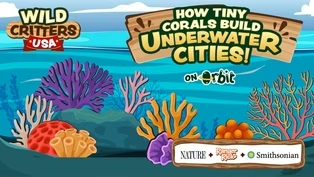
How Tiny Corals Build Underwater Cities | Wild Critters USA
Video has Closed Captions
Kids discover coral reefs on this Wild Critters episode with the Smithsonian. (31m 13s)
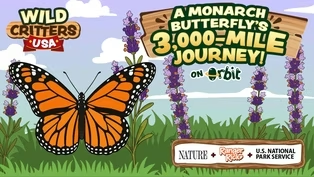
A Monarch Butterfly’s 3,000-Mile Journey | Wild Critters USA
Video has Closed Captions
Follow the monarch butterfly's incredible 3,000-mile migration to Mexico. (29m 9s)
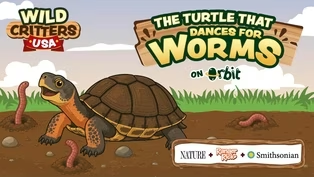
The Turtle that Dances for Worms | Wild Critters USA
Video has Closed Captions
Meet Wanda, the wood turtle who dances to trick worms out of the ground. (25m 47s)
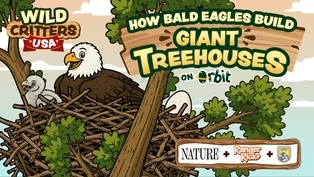
How Do Baby Bald Eagles Learn To Fly? | Wild Critters USA
Video has Closed Captions
Discover how bald eagles build giant nests and learn to fly! (27m 16s)
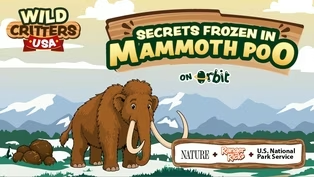
Ice Age Secrets Frozen in Mammoth Poo | Wild Critters USA
Video has Closed Captions
Discover mummified mammoth poop and the Ice Age secrets it holds. (29m)
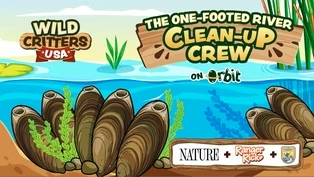
Meet Nature's Water Cleaners | Wild Critters USA
Video has Closed Captions
Discover how tiny freshwater mussels keep streams healthy! (27m 29s)
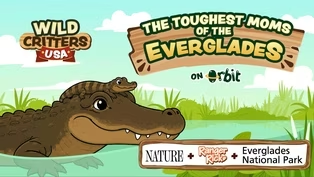
The Toughest Moms of the Florida Everglades | Wild Critters USA
Video has Closed Captions
Discover the amazing American alligator and the wetlands of the Florida Everglades. (27m 28s)
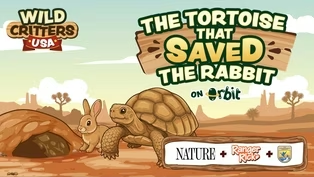
The Tortoise that Saved the Rabbit | Wild Critters USA
Video has Closed Captions
Discover the incredible Mojave desert tortoise on this family episode of Wild Critters. (27m 16s)
Official Trailer | Wild Critters USA
Video has Closed Captions
Explore amazing American wildlife and outdoors in this family podcast series! For kids ages 3-11. (1m 11s)
Providing Support for PBS.org
Learn Moreabout PBS online sponsorshipChild This episode is part of the series Wild Critters USA, a collaboration between Orbit, PBS Nature, and the National Wildlife Federation.
Rob - Host Well, Hank, welcome back to our wildlife neighborhood tour, Wild Critters USA.
Rob - Host This summer, we're traveling across America to meet some of our wild neighbors.
Rob - Host Last time we visited the Mojave Desert to get to know a special tortoise.
Rob - Host Today we're visiting a prairie up in the state of Montana.
Rob - Host Whoa, it is so wide open out here.
Rob - Host I can see for miles and miles.
Rob - Host That is a lot of grass.
Rob - Host No, seriously, look at all this grass.
Rob - Host You know what I'm thinking, Hank?
Rob - Host This might be the world's biggest soccer field.
Rob - Host Okay, good point.
Rob - Host There's no goals or players.
Rob - Host or soccer balls.
Rob - Host But can you imagine mowing this thing?
Rob - Host We'd need 20 lawn mowers.
Rob - Host No, 50 lawn mowers.
Rob - Host No, 100 lawn mowers.
Rob - Host But wait a second.
Rob - Host If nobody is mowing all this grass, why doesn't it get even taller?
Rob - Host And why aren't there a bunch of trees out here?
Rob - Host Well, Rob - Host It turns out the prairie has its own lawn mowers.
Rob - Host They're furry, they're hungry, and they weigh as much as a small car.
Rob - Host Today, we're meeting one of America's most famous wild neighbors, the American bison.
Child My question is, why do buffaloes have horns?
Child My question is, what is the predator of the American bison?
Child Why do basins live in herds and how big are their herds?
Rob - Host And to help us out, we found an awesome guest.
Rob - Host His name is Dr.
Rob - Host Andy, and he's a scientist at the Smithsonian National Zoo.
Rob - Host But first, let's go meet a new friend.
Rob - Host All right, orbiters, we are here with a brand new friend today.
Rob - Host Welcome to orbit, Luna.
Child I'm so excited to be here.
Rob - Host Miss Luna, can you tell us about yourself?
Child My name is Luna from New York, and I'm in first grade.
Child I live with Mommy, Daddy, and two cats.
Child I enjoy cuddling with my cats and snacking and playing softball.
Rob - Host What are your cats' names?
Child Nala and Simba.
Rob - Host And tell us about Nala and Simba.
Child Nala is black and white.
Child Simba is gray, black, white.
Rob - Host Yeah.
Rob - Host And what are their personalities like?
Rob - Host Are they the same or are they very different?
Child Simba's a kitten, so.
Child She loves to play with me.
Child Whatever.
Child Whatever.
Child Whenever she gets to play, she plays with my legs.
Child And Nala's more like a cuddly cat.
Rob - Host And does Simba scratch her legs?
Rob - Host Or does she scratch things sometimes?
Child She bites my legs.
Child She scratches me.
Child I have a bunch of scratches from.
Rob - Host But we still love Simba, even though she bites and scratches.
Rob - Host Yeah.
Rob - Host Well, hey, tell us about what is something that you are curious about in life.
Child Why do cows chew, spit, and re-chew and how does it help them?
Rob - Host Interesting.
Child I have no idea why.
Rob - Host You have no idea why.
Rob - Host We're going to have to produce an episode about cows.
Child Yep.
Rob - Host Yeah.
Rob - Host And why are cows interesting to you?
Child Because they do that.
Rob - Host Because of the chewing thing.
Child Yeah.
Rob - Host That sounds like a good project to investigate.
Rob - Host Maybe you can do that.
Rob - Host Maybe our listening families can do that too.
Rob - Host They can learn together about why do cows chew and then swallow and then re-chew their food.
Rob - Host Yeah.
Rob - Host It sounds kind of yucky to me.
Child That's what many grass eater animals do.
Rob - Host Oh, interesting.
Child Maybe it helps their digestive system.
Rob - Host That is a great hypothesis.
Rob - Host You're probably right.
Rob - Host It probably makes it easier for them to digest their food.
Child Yeah, I bet koalas don't do that.
Rob - Host You bet koalas.
Child They're too cute to do that.
Child Koalas are too cute to do it.
Rob - Host Koalas only do cute things.
Rob - Host They don't do weird things like cows.
Child Yeah.
Rob - Host Well, hey, Miss Luna, today we are going to talk about the American bison.
Rob - Host That's another really big plant-eating animal.
Rob - Host Imagine you had one of these bison superpowers.
Rob - Host Which one would you choose?
Rob - Host What are some of the bison superpowers?
Child Super strength, super thick fur Child to live in cold weather, horns to fight off predators, and live in a huge herd with all your family and friends.
Rob - Host Okay, so families, you can pause the episode here.
Rob - Host Would you rather have super strength, super thick fur for living in the cold weather, horns to fight off predators, or live in a huge herd with all your family and friends?
Rob - Host All right, Miss Luna, what is your answer to this?
Child I'd rather live in a huge herd because you'd get to be with all your family and friends.
Child But also, super strength is pretty cool because you can pick up dirt, make it into a ball, and then have a dirt fight instead of a snowball fight.
Rob - Host Would you do that with your friends that also have super strength in the very large bison herd?
Child Yes.
Child I'll throw it at them.
Child Or I can also throw those at predators so that they have dirt on their eyes and then they won't see us so we can run away.
Rob - Host That's right.
Rob - Host All those wolves and grizzly bears, they're going to be like, wow, that one bison over there keeps throwing dirt balls at us.
Rob - Host Are there things that you are interested about American bison, Miss Luna, that we might learn in this episode?
Child Maybe.
Rob - Host Or maybe lots of things.
Child How big they are and how scientists are working to take care of these big, cute animals.
Child I don't know why I call every animal that is big cute.
Rob - Host They are very cute.
Rob - Host I totally agree with you.
Rob - Host Miss Luna, today's guest is Dr.
Rob - Host Andy from the Smithsonian National Zoo.
Child Hey, Dr.
Child Andy, what do you do for work?
Dr.
Andy Boyce - Smithsonian Institute Yeah, hi, Orbiters.
Dr.
Andy Boyce - Smithsonian Institute I am Andy Boyce.
Dr.
Andy Boyce - Smithsonian Institute I am a research ecologist for the Smithsonian National Zoo and Conservation Biology Institute.
Dr.
Andy Boyce - Smithsonian Institute I actually work out here in the grasslands of Montana, studying the conservation of grassland ecosystems and all the animals that live in them.
Rob - Host Hey, Mr.
Andy, our friend Sophia has a question about your job.
Child Hello, my name is Sophia.
Child I live in Guadalajara, Mexico, and my question is, Child Where is the Smithsonian?
Dr.
Andy Boyce - Smithsonian Institute The Smithsonian is the world's largest network of museums and research institutions.
Dr.
Andy Boyce - Smithsonian Institute Most people know about the Smithsonian from Washington, D.C.
Dr.
Andy Boyce - Smithsonian Institute We have a bunch of museums like Air and Space and the Museum of Natural History and even the National Zoo itself in Washington, D.C.
Dr.
Andy Boyce - Smithsonian Institute But the Smithsonian is also a big network of scientists who study conservation and science problems all over the world.
Rob - Host Hey, Luna, are you ready to learn about American bison?
Child Yes, let's do it.
Rob - Host All right, here we go.
Rob - Host Hey parents, if you're curious orbiters want to submit questions for upcoming episodes, just visit the link we'll leave in the show notes.
Rob - Host We notify families of upcoming episodes so that they can let us know what their little ones want to learn.
Rob - Host Alright, new Orbiters are ready to start learning.
Rob - Host Hi Orbit, my name is Ygritte Mostajo.
Child I'm 10 years old.
Child I live in Santa Cruz, Bolivia.
Child And my question is, what is an American bison?
Child Hi, my name is Victoria.
Child I live in Tijuana, Mexico.
Child And my question is, what is the difference between Alaskan Bison and American Bison?
Child Hello Orbit, my name is Antonella.
My question is, what they're like American Bison?
Bye.
Rob - Host So we want to know what are bison and if there are different types of bison.
Dr.
Andy Boyce - Smithsonian Institute Thank you so much for the question.
Dr.
Andy Boyce - Smithsonian Institute So American bison is a species of grazing mammal native to North America.
Dr.
Andy Boyce - Smithsonian Institute Within American bison, there are two different subspecies, so closely related animals, the plains bison and the wood bison.
Dr.
Andy Boyce - Smithsonian Institute They're really similar, but wood bison live farther north in areas with some trees, and plains bison live in the grasslands in the middle of the North American continent.
Rob - Host Hey, orbiters, do you remember what a mammal is?
Rob - Host We talked about it on a previous episode, so you're probably experts.
Rob - Host Let's make it a quiz.
Rob - Host Shout out your answers to each of these.
Rob - Host First, do mammals have fur or feathers?
Rob - Host What do their babies drink from their mothers?
Rob - Host Are they warm-blooded or cold-blooded?
Rob - Host And a bonus, are humans mammals or reptiles?
Rob - Host All right, if you said mammals have fur, drink milk from their mothers, and are warm-blooded, which means they keep a constant body temperature, you were right.
Rob - Host And we humans are mammals, just like bison, but smaller, and with less hair, and eat a lot less grass.
Rob - Host Hey, Dr.
Andy, what makes bison different from other animals like buffaloes?
Dr.
Andy Boyce - Smithsonian Institute Bison and buffalo can actually mean the exact same thing.
Dr.
Andy Boyce - Smithsonian Institute In fact, in Native American communities throughout North America, buffalo is actually the more common name than bison.
Child Hello, I'm Milam.
I'm seven years old and I live in Houston, Texas.
Child And my question is, where do American bison live?
Child Bye.
Dr.
Andy Boyce - Smithsonian Institute Yeah, thanks, Milam, for the question.
Dr.
Andy Boyce - Smithsonian Institute American bison used to live almost everywhere in North America, from Florida all the way up to Alaska.
Dr.
Andy Boyce - Smithsonian Institute Now, bison mostly live on grasslands, also known as prairies, in the Great Plains in the center of the continent.
Dr.
Andy Boyce - Smithsonian Institute The most famous herd is in Yellowstone National Park in Wyoming and Montana, but small herds exist all over North America from Mexico to Canada.
Rob - Host All this talk about grasslands reminds me of a question we received from Damika.
Child Hello, Orbit.
Child My name is Damika.
Child I am 9 years old.
Child I live in Venezuela.
Child And I want to know, is the grassland the same thing that grows in my yard or in the park?
Child Thank you.
Child Goodbye.
Rob - Host We brought this question to our friend David Mizejewski.
Rob - Host Mr.
Rob - Host David is a science advisor for Ranger Rick Magazine from the National Wildlife Federation and is helping us out with this Wild Critter series.
Rob - Host Hey, Mr.
David, are yards and parks also grasslands?
Rob - Host Great question, Damika.
Dr.
Andy Boyce - Smithsonian Institute Grass does grow in people's yards and in parks, but it's not the same thing as a grassland.
Dr.
Andy Boyce - Smithsonian Institute Grasslands are big open spaces in nature where lots of different kinds of grasses grow, along with all sorts of wildflowers and other plants.
Dr.
Andy Boyce - Smithsonian Institute And all those different kinds of plants provide food and places to hide and nesting spots for birds and bees and butterflies and lots of other wildlife.
Dr.
Andy Boyce - Smithsonian Institute Sometimes even big wildlife like bison, too.
Dr.
Andy Boyce - Smithsonian Institute The grass that grows in people's yards and parks is usually just one kind of grass, and it's usually mown down short into a lawn, which isn't really a natural environment, and it doesn't help out the wildlife.
Rob - Host Thank you, Mr.
David.
Rob - Host Hey parents, if you'd like to continue learning about grasslands, Ranger Rick Magazine has lots of great wildlife resources for families.
Rob - Host I'll leave a link in the show notes.
Rob - Host Let's keep getting to know these giants of the grasslands.
Child Hello, my name is Josh and I'm four years old and I live from Houston, Texas.
Child My question is, why do buffaloes have horns?
Child My name is Amelia.
I'm 10 years old and I'm from New Rochelle.
Child My question is, what is the predator of the American bison?
Dr.
Andy Boyce - Smithsonian Institute Yeah, thanks, Josh.
Dr.
Andy Boyce - Smithsonian Institute Bison have horns for two primary reasons, and both males and females have them.
Dr.
Andy Boyce - Smithsonian Institute The first big one is to defend against predators like wolves and grizzly bears.
Dr.
Andy Boyce - Smithsonian Institute Second is for males to fight and compete against each other for females.
Rob - Host And Amelia asked about predators.
Rob - Host Do you know what a predator is, Orbiters?
Rob - Host A predator is an animal that hunts, catches, and eats other animals to get energy and survive.
Rob - Host Kind of crazy to think that an animal as big as a bison has to worry about predators.
Rob - Host Can you tell us more, Dr.
Andy?
Dr.
Andy Boyce - Smithsonian Institute Yeah, thanks for the question, Amelia.
Dr.
Andy Boyce - Smithsonian Institute So wolves and grizzly bears are the primary predators of bison.
Dr.
Andy Boyce - Smithsonian Institute We don't necessarily think of bears and wolves as living in grasslands, but they used to roam the prairies right alongside bison.
Dr.
Andy Boyce - Smithsonian Institute And in fact, when Lewis and Clark were exploring the western U.S., they encountered grizzly bears and wolves on the prairie almost every day.
Rob - Host Now that sounds super scary.
Rob - Host Imagine that, Orbiters.
Rob - Host Lewis and Clark were two explorers who traveled across the continent in search of a path to the Pacific Ocean.
Rob - Host Along the way, they saw lots of new things, including huge herds of bison and massive grizzly bears, including some grizzly bears that were not too happy to see a bunch of humans walking around their territory.
Child Hi, I'm Eliza.
I'm 9 years old and I live in Ecuador.
Child And my question is, how big can be bison be?
Rob - Host Okay, Orbiters, what's your hypothesis?
Rob - Host If A full-grown man weighs 180 pounds or 80 kilograms, how many pounds or kilograms do you think a bison weighs?
Rob - Host Shout out your guess.
Dr.
Andy Boyce - Smithsonian Institute Thanks, Eliza.
Dr.
Andy Boyce - Smithsonian Institute Bison can be absolutely massive.
Dr.
Andy Boyce - Smithsonian Institute So male bison can get up to about 2,500 pounds and females about half that size.
Dr.
Andy Boyce - Smithsonian Institute That's about as heavy as your average car.
Dr.
Andy Boyce - Smithsonian Institute You can kind of think about them as like really strong cows, cows that have been lifting weights.
Rob - Host 2,500 pounds!
Rob - Host That's more than 1,100 kilograms.
Rob - Host And that's around 13 full-grown men.
Rob - Host Whoa.
Rob - Host Now, a really important question from our curious friend, Juliana.
Child Hi, I'm Juliana.
Child I'm from Quito, Ecuador.
Child And my question is, what do bison eat?
Bye.
Dr.
Andy Boyce - Smithsonian Institute Yeah, thanks, Juliana.
Dr.
Andy Boyce - Smithsonian Institute Bison eat all sorts of plants, from flowers to even cactus, but their favorite food is native grass.
Rob - Host We'll learn more about why this is important soon.
Rob - Host My name is Emily.
Child I am nine years old.
Child I live in New Rochelle.
Child My question is, how long is an American bison's life span?
Dr.
Andy Boyce - Smithsonian Institute Yeah, thanks, Emily.
Dr.
Andy Boyce - Smithsonian Institute Bison can live up to about 25 years in captivity, but a wild bicycle typically lives somewhere between 10 to 15 years.
Dr.
Andy Boyce - Smithsonian Institute That number is higher for females who tend to live a little bit longer and lower for males who are out there battling against each other during every breeding season.
Rob - Host All right, orbiters, we're about to start learning about one of the most incredible, awe-inspiring things about American bison, their herds.
Rob - Host But first, let's pause for a mystery sound.
Rob - Host You can wiggle around and move while you listen and think about what the sound is.
Rob - Host I'll give you a hint.
It's a type of animal that lives close to the ocean.
Rob - Host What do you think it is?
Rob - Host Stick around to the end for the answer.
Rob - Host Okay, let's start learning about these amazing herds.
Child Hi, my name is Leo.
Child I have six years.
Child And my question is, why do pythons live on herds and how big are their herds?
Dr.
Andy Boyce - Smithsonian Institute So that's a really good question, Leo.
Dr.
Andy Boyce - Smithsonian Institute So bison are social animals just like humans.
Dr.
Andy Boyce - Smithsonian Institute they just, they like being around each other.
Dr.
Andy Boyce - Smithsonian Institute Living in big herds can have important advantages like protection from predators, having a helping hand or a hoof to raise your baby bison, or learning from older bison about where to go to find good food and water.
Dr.
Andy Boyce - Smithsonian Institute Before 1800, there were somewhere between 30 and 60 million bison roaming North America.
Dr.
Andy Boyce - Smithsonian Institute There are stories from explorers and Native Americans of herds that were so huge Dr.
Andy Boyce - Smithsonian Institute They stretched all the way to the horizon, and the ground literally shook as they passed.
Rob - Host Can you imagine that, Hank?
Rob - Host It's kind of like an earthquake, but furrier and with horns.
Rob - Host And probably lots and lots of bison poo.
Dr.
Andy Boyce - Smithsonian Institute Nowadays, herds of bison are a lot smaller.
Dr.
Andy Boyce - Smithsonian Institute A typical conservation herd of bison is between 100 and 1,000 animals, with some of the biggest herds in national parks like Yellowstone or on conservation lands like American Prairie in Montana.
Rob - Host In this episode, co-host Luna sent in a super interesting question for today's episode.
Child Hi, my question is, what's the role in the ecosystem?
Dr.
Andy Boyce - Smithsonian Institute Yeah, thanks, Luna.
Dr.
Andy Boyce - Smithsonian Institute So without grazing animals like bison, grasslands literally wouldn't exist.
Dr.
Andy Boyce - Smithsonian Institute If they're left alone and not grazed by animals by bison, over time they would gradually turn into forests.
Dr.
Andy Boyce - Smithsonian Institute So bison have the power to create and maintain grassland ecosystem themselves.
Dr.
Andy Boyce - Smithsonian Institute They also graze certain areas really heavily, creating habitat for animals that like short grass.
Dr.
Andy Boyce - Smithsonian Institute And at the same time, they leave other areas alone, giving places for animals to live that like tall, dense patches of grass.
Dr.
Andy Boyce - Smithsonian Institute Without them, grasslands would look the same everywhere and wouldn't be home to as many species of animals.
Dr.
Andy Boyce - Smithsonian Institute There are a million other roles that bison play in the ecosystem too.
Dr.
Andy Boyce - Smithsonian Institute Their wallows, places where they take dust baths, can create small ponds for amphibians like salamanders and toads.
Dr.
Andy Boyce - Smithsonian Institute Their hair, which is really dense and really cozy and warm, is used by birds to line their nests.
Dr.
Andy Boyce - Smithsonian Institute And of course, they're an important source of food for predators like wolves and bears.
Rob - Host I asked Dr.
Andy how they prevent grasslands from turning into forests.
Rob - Host He gave me a very surprising answer.
Dr.
Andy Boyce - Smithsonian Institute A bison, especially during the summer, is like one of the itchiest animals on the planet.
Dr.
Andy Boyce - Smithsonian Institute They are constantly scratching against things, rubbing against things, and dust bathing.
Rob - Host When Hank has an itch he can't reach, he might roll around in the grass or walk over to me and I scratch it for him.
Rob - Host That's right, Hank.
Right on that tricky spot on your back.
Rob - Host But I can't scratch a bison's back.
Rob - Host So you have hundreds or thousands of huge, itchy bison the size of cars walking around looking for things to scratch their backs.
Rob - Host And what do they find?
Rob - Host At the edge of the forest, there are young pine trees that are just starting to grow.
Dr.
Andy Boyce - Smithsonian Institute And those tend to make amazing scratching posts for bison.
Dr.
Andy Boyce - Smithsonian Institute So they are like body slamming these things constantly, which prevents that encroachment of trees onto grasslands.
Rob - Host Bison kind of sound like they would be really good at wrestling.
Rob - Host Okay, now we have a very good, very important question from our friend Cristobal.
Child Hi, Orbit.
Child My name is Cristobal.
Child I live in Panama City, and I have six years old.
Child And my question is... Child What happens if the American bison disappears from our planet?
Child Bye.
Dr.
Andy Boyce - Smithsonian Institute Cristobal, thanks for the question.
Dr.
Andy Boyce - Smithsonian Institute Well, unfortunately, we know actually a lot about what would happen since during the 1800s, we almost lost bison from North America and they were pushed out of huge, huge portions of our country and our continent.
Dr.
Andy Boyce - Smithsonian Institute So first of all, we would lose an animal that just helps create homes for so many other grassland species.
Dr.
Andy Boyce - Smithsonian Institute Without bison to graze the grass and keep it short, species of birds like horned larks and mountain plovers would disappear.
Dr.
Andy Boyce - Smithsonian Institute Animals like antelope would have a harder time making it through harsh, snowy winters without bison to clear the snow for places for them to forage.
Dr.
Andy Boyce - Smithsonian Institute And predators like wolves and grizzly bears would lose their source of food.
Rob - Host These bison sound really important for lots of animals.
Dr.
Andy Boyce - Smithsonian Institute Bison are what we call a keystone species.
Dr.
Andy Boyce - Smithsonian Institute When you remove them from the ecosystem, almost all the other parts of it tend to fall apart.
Rob - Host So when Dr.
Andy talks about bison, he's not just describing an animal that lives in grasslands.
Rob - Host He's describing an animal so big, so powerful, so important that it literally creates and shapes grassland ecosystems.
Rob - Host Bison are some of the greatest lawnmowers, landscapers, and excavators to have ever lived on the planet.
Rob - Host And they do all this naturally just by being their big, fluffy, hungry, itchy, tree body slamming selves.
Rob - Host Hey, Dr.
Andy, now that we know how important American bison are, let's get to this question from our friend Alina.
Child Hi, my name is Alina, live in California, and my question is, how do scientists study and protect American bison?
Bye, orbiters.
Dr.
Andy Boyce - Smithsonian Institute Yeah, thanks so much, Alina.
Dr.
Andy Boyce - Smithsonian Institute Scientists like me get to study what happens when bison are restored to ecosystems.
Rob - Host Being restored means that bison used to live in a place, then they stopped living there for a while, sometimes a very, very long time, and then they were brought back.
Rob - Host Kind of like a coming home party.
Dr.
Andy Boyce - Smithsonian Institute I've learned things like how bringing back bison creates more biodiverse ecosystems and healthier streams with more species of birds.
Dr.
Andy Boyce - Smithsonian Institute It's not just scientists, though, that have a role to play with bison conservation.
Dr.
Andy Boyce - Smithsonian Institute So Native American tribes and private conservation organizations are really the ones that are bringing bison back to their lands.
Dr.
Andy Boyce - Smithsonian Institute In the last 20 years, the number of bison herds created by tribal nations and conservationists has more than tripled in North America, which is tremendously exciting.
Rob - Host So cool.
Rob - Host We are all in this together.
Rob - Host Yeah, Hank, you too.
Rob - Host Hey, let's go check in with our friend Luna.
Rob - Host Hey, Luna, are you ready to take a short break and stretch and move around a little bit?
Rob - Host Yeah.
Rob - Host Me, too.
Rob - Host Okay, what is a movement that orbiters should do?
Child Maybe a wolf.
Child You basically do a bear crawl, but very fast while howling.
Rob - Host Okay, so you get down on your hands and knees.
On your feet, hands and feet.
Rob - Host Okay, so you're on your hands and feet and you just crawl around super fast while you make wolf sounds.
Child Yeah.
Rob - Host And if it is an orbiter's second or third time listening to the episode, how should they change it up?
Child Do that backwards.
Rob - Host Wow.
Rob - Host I bet somebody's going to run into a chair or into a wall.
Child Just clear everything, all the furniture and then do it.
Rob - Host All right, Orbiters, I don't make the rules.
Rob - Host Luna makes the rules.
Rob - Host And the rules are, do your best wolf impression, moving forward if it's your first time, moving backward if it's your second or third time.
Rob - Host And while we're moving around like wolves, let's recap what we've learned.
Rob - Host American bison are giant mammals, which means they have fur, drink milk from their mothers when they're babies, and are warm-blooded.
Rob - Host They live in grassland ecosystems called prairies.
Rob - Host They used to roam across much of North America in enormous herds that stretched as far as the eye can see.
Rob - Host Bison are a keystone species because their grazing, digging, and even their scratching help create homes for many other plants and animals.
Rob - Host We also learned that scientists like Dr.
Andy, conservation organizations like the Smithsonian Institute, and Native American tribal nations are working together to restore bison to these ecosystems, so both the bison and the many species that depend on them can thrive.
Rob - Host Hey, Dr.
Andy, how can families continue to learn about prairies and bison?
Dr.
Andy Boyce - Smithsonian Institute If you live close to a grassland, like in one of the western states, or you're on vacation, you can come see grasslands and bison at national parks like Yellowstone or Teddy Roosevelt, or at private nature reserves like American Prairie, which has a herd of about 1,000 bison, and where I do a lot of my work in Montana.
Dr.
Andy Boyce - Smithsonian Institute If you don't live near one of these areas, I would urge you to go see bison in person at a local zoo near you.
Dr.
Andy Boyce - Smithsonian Institute They're amazing animals and really are best appreciated.
Rob - Host Dr.
Andy also recommended some great resources that families can access online from their homes.
Rob - Host Parents, I'll leave links in the show notes.
Rob - Host Hey, Dr.
Andy, something else you told me is interesting.
Rob - Host You study birds primarily, but you're also interested in bison.
Rob - Host Can you tell us more?
Rob - Host And Orbiters.
This is a cool opportunity for a new vocabulary word.
Rob - Host Dr.
Andy is a special kind of bird scientist called an ornithologist.
Rob - Host Listen in the answer for when Dr.
Andy says the word ornithologist.
Dr.
Andy Boyce - Smithsonian Institute I study birds for a living and I'm interested in their conservation.
Dr.
Andy Boyce - Smithsonian Institute And grassland birds are the most rapidly declining group of birds anywhere in the world.
Dr.
Andy Boyce - Smithsonian Institute And that's in part because we haven't done a great job of protecting grasslands.
Dr.
Andy Boyce - Smithsonian Institute But I take an interest in bison as an ornithologist because bison are these keystone species that modify the structure of grasslands.
Dr.
Andy Boyce - Smithsonian Institute And that's what grassland birds care about.
Rob - Host Help me out.
What does modify the structure of grasslands mean, Dr.
Andy?
Dr.
Andy Boyce - Smithsonian Institute You know, there are certain grassland birds that want their grass this short, or medium short, or tall and dense.
Dr.
Andy Boyce - Smithsonian Institute And bison, along with other keystone species like prairie dogs and also fire, are what create habitats for those birds on the landscape.
Dr.
Andy Boyce - Smithsonian Institute So understanding and conserving bison is really a direct feedback into protecting grassland birds.
Rob - Host So helping bison also means we're helping out little birds that depend on bison.
Rob - Host So cool.
Rob - Host Thank you for joining us on Orbit today, Dr.
Andy.
Dr.
Andy Boyce - Smithsonian Institute Bye, Orbiters.
Dr.
Andy Boyce - Smithsonian Institute Thank you so much for your interest and so much for listening.
Dr.
Andy Boyce - Smithsonian Institute The message I want to leave everybody with is that bison have been through a lot, but they are coming back.
Dr.
Andy Boyce - Smithsonian Institute They are a national mammal and represent some of the most beautiful, wild, and untamed parts of our nation.
Dr.
Andy Boyce - Smithsonian Institute So go out there, appreciate them, love them, and protect our grasslands.
Rob - Host Hey parents, our guest today was Dr.
Andy Boyce, a research ecologist at the Smithsonian's National Zoo and Conservation Biology Institute.
Rob - Host You can find information about Dr.
Boyce and the Smithsonian\'92s National Zoo and Conservation Biology Institute in the show notes.
Rob - Host Hey, before we wrap up, I bet a few of you are curious about the mystery sound.
Rob - Host Do you remember it?
Rob - Host If you said it's a sea lion, I would be very impressed.
Rob - Host You got it right.
Way to go!
Rob - Host All right, let's go check in with Luna one more time.
Rob - Host Hey, Luna, we are about to wrap up this episode.
Rob - Host What did you think of learning with Dr.
Andy?
Child He was awesome, awesome with a meatball on top.
Child What?
I learned that from my friend.
Rob - Host Awesome sauceome with a meatball on top.
Rob - Host What do you think it's like to be in the middle of one of those huge hurts?
Child Maybe like Thanksgiving when you gather with your family.
Rob - Host Interesting.
Rob - Host So you're just surrounded by all your family.
Child Family and friends.
Rob - Host And your friends.
Rob - Host Do you think the little girl and boy bison play games with each other?
Child Yeah, I think they play Child Chase the tail.
Rob - Host Are they chasing their own tail or are they chasing somebody else's tail?
Child The other baby bison's tail.
Rob - Host Okay.
Rob - Host And how do you play chase the tail?
Child You see another one of the baby bison's tail and then you... Child Try to get it.
Rob - Host And the other baby bison runs away.
Child Yeah.
Rob - Host I think they probably would play hide and go seek.
Child Probably.
Child Or maybe, or maybe headbutt the tree?
Rob - Host Or maybe headbutt the tree.
Rob - Host Honestly, that actually is, that is a game that they play.
Rob - Host Before we say goodbye, why don't we give families a conversation starter?
Rob - Host What is something that families can talk about together?
Child You could do this, would you rather?
Child Would you rather jump super high like a kangaroo or change colors like a chameleon.
Rob - Host Wow, that is a great would you rather.
Rob - Host And families, we recommend that you have a very serious conversation about this.
Rob - Host Miss Luna, what is your answer to that?
Child I would do jump super high like a kangaroo because then when my friends don't see me at the door, well, where there's a window, I just go, hi, I'm here.
Child Hello?
Child Can you open the door?
Rob - Host So you're using it to jump up and see through high windows.
Rob - Host That is a very, very specific reason to choose the kangaroo.
Rob - Host Hey, Luna, we are about to finish this episode.
Rob - Host I hear you have a joke for us.
Child What room can you not go into?
Rob - Host All right, Orbiters, what room can you not go into?
Rob - Host I feel like I can go into most rooms.
Rob - Host I give up.
Rob - Host What is it?
Child Into a mushroom.
Rob - Host A mushroom.
Rob - Host Oh yeah, that is true.
Rob - Host You can't go into a mushroom.
Rob - Host Well, Luna, we are so thankful that you joined us today to help us learn about American bison.
Rob - Host Do you have any special messages for our audiences?
Child Keep your brain going and keep your curiosity.
Rob - Host I love it.
Rob - Host Luna, you're such a delight.
Rob - Host Thank you for joining Orbit.
Rob - Host We'll see everybody next week.
Child Bye.
Rob - Host One more special thanks to our friends at PBS Nature and the National Wildlife Federation for their help making this Wild Critters USA series.
Rob - Host Orbit is produced by Cumbre Kids.
Rob - Host This episode was written by me, Robert Carpenter.
Rob - Host The producer is Gerwuin Riera.
Rob - Host Artwork for the episode by Moises Monsalve and Jorge Wake.
Rob - Host We'll see you in the next Wild Critters episode.
Rob - Host Ciao.
Child The important thing is not to stop questioning.
Albert Einstein.
Child The end.
 New Episode
- Science and Nature

Explore scientific discoveries on television's most acclaimed science documentary series.









 New Episode

Support for PBS provided by:
Major support for NATURE is provided by The Arnhold Family in memory of Henry and Clarisse Arnhold, Sue and Edgar Wachenheim III, The Fairweather Foundation, Charles Rosenblum, Kathy Chiao and...