
Kathryn Jezer-Morton joins Geoff Bennett on On 'Settle In'
Clip: 10/19/2026 | 4m 38sVideo has Closed Captions
On 'Settle In,' Kathryn Jezer-Morton and Geoff Bennett discuss social media's impact
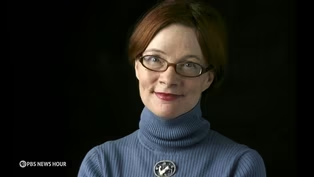
Social media lets us share our lives with family, friends, and strangers. But how do people decide what to post, what to leave out, and what do those decisions say about them? On "Settle In," Geoff Bennett discusses that with Kathryn Jezer-Morton, author of "The Story of Your Life," a new book about how the incentives of social media platforms have narrowed the kinds of stories we tell.
Problems playing video? | Closed Captioning Feedback
Problems playing video? | Closed Captioning Feedback
Major corporate funding for the PBS News Hour is provided by BDO, BNSF, Consumer Cellular, American Cruise Lines, and Raymond James. Funding for the PBS NewsHour Weekend is provided by...
Kathryn Jezer-Morton joins Geoff Bennett on On 'Settle In'
Clip: 10/19/2026 | 4m 38sVideo has Closed Captions
Social media lets us share our lives with family, friends, and strangers. But how do people decide what to post, what to leave out, and what do those decisions say about them? On "Settle In," Geoff Bennett discusses that with Kathryn Jezer-Morton, author of "The Story of Your Life," a new book about how the incentives of social media platforms have narrowed the kinds of stories we tell.
Problems playing video? | Closed Captioning Feedback
Where to Watch PBS News Hour
PBS News Hour is available to stream on pbs.org and the PBS app.
Providing Support for PBS.org
Learn Moreabout PBS online sponsorshipGEOFF BENNETT: Social media has become the main way we share our lives with family, friends, and strangers alike.
In this week's episode of "Settle In," I spoke with Kathryn Jezer-Morton, author of the new book "The Story of Your Life" about how the incentives of social media platforms have narrowed the kinds of stories we tell and shapes how we see ourselves.
You write about what you call the redemption narrative, the pressure to turn whatever difficulty one is going through into this story of personal growth or triumph.
Why are we so drawn to that?
KATHRYN JEZER-MORTON, Author, "The Story of Your Life: How Social Media Shapes the Way We Experience Everything": You know, I think that's something that is really at the core of American identity.
I mean, I think that the project of the United States was sort of built on this idea of starting something in a new place and overcoming the odds in order to make it work.
And I think that's the story of capitalism.
It's the story of economic progress as we know it today.
So, to me, this is just an extension of that.
But it's just not the only story.
And I do think it makes sense to tell a story about redemption when you're talking about a business, when you're talking about an enterprise.
I think it makes less sense to lean on that narrative when you're talking about a family or an individual, just because a family's life is always going to have ups and downs.
GEOFF BENNETT: There's something almost radical these days about saying, yes, this experience was difficult, and it didn't necessarily make me a better person.
(LAUGHTER) GEOFF BENNETT: It was just something I had to go through.
KATHRYN JEZER-MORTON: Yes, right.
That's right.
That's -- to kind of just let it land on that kind of unresolved note is really dissonant, I think, to the contemporary ear.
People want to hear a resolution.
They want to hear the takeaways, what I learned from.
And this is really, I think, a product of this narrative orientation that we have towards redemption.
Make it better.
Learn something from your troubles.
And I just don't believe that that's always the path that we take.
And the people that I spoke to in this book really reinforced that idea for me that it's not always just better and better and better.
GEOFF BENNETT: Well, say more about the people with whom you spoke for the book and how you determined who you would speak with and what stories you would include.
KATHRYN JEZER-MORTON: Yes, I mean, it really just started leaving my bubble, trying to find strangers.
I joined like Meetup.com groups, just any place where I could go where I would be able to talk to strangers without making people uncomfortable.
I went on Facebook and community groups, and I asked if I could talk to people.
I really just kind of tried everything.
And I just spoke to a lot of different kinds of people, mostly millennials, I would say.
And I heard a lot of stories.
Basically, if someone told me a story that really stuck in my head, I would be like, I'm going to build a chapter around this, and then I would find other stories, and I would just kind of put them together.
But I kind of let the data lead the way, and I was just looking for people to surprise me.
And it was not hard to find people to surprise me, I have to say.
It was a lot easier than I thought it was going to be.
GEOFF BENNETT: One of the real paradoxes you identify in your book is that social media promises individuality and self-expression, but actually produces an enormous amount of conformity.
What did you find when you were sort of researching and stitching together that part of your book?
KATHRYN JEZER-MORTON: Yes, I call it like a small-C conservatism.
People want to replicate ways of being that they have already seen, which is a fundamentally conservative orientation.
Like, I want it to be the traditional way.
And I think a lot of that is just because people -- not everyone is like a natural-born storyteller with a huge creative well of ideas, and they just figure, hey, that looked cool, I'm going to do it that way.
So, I mean, that's just a basic human orientation.
But I also just think that we -- this is now our version of success.
When we see someone taking a cool-looking vacation, we're like, that's what success is.
I want to do that.
If I'm able to do that, I will have succeeded.
And so, yes, it does sort of funnel us into these ways of telling our story that are really, really similar to each other.
GEOFF BENNETT: And you can watch all episodes of "Settle In" on our YouTube page or wherever you get your podcasts.
 New
Arthur Jafa explores complexities of Black American life
Video has Closed Captions
Arthur Jafa explores complexities of Black American life in new exhibition (6m 27s)
 New
E-aviation takes off as companies seek new era of flight
Video has Closed Captions
Electric aviation takes off as companies seek new era of flight (8m 33s)
 New
French authorities impose curfews after weekend rioting
Video has Closed Captions
French authorities impose curfews after weekend rioting (3m 31s)
 New
News Wrap: Judge clashes with DOJ over D.C. golf course
Video has Closed Captions
News Wrap: Federal judge clashes with DOJ over D.C. golf course (4m 31s)
 New
Ohio becomes midterm battleground after years of GOP wins
Video has Closed Captions
Ohio becomes midterm battleground after years of Republican wins (5m 19s)
 New
Remembering film critic and News Hour regular Ann Hornaday
Video has Closed Captions
Remembering Ann Hornaday, film critic and News Hour regular (2m 33s)
 New
Tamara Keith and Carrie Dann on Trump's record-low approval
Video has Closed Captions
Tamara Keith and Carrie Dann on Trump's approval rating hitting a record low (6m 46s)
 New
Trump escalates Zelenskyy feud as Russia continues attacks
Video has Closed Captions
Trump escalates clash with Zelenskyy as Russia continues deadly attacks on Ukraine (3m 22s)
 New
U.S. must pressure Putin to end war, Ukrainian official says
Video has Closed Captions
U.S. must put pressure on Russia so Putin ends the war, Ukrainian official says (6m 37s)
Providing Support for PBS.org
Learn Moreabout PBS online sponsorship New Episode
- News and Public Affairs

Today's top journalists discuss Washington's current political events and public affairs.
 New Episode
- News and Public Affairs

FRONTLINE is investigative journalism that questions, explains and changes our world.
 New Episode
 New Episode
 New Episode



 New Episode
 New Episode


 New Episode
 New Episode
Support for PBS provided by:
Major corporate funding for the PBS News Hour is provided by BDO, BNSF, Consumer Cellular, American Cruise Lines, and Raymond James. Funding for the PBS NewsHour Weekend is provided by...