
Schools Race to Keep Pace with AI in the Classroom
Clip: 8/7/2026 | 17m 25sVideo has Closed Captions
Natasha Singer discusses AI in schools.
Natasha Singer, NYT technology reporter has been following the use of AI in the classroom — particularly the way American schools are rushing to adopt chatbots that were once banned. And while tech companies have been making assurances about AI to educators, parents and teachers remain concerned about the lack of guardrails. Singer discusses the problem of balancing "AI literacy" with safety.
Problems playing video? | Closed Captioning Feedback
Problems playing video? | Closed Captioning Feedback
Schools Race to Keep Pace with AI in the Classroom
Clip: 8/7/2026 | 17m 25sVideo has Closed Captions
Natasha Singer, NYT technology reporter has been following the use of AI in the classroom — particularly the way American schools are rushing to adopt chatbots that were once banned. And while tech companies have been making assurances about AI to educators, parents and teachers remain concerned about the lack of guardrails. Singer discusses the problem of balancing "AI literacy" with safety.
Problems playing video? | Closed Captioning Feedback
Where to Watch Amanpour and Company
Amanpour and Company is available to stream on pbs.org and the PBS app.
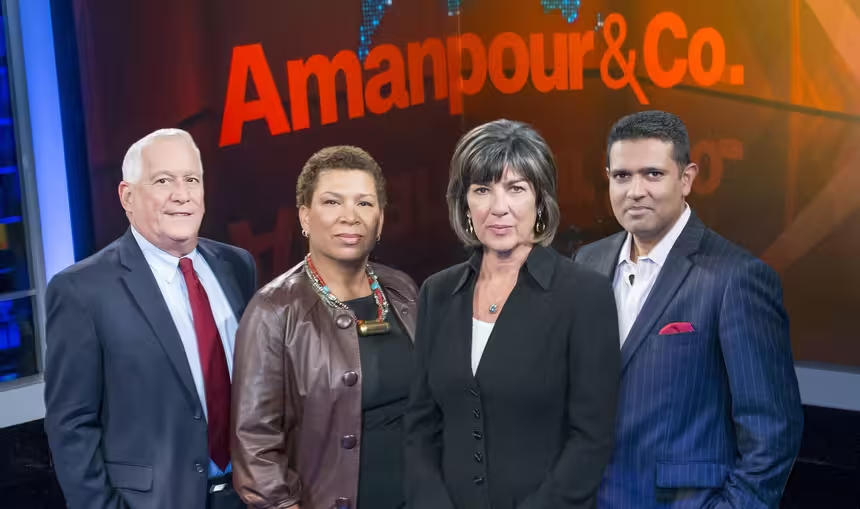
Watch Amanpour and Company on PBS
PBS and WNET, in collaboration with CNN, launched Amanpour and Company in September 2018. The series features wide-ranging, in-depth conversations with global thought leaders and cultural influencers on issues impacting the world each day, from politics, business, technology and arts, to science and sports.Providing Support for PBS.org
Learn Moreabout PBS online sponsorshipNatasha Singer, thanks so much for joining us.
You are a New York Times reporter that has covered technology in the classroom for quite some time now.
And, you know, I wonder if there's something different about what's happening in the conversations that parents and teachers and students are having today versus previous cycles when laptops were introduced into schools or the Internet came in or social media.
Now, I mean, there seems to be a lot of focus around AI.
I think that's right.
And, you know, I've been covering tech in schools for The New York Times for more than a decade.
And we've seen some of these previous school tech cycles.
And I think they're important because I think they're actually one of the things that's behind this concern about AI.
So if you go back about 10, 15 years when companies like Microsoft and Google and Apple were saying, "Schools, if you just give every kid a Chromebook or an iPad, it will magically transform education and kids will learn valuable career skills," right?
And then they said, "Well, if you just give every kid access to YouTube and social media, it will revolutionize learning and they'll gain valuable career skills."
And then more recently, "If we just teach every kid to code, it will transform learning and give every child valuable career opportunities."
And so in this context, now we have Google and Microsoft and new players like OpenAI that makes chat GPT coming.
And they're saying something very familiar, which is, "If we just teach every kid to use chatbots, it will transform learning and give them valuable career opportunities."
And the issue is the last few tech cycles didn't exactly pan out the way the tech industry promised.
And I think parents are much more wary this time with AI, partly because of these past cycles that didn't pan out and partly because the tech industry is framing AI as a magical, powerful tool.
And so if we're going to put this super powerful tool in schools, parents are rightly concerned.
One of the things they're concerned about, as you know, is that some of these chatbots have fueled industrial scale student cheating.
And we're worried about the chatbots giving kids misinformation.
And we're worried about kids forming relationships with chatbots.
And I think all of this is fueling a national discussion like what did we learn from social media?
What did we learn from this whole give every child a laptop?
Are we applying any of these lessons now?
The dream was every child can have an individualized tutor.
And it came once in the form of software.
Now it's coming in the form of AI.
Are those things working?
Have we seen the gains that we were kind of sold?
Well, again, if you go back a decade or so, the tech industry and billionaires like Bill Gates were saying like big data will transform education.
And one of the things was, we'll have these personalized learning apps that have algorithms that can customize math or reading lessons to your child in real time.
And many of those did not pan out.
A few do have research showing gains.
But parents are also concerned about them because a lot of them have video game-like engagement techniques.
And they have sounds and they have points.
And you can gain points if you get the math problem right to customize your avatar and all these things.
And so I think one of the questions for parents is, is this edutainment?
Are kids really learning anything?
And I think now with AI, the promise and the marketing of an AI can customize what it's saying to each child at the right moment.
The promise is incredible.
We would all love that to happen.
But what we're seeing is studies showing that the more you outsource your thinking, your research, your writing to an AI, you know, it's going to hinder kids from developing critical thinking, and it can impede learning.
And so I think, again, you have parents saying, "Can't we test this first before we put it in every student's hands?"
So it's not necessarily completely anti the technology.
What are the people here, let's say New York or in other cities, advocating for?
In New York, since you're there, you know, you've seen thousands of parents sign a petition asking for a pause on rolling out student facing AI tools.
And you've also seen the New York City Council, more than half of them, sign a letter to the mayor and the superintendent urging a multi-year pause in other cities like Los Angeles, and then with their national children's advocacy groups like Fair Play for Kids and Schools Beyond Screens and Smartphone-Free Childhood.
And what they're saying is they were advocating for a five-year moratorium on AI in schools.
And I think it's super complicated because, first of all, the majority of high school students are already using AI in their own personal lives.
So are a lot of middle school students.
And I spend a lot of time talking to students about how they're using AI because I'm just interested.
Like, I think there's a false split between what kids are doing with AI in schools and what they're doing outside of schools.
And, you know, we all use learn to use Google as our information retrieval system.
Well, teens are using AI.
They're not they're bypassing the Google search.
And they're saying, chat, I'm out to lunch with my friends.
How many calories is this salad?
Chat, like, what is the capital of Mongolia?
Chat, can you explain to me how to make a birdhouse?
Chat, I'm like, make a selfie in which I look like I'm a cyberpunk, you know, in an animated movie, right?
Like, like, it has become part of the fabric of their lives.
And so the notion that we should not teach students about this is also problematic because they're navigating an AI-fueled world.
And so I think what's going to be interesting is to see how schools and parents find a balance between making sure students can use these tools in ways that are effective and also having guardrails to make sure that some of the risks and harms of AI are going to be reduced, especially for kids.
>> So you highlighted how two very different districts in the opposite sides of the country were dealing with technology and AI and how to implement it.
>> Yes.
I had visited Miami-Dade County public schools, and they were rolling out Google's Gemini for more than 100,000 high school students, all high school students.
And what was fascinating about that is, you know, you could have thought, oh, this is a Google-driven, you know, school project, but actually, you know, Miami-Dade County has a very sophisticated education technology department, and they decided to vet all the commercially available tools, the Microsoft tool and the Google tool and the OpenAI, AI, and a few other ones, and really stress test them.
And so they spent months saying awful things to the chatbot to see what would happen, or trying to get them to produce answers, and they concluded that Google was the best fit for their school system.
And then they trained more than 1,000 teachers, and I sat in on some of the trainings for teachers.
And teachers were, in the beginning, very gingerly trying out different ways of using Gemini.
And so I went to an English language arts class where students were writing short essays about free will and fate, you know, and in Oedipus Rex, you know, do you have the ability to direct your fate or is it chosen for you?
And they had to write just a very short, you know, few paragraphs.
And then the teacher asked them to put it into Gemini, and Gemini gave them instant feedback.
And the feedback was not, "Oh, your writing is beautiful or problematic or your vocabulary could be better."
It was just, "Is your thesis topic sound?
Are the examples you're using good enough to make your point?
And do you have a good enough concluding sentence?"
Right?
So it was like interim feedback to help the students who might be stuck.
And then they improved their work and handed it in to the teacher.
And then by contrast, as you know, Los Angeles Unified School District, which is the second largest school district, contracted with a startup to create a chatbot called Ed.
And LA schools launched it with huge fanfare that Ed was going to be able to help students and direct them to the right resources and let parents talk to the chatbot and make sure that, you know, their kids were on track and so on.
But very quickly, it turned out that the AI startup was not really equipped to build this kind of thing for such a big school district.
There were questions raised about how it was handling students' personal information, and then the Justice Department came in and charged the startup with defrauding investors.
And so it's quite a contrast because Los Angeles Schools is the second largest school district, right?
And they could have used Gemini or Microsoft.
So why they went with a small startup that did not have a track record, you know, there's all kinds of questions and different folks are looking into it.
And so, you know, we don't know the answer to that.
But then we see Miami, which is the third largest school district going about this in a very methodical, careful way.
And so it's like the tale of two school districts going opposite directions.
You also have the federal government and the president going out and say, hey, listen, an executive order is out there already saying AI should be integrated across subjects.
We're going to prioritize federal funding for this.
And frankly, there's a huge chunk of our economy at this moment that's dependent on a handful of AI companies.
So I wonder, when you see that tension, how do the instructors on the ground, the students, the parents, how do they deal with that?
So I think at different times in the history of the United States, we've had different economic imperatives.
So AI is going to fuel our economy, and if we don't keep ahead, we are not going to be competitive globally.
And so you can understand the economic imperatives for wanting to have a trained workforce.
And you also have tech companies going around saying to teachers and schools like, "You must train kids for the AI-driven future.
You must train kids for the AI-first future."
And of course we want students to have career skills and to be able to go out and use the latest technology and use it in their jobs and their lives.
But I think the tension is that who's thinking about what's in the best interest of kids?
So I think the speed at which the industry is moving and wants kids to learn different things gives some schools whiplash.
And so if we think about what actually are the durable skills we want kids to learn, I'm seeing some schools think about AI literacy as a broad-based way of teaching kids and equipping them to be able to deal with any technology that comes down the pike.
I visited this charter school in New Jersey where two high school teachers saw that their 12th graders were all using AI, but they didn't know anything about it.
And they did not want the students to graduate without understanding that you're going to submit your resume and AI is going to read it.
You may be rejected before a human ever sees your credentials.
And how are we going to operate in that world?
So they started an AI literacy class in February, and I went to visit and it was just the beginning.
And they pitched it to the students as a kind of AI driver's license.
They said to the students, like, when you're in a car, you don't let the car steer you, you steer the car.
So we want to try to work out a way where you understand how AI works.
And you're going to steer your own use of AI and make choices and not be steered by these tools.
And so the students did this whole audit of all the apps and AIs they used and looked at when these tools were shaping them and steering them and saying, "Don't you want me also to look at this?"
And when they were making active choices.
And they had a kind of fascinating reaction to understanding how they had basically given away some of their autonomy to AI and they wanted to get it back.
There's another powerful lobby here when it comes to anything in the classroom, and that's the teachers' unions.
Last year we saw Randy Weingarten, who we've had on the program before, the American Federation of Teachers.
They partnered with Microsoft and OpenAI and Anthropic, and I think it was like a $23 million initiative called the National Academy for AI Instruction.
And yet now we see Randy Weingarten, her tone has changed, her opinion has changed on, you know, not just the adoption, but really how it needs to be rolled out.
So again, I think that this is kind of an incredible turnabout in such a short time, because last July, so last summer, the Teachers Union did do this $23 million deal with Microsoft and OpenAI to bankroll teacher training.
And Randy Weingarten said at the time, you know, we're not just going to teach teachers how to use these tools effectively.
Our teachers are going to have a seat at the table with OpenAI and Microsoft and Anthropic, and they're going to be able to weigh in on how these tools are developed for schools and how they're used.
And that was the rationale at the time.
And I sat in on one of those workshops.
You know, the AFT let me sit in.
They were starting them in New York.
And teachers learned, you know, about privacy and security.
They also learned how to generate emails to parents and lesson plans and things with AI.
And then they use some tools like Suno.
It's a song generating app, right?
So they generated like songs for different subjects as learning aids for the kids.
And I think it was really useful.
I think it was also, you know, very tool and machine focused, right?
All the kind of contextual things and all the kind of hard questions you would want students to ask to think critically were not part of the workshops I sat in on.
And now here we are less than a year later and Randy Weingarten gave a speech at the National Press Club saying that she thought AI was risky, that she was worried about kids' safety, about them forming relationships with chatbots, about AI diminishing learning, and she urged elementary schools to not use student-facing AI at all for kids.
And so in less than a year you have a transformation of somebody who was very enthusiastic about AI and still believes that teachers really need to master these tools, but now has deep concerns that AI is the second coming of social media and could be risky.
When you talk to parents, have you found anyone that is well balanced in this?
That they, on the one hand, want their child not to be left behind if there's a huge technological wave that's coming, right?
And on the other hand, they also want to keep their kids safe and they want to make sure that they don't have weird relationships with chatbots and etc.
So, I mean, are there are there places that are doing it right?
And is there someone that's, you know, got a message that resonates with parents to be even keeled about this?
I think that, you know, we have more than 13,000 school districts in the United States.
And as you pointed out, they're each doing their own thing.
And I think that parents are trying to navigate this.
And I think one of the issues is, these AI products are so new.
And we're seeing adults struggle with having relationships with chatbots and spending a lot of time on chatbots and outsourcing things to chatbots and feeling like their own critical thinking muscles are shrinking.
And so I think that we don't know what the impact of these powerful tools are going to be on schools.
And so when I talk to parents, some of them want there to be a moratorium on AI.
Some of them want their kids to learn these career skills.
And some, as you say, are trying to find a balance.
And they would like to see a kind of broad-based tech education that is not centered on industry products, but that is centered on students learning how these things work, how to use them, but also what the risks are, what the drawbacks are, and how to just ask questions about how tech is shaping us, what could be good for our communities, what we might not want.
And I think there's a beginning of that kind of broad-based movement, but also I just feel like the fight over AI is part of this larger conversation we've been having over education for centuries in the United States, which is what is the purpose of public schooling, right?
Is it to teach kids to be active citizens in a democracy and educated voters?
Is it to help them learn job skills?
Is it to help the prevailing most powerful industry of the day train their workers?
Is it to help students discover their passions, figure out who they want to be, what their moral code is, how they can help their communities?
And so what you think AI education should be depends on what you think the purpose of education should be.
But I think when I talk to many parents, they think the purpose is all of the above.
So how can we have AI education that satisfies all of the above?
Those are good questions to end on.
Natasha Singer, reporter at the New York Times.
Thanks so much for your time.
 New Episode
- News and Public Affairs

Top journalists deliver compelling original analysis of the hour's headlines.

- News and Public Affairs

FRONTLINE is investigative journalism that questions, explains and changes our world.
 New Episode
 New Episode
 New Episode
 New Episode
 New Episode
 New Episode

 New Episode
 New Episode

Support for PBS provided by: