
October 1, 2023 - PBS News Weekend full episode
10/1/2023 | 26m 45sVideo has Closed Captions
October 1, 2023 - PBS News Weekend full episode
October 1, 2023 - PBS News Weekend full episode
Problems playing video? | Closed Captioning Feedback
Problems playing video? | Closed Captioning Feedback
Major corporate funding for the PBS News Hour is provided by BDO, BNSF, Consumer Cellular, American Cruise Lines, and Raymond James. Funding for the PBS NewsHour Weekend is provided by...
Support provided by:

October 1, 2023 - PBS News Weekend full episode
10/1/2023 | 26m 45sVideo has Closed Captions
October 1, 2023 - PBS News Weekend full episode
Problems playing video? | Closed Captioning Feedback
How to Watch PBS News Hour
PBS News Hour is available to stream on pbs.org and the free PBS App, available on iPhone, Apple TV, Android TV, Android smartphones, Amazon Fire TV, Amazon Fire Tablet, Roku, Samsung Smart TV, and Vizio.
Providing Support for PBS.org
Learn Moreabout PBS online sponsorshipJOHN YANG: Tonight on PBS News Weekend, the messy rollout of the latest COVID booster and what you need to know about protecting yourself this fall.
Then, the explosion in popularity of e-bikes and why their introduction hasn't been the smoothest ride, especially when you're on an.
WOMAN: Especially when you're on e-bike and your speed has suddenly increased much faster than you've ever gone, it just requires a little bit more thought and care, I think, with our riding.
JOHN YANG: And the complicated and shifting definitions of Hispanic and Latino.
(BREAK) JOHN YANG: Good evening.
I'm John Yang.
A day after House Speaker Kevin McCarthy narrowly averted a government shutdown by engineering passage of a short term spending bill, a leading McCarthy critic says he'll try to remove him from the speaker's chair.
After a hectic and chaotic day in the House late last night, the Senate overwhelmingly approved the 45-day spending bill, sending it to President Biden, who signed it shortly before the midnight deadline.
It was McCarthy's surprising turn to Democrats for votes that made it possible, but hardline House Republicans say that broke promises McCarthy made in January to become speaker.
McCarthy critic Matt Gaetz of Florida appeared on CNN's State of the Union.
REP. MATT GAETZ (R) Florida: I think we need to rip off the Band Aid.
I think we need to move on with new leadership that can be trustworthy.
JOHN YANG: McCarthy says he's confident he'll survive, but that also may require votes from Democrats.
Congress now has 45 days to try to pass full year spending bills.
A big issue will be aid to Ukraine, which President Biden wants, many House Republicans oppose and the stopgap bill left out.
Today also marks the end of two pandemic era safety nets, federal funding for childcare program stops, and after a three year moratorium, student loan repayments resume.
Buffalo Bills safety Damar Hamlin returned to regular season action today for the first time since a near death experience earlier this year.
Hamlin was on the kickoff return unit to open the game with the Miami Dolphins in January.
Hamlin's heart stopped while making a routine tackle in a game in Cincinnati.
And another milestone for America's longest living president Jimmy Carter turns 99 today.
He celebrated in Plains, Georgia, with Rosalynn, his wife of 77 years, and their children, grandchildren, and great grandchildren.
Mr. Carter entered hospice care in February.
And we'd like to wish him a very happy birthday as well.
Still to come on PBS News Weekend, who identifies as Hispanic and who says they're Latino?
And the story of a Mexican American journalist and activist who devoted her life to fighting racism and discrimination.
(BREAK) JOHN YANG: When federal health officials approved a new COVID booster earlier this month and recommended it for anyone six months or older, doses were expected to be available in pharmacies within days.
But two weeks later, many people are having trouble finding the vaccine.
And if they do find it, some are having trouble getting insurance to pay for it.
And some nursing homes, which are more vulnerable to COVID, haven't even begun vaccinating residents yet and may not until November.
Katelyn Jetelina is a University of Texas epidemiologist and author of the popular newsletter Your Local Epidemiologist.
Katelyn, why is the rollout of this new booster a little messier than the previous rollouts?
KATELYN JETELINA, Author, "Your Local Epidemiologist": Yeah, it's been messy, to say the least, like you said.
And this is because of a massive shift coming out of the emergency that COVID-19 vaccines are now commercial.
So in other words, the U.S. government is no longer responsible for purchasing or distributing these vaccines.
So this means we have now multiple payers i.e.
Insurance companies and changes to the delivery system, which has unfortunately resulted in this slow rollout and fragmented inequitable and, quite frankly, imperfect system.
General Perna was in charge of it during the pandemic.
He was the chief operation officer of Operation Work Speed.
And I think a lot of people underappreciate, including me, the massive task of getting 330,000,000 people a vaccine quickly.
I think it was 24 hours after the initial rollout in December of 2020, and it saved lives.
JOHN YANG: This week, the Health and Human Services Secretary, Xavier Becerra, called in the insurance company executives to remind them or get them to recommit to paying for these vaccines.
Is that also a factor or a result of this moving from the government to commercial?
KATELYN JETELINA: Yeah, commercial is very confusing because COVID is also not our normal flu vaccine.
But bottom line to the general population, no one should be paying for a COVID-19 vaccine.
Private insurance companies are mandated to cover this vaccine with no copay.
Now insurance companies are no longer required to pay out of pocket.
So this may mean you have to get your vaccine at your doctor's office opposed to a pharmacy that's not in network and then under an uninsured people, CVS and Walgreens are required by federal law to give you a vaccine at no cost.
Thanks to this new federal bridge program.
JOHN YANG: There was a Kaiser Family Foundation poll that found that 46% of those surveyed said they either definitely or probably will get this new booster.
And that's above what it was for the previous booster at the beginning of the year, but also below what it was for the initial vaccine.
Is that good news or bad news that number?
KATELYN JETELINA: You know, I think it's good news.
I'm actually pleasantly surprised it's about 50 percent.
That's about what we see with the flu vaccine every year pre pandemic and during pandemic.
And I think that if we can get up to those flu vaccine numbers, we're a whole lot better than we did last fall, which was about one in four Americans getting their fall boosters.
JOHN YANG: You talked about the three vaccines that are out there this fall for people COVID, seasonal flu, and RSV, the respiratory virus.
Walk us through what people should be thinking about this, about when to get them, which ones to get.
Can you mix them?
Can you get two or all three at the same time?
Let's start with COVID.
KATELYN JETELINA: Yeah.
So everyone over six months and older are eligible to get the COVID-19 vaccine.
You can get it with your flu.
You can also get it with your RSV vaccine, which cuts down the number of visits you have to the pharmacy or the doctor's office.
The most challenging thing with COVID-19 vaccines is timing.
When should you get your COVID-19 vaccine?
And this is dependent on, of course, your risk calculus.
How long do you want to wait?
It depends on how at risk you are.
So those over 65, I tell people to get their vaccine right away, and it also depends on the last time you were infected.
So we suggest people getting their vaccine about at least three to four months after infection.
JOHN YANG: And the RSV vaccine.
KATELYN JETELINA: People are eligible if they're over the age of 60.
And pregnant people are now eligible to have the vaccine in their last trimester of pregnancy to help their newborn.
And we also have monoclonal antibodies.
And this isn't a vaccine, but it's more like antibody medication that little kids under eight months old can get in their first RSV season.
RSV doesn't wane as quickly the protection doesn't wane as quickly as COVID-19 or flu vaccine.
So you should get it right away, and it'll be durable throughout the season and even maybe into next season.
We're waiting to see data on that.
JOHN YANG: Seasonal flu vaccine, there's always, or at least I've heard this debate about whether you get it early or get it late.
What's your recommendation?
KATELYN JETELINA: Yeah, so everyone over six months is eligible for flu vaccine.
It does wane, I would say not as quickly as COVID-19.
And so, particularly among older adults, we suggest getting the vaccine in October.
So all this is really confusing to keep in mind, but I think the bottom line is if you're eligible, get the flu COVID and RSV vaccine before Halloween, and you should be pretty darn protected going into this winter.
JOHN YANG: Katelyn Jetelina, your local epidemiologist.
Thank you very much.
KATELYN JETELINA: Thanks for having me.
JOHN YANG: E-bikes are bikes with electric motors to assist riders, and their popularity has soared recently.
Last year, U.S. sales topped $1.3 billion.
While they're being hailed as a more accessible form of transportation, as Ali Rogin reports, their introduction hasn't been a totally smooth ride.
ALI ROGIN: Since the introduction of the modern e-bike in the 1990s, their popularity has steadily grown in many parts of the world.
But it wasn't until 2020 that their use in the U.S. for recreation and as a cheaper, clean and equitable means of transportation really took off.
They have many benefits, but the sudden rise of e-bike use in America has come with challenges, including deadly battery fires and rider and pedestrian deaths.
Molly Hurford writes about e bikes for the magazine Bicycling and is the co-host of the podcast Consummate Athlete.
Molly, thank you so much for joining us.
In terms of e bikes, how does it work?
MOLLY HURFORD, Contributing Writer, "Bicycling": Yeah, e bikes are a little bit you don't really get how they work until you're ones.
E-bike can't actually just down the street without your pedal power.
So basically all that it's doing is giving you a little extra oomph with every pedal stroke and all the e-bikes let you sort of regulate just how much extra you want.
So picture a bit of like a throttle basically on the handlebars that lets you say, like, I want to go a little bit harder up this hill, and then suddenly you're getting that extra little boost.
ALI ROGIN: And what is behind this surge in popularity in the United States?
MOLLY HURFORD: You don't like to give COVID credit for anything, but we do have to say cycling just really exploded in popularity in 2020, 2021, especially e-bikes, partially because, especially in cities, people weren't comfortable using public transportation.
So what do you do?
You get an e-bike and suddenly it's much easier to make that 5, 10, 15 miles commute without showing up to work completely drenched in sweat.
The price on e-bikes has also come down hugely.
It used to be when I first started covering e-bikes.
Bikes would start at $4,000, $5,000 and could go up to, you know, 10,000, 15,000.
Now you can still buy a $15,000 e-bike, but you can also get $1,500 e-bike that's actually quite good quality.
We're not only seeing people using them for delivery work in the major metropolitans, we're seeing people do the commute, we're seeing people ride on the road for fun and the older people being able to keep up with their kids or their friends on the group rides, for people who either have been injured or have neuromuscular issues or have certain disabilities.
The e-bikes have actually given them the ability to ride a bike again, which is absolutely amazing.
ALI ROGIN: What about battery fires?
What are the concerns over batteries and e-bikes?
MOLLY HURFORD: Yeah, so the biggest problem with this is actually it's aftermarket batteries and aftermarket chargers.
So if you're using, you know, a new e-bike with the battery it came with and the charger that it came with, you shouldn't have any problems with charging.
I know in New York City, they actually are adding some ability to go in and trade in your old battery to get a safer new one.
Unfortunately, it is also causing some apartment buildings in New York to actually ban having e-bikes or scooters or anything like that does have these lithium batteries.
ALI ROGIN: One paradox seems to be that these e bikes are faster than your average analog bike, but they're slower than cars.
So how are they being regulated and are they being regulated?
MOLLY HURFORD: You kind of hit the nail on the head with one of the very tricky topics of e-bikes.
Now they do mostly.
I think actually all of them in the U.S. would have a speed governor on them.
So you can only go so fast.
It's only going to give you a certain amount of assist.
So you're not going to really get up to speeds over even like 20 miles an hour on flat, for the most part.
And some municipalities actually have started kind of monitoring where e-bikes are allowed to go, if they're allowed to go on pedestrian trails, if they're allowed to go on the mountain bike trails.
ALI ROGIN: And one other concern seems to be that as the popularity of these e-bikes rises, so too has the rate of injury and some of the severity of injuries.
And in fact, the city of Encinitas, California, declared a state of emergency for e-bike safety after the death of a 15-year-old who was one of them.
What is the debate like right now over e-bike safety and whether anything needs to change?
MOLLY HURFORD: Yes.
I mean, e-bikes really are going to bring up the helmet laws.
Do we need to have helmets on?
Is that going to be a law for when you're riding your bike right now?
It's not in most states unless you are a minor.
And I mean, the other thing really is just education around them.
We don't really think that hard about the ability to ride bikes safely as adults.
We just kind of assume that, oh, of course we know what we're doing.
But especially when you're on an e-bike and your speed has suddenly increased much faster than you've ever gone, suddenly things like coming to a stop, especially with like a heavier cargo e-bike, you need to stop a lot sooner.
Cornering, you know, your chances of sliding out in a corner are much greater.
But it's not to say that the e-bikes themselves are dangerous.
It just requires a little bit more thought and care, I think, with our riding.
ALI ROGIN: Molly Hurford with the magazine Bicycling.
Thank you so much for your time.
MOLLY HURFORD: Thank you so much for having me.
JOHN YANG: National Hispanic Heritage Month, which runs through October 15, celebrates a population of 64 million people that's diverse, growing and constantly changing.
But can a single term, whether it's Hispanic or Latino, describe a population of such varied ancestry, immigrant generations and geographic origin?
Mark Hugo Lopez is Director of Race and Ethnicity at the Pew Research Center, and Cristina Mora is a University of California, Berkeley sociology professor and author of Making Hispanics How Activists, Bureaucrats, and Media Constructed a New American.
Cristina, I want to start with you.
As the title of your book suggests, these terms are of relatively recent origin.
How did they come about?
How did they start?
CRISTINA MORA, University of California, Berkeley: Well, the idea of Hispanic itself has a very long history in sort of the colonial projects of Spanish colonization.
But the idea of it as a category in the United States that would be used to collect data and to identify a people really is at the latter half of the 20th century.
So really around the 1960s and 1970s, as Mexican, Puerto Rican, and even some Cuban populations rallied to sort of get together and ask that government start collecting their data.
And of course, if government's going to collect their data and the state's going to be able to track, for example, Hispanic poverty rates or Mexican and Puerto Rican employment rates, for example, it had to be called something, right?
And, you know, my work and the book tracks, really.
How did this category come to look at these populations, the Mexican American demands for data, the Puerto Rican demands for data, and see them as sort of a common set of communities that could be, you know, put together in an umbrella panethnic category that's large enough, right, to be compared to other groups like blacks and whites.
JOHN YANG: Mark, you've been polling this community since 2008.
What have you learned about how individuals identify themselves and what factors go into that decision?
MARK HUGO LOPEZ, Director of Race and Ethnicity Research, Pew Research Center: Yeah, it's really interesting.
We found that it's mostly the country of origin term that today Latino adults tell us that they use most often to describe themselves.
Perhaps a pan ethnic term might be the second most common thing that they use.
An American might be another term that they use.
But interestingly across immigrant generations, if you're an immigrant you're more likely to say your country of origin is how you most often describe yourself as Mexican or Cuban or Puerto Rican.
If instead if you're us Born to immigrant parents, you might be using both your country of origin but also American equally or perhaps one more than the other.
But by that third or higher generation U. S. born people of U.S. born parents, we begin to see really American is the most common term that's used most often by that population to describe themselves.
JOHN YANG: Cristina, are these two terms Latino and Hispanic, are they interchangeable?
CRISTINA MORA: For many, there are, and of course there are real preferences and there have always been real preferences.
We've seen since some of the first pollings in the 1980s around this issue that folks in LA, New York, even Houston in urban areas preferred the term Latino and folks in Colorado in more rural areas of Texas, even more rural areas of California preferred the term Hispanic.
So there was a real geographic connection to this.
And then there was likely a real generational connection to this with some generations really liking the term.
Even the predecessor of Hispanic Espanol with an o at the end having a preference for that.
And so we see not only geography, not only national origin, but also generation as being very well connected to certain labels over others.
So for example, folks have likely heard the term Afro-Latino, but you rarely ever hear the term Afro-Hispanic for example.
And so there are just ways that certain terms have been connected to preferences over time.
This, I think, just really connects to the fact that there's actually never been one term for which everyone has loved equally and has wholeheartedly been embraced.
You know, pan-ethnicity or these pan-racial categories are really secondary.
Yet just because they're secondary to national origin doesn't mean they're less important.
And they're quite powerful for how we organize the way we live in the world.
So, for example, I actually think of myself as Mexican-American, but also Chicana.
And I use the term Latina, and sometimes I use the term Latinx.
They're a much younger generation that grew up with different gender politics or sexuality politics than my generation grew up with.
I'll often use the term Latinx in many ways because these are bridges.
These are different ways of sort of speaking about this complicated and diverse heritage that we have.
JOHN YANG: Mark, what is your polling found about the use and acceptance of Latinx?
MARK HUGO LOPEZ: Yeah, it's really interesting.
So about four years ago in 2019, we asked Latino adults or Hispanic adults in the U.S. have they ever heard of the term Latinx?
75 percent or three quarters told us no, they hadn't.
We followed up with a question, though, among those who had heard the term, do they use it themselves to describe their identity?
And about 3 percent of Latino adults overall tell us that they use the term.
More recently, we've asked Latinos which term do they prefer to describe the population.
Hispanic more than Latino was preferred, but about 18 percent of Latino adults tell us they have no preference for either term, and only about 3 percent indicate Latinx is the term that they prefer to describe the population.
But what this speaks to is the diversity of the population.
As Cristina was noting, there are many different generations here, many different perspectives on how one chooses to identify, and it really is up to the individual how they choose to identify.
JOHN YANG: And you've also found in your polls, Mark, that as the generations go on, as the generations become more distant from the generation that immigrated, that identity sort of wanes a little bit.
MARK HUGO LOPEZ: That's right.
In fact, we've found that by that fourth generation, in fact, people who might have ancestry in Latin America may no longer even decide to call themselves Hispanic or Latino.
So it's really interesting to see how things can change across the generations, partly because of intermarriage as people grow up in households where one parent is Hispanic, one parent is not.
People may be proud of both heritages of their parents, but what about the grandchildren?
Next, maybe they may acknowledge that ancestry of Hispanic ancestry, but not necessarily say that they're Hispanic or Latino themselves.
JOHN YANG: Mark Hugo Lopez of the Pew Research Center and Cristina Mora of the University of California, Berkeley.
Thank you both very much.
MARK HUGO LOPEZ: Thank you.
CRISTINA MORA: Thank you.
JOHN YANG: Finally tonight, we bring you the story of a journalist and activist who spent her life improving the lives of women and Mexican immigrants at the turn of the 20th century.
Ali Rogin is back with our series hidden histories.
ALI ROGIN: Jovita Idar believed education was the way forward, and she seldom backed down in the face of a fight.
She lived by her own mantra, educate a woman, and you educate a family.
Born in Laredo, Texas, in 1885, she fought for women's rights and was a pioneer in the modern Mexican American civil rights movement.
Idar started her career as a teacher in 1903, working hard to ensure poorer children received an education.
She also pushed for bilingual instruction in public schools.
Her teaching career was short lived.
Inspired by her father Nicasio, and his work running a newspaper, she joined the family business.
La Cronica, The Chronicle was a source of news and activism around the rights of Mexican Americans.
Idar wrote articles challenging racism at a time when so called Juan Crow laws were being used to suppress Mexican American rights.
At the time, it wasn't uncommon to see signs outside businesses across the south that read no dogs, no Negroes, no Mexicans.
After the lynching of 14-year-old Antonio Gomez outside Austin in 1911, Idar and her family organized a gathering that became the catalyst for the modern Mexican American civil rights movement.
Idar also took on issues outside her home state of Texas.
In 1914, she wrote an editorial criticizing President Woodrow Wilson's order to send troops to the U.S. border during the Mexican Revolution, which lasted from 1910 to 1920.
Idar later joined a White Cross nursing unit on the side of the Revolutionary Army to help injured soldiers.
But eventually she returned to journalism, writing for La Cronica after her father's death, as well as a number of other Spanish language newspapers.
Idar continued to spotlight the injustices facing Mexican Americans until her death in 1946 at the age of 60.
She is quoted as saying Women recognize their rights proudly, raise their chin and face the struggle.
The times of humiliation have passed.
Women are no longer men's servants, but their equals, their partners.
Earlier this year, she was honored by the U.S. mint with her own coin, a quarter inscribed with the words teacher, evolution, and Mexican American rights.
For PBS News Weekend, I'm Ali Rogin.
JOHN YANG: And that is PBS News Weekend for this Sunday.
I'm John Yang.
For all of my colleagues, thanks for joining us.
Have a good week.
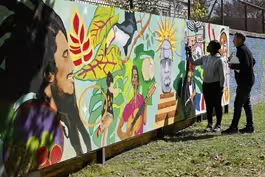
Hispanic? Latino? How the language of identity is shifting
Video has Closed Captions
Hispanic? Latino? How the language of identity is shifting over time (6m 58s)
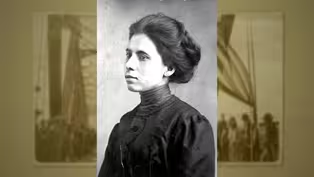
Jovita Idar’s fight for the rights of women and immigrants
Video has Closed Captions
Jovita Idar’s fight for the rights of women and Mexican immigrants (2m 39s)
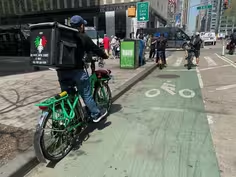
Surging e-bike popularity creates regulatory challenges
Video has Closed Captions
E-bike popularity is surging, creating regulatory challenges on U.S. roads (5m 22s)

What’s behind a messy rollout of the new COVID vaccines
Video has Closed Captions
What’s behind the messy rollout of this fall’s new COVID vaccines (6m 4s)
Providing Support for PBS.org
Learn Moreabout PBS online sponsorship
- News and Public Affairs

FRONTLINE is investigative journalism that questions, explains and changes our world.

- News and Public Affairs

Amanpour and Company features conversations with leaders and decision makers.












Support for PBS provided by:
Major corporate funding for the PBS News Hour is provided by BDO, BNSF, Consumer Cellular, American Cruise Lines, and Raymond James. Funding for the PBS NewsHour Weekend is provided by...