
June 22, 2026 - PBS News Hour full episode
6/22/2026 | 57m 46sVideo has Closed Captions
June 22, 2026 - PBS News Hour full episode
June 22, 2026 - PBS News Hour full episode
Problems playing video? | Closed Captioning Feedback
Problems playing video? | Closed Captioning Feedback
Major corporate funding for the PBS News Hour is provided by BDO, BNSF, Consumer Cellular, American Cruise Lines, and Raymond James. Funding for the PBS NewsHour Weekend is provided by...
June 22, 2026 - PBS News Hour full episode
6/22/2026 | 57m 46sVideo has Closed Captions
June 22, 2026 - PBS News Hour full episode
Problems playing video? | Closed Captioning Feedback
Where to Watch PBS News Hour
PBS News Hour is available to stream on pbs.org and the PBS app.
Providing Support for PBS.org
Learn Moreabout PBS online sponsorshipNICK SCHIFRIN: Good evening.
I'm Nick Schifrin.
Geoff Bennett and Amna Nawaz are away.
On the "NewsHour" tonight: The U.S.
temporarily lifts sanctions on Iran, as Vice President Vance says Tehran will allow U.N.
nuclear inspectors back into the country.
The United Kingdom's uncertain political future after Keir Starmer succumbs to political pressure and resigns as prime minister.
And melting ice.
The scientist and his family who've been tracking rapidly melting glaciers for nearly half-a-century.
MAURI PELTO, Glaciologist, Nichols College: This landscape has been shaped by ice.
And so to understand the landscape and the ice, you really have to walk across it.
(BREAK) NICK SCHIFRIN: Welcome to the "News Hour."
The U.S.
temporarily removed oil sanctions on Iran today, creating the potential for an Iranian economic windfall in U.S.
dollars, as the first round of talks ended in Switzerland.
Vice President J.D.
Vance led the U.S.
delegation mediated by Qatar and Pakistan.
The negotiations come as one of the main sticking points, the war in Lebanon appeared, to calm, at least for the day.
Liz Landers begins our coverage.
DONALD TRUMP, President of the United States: If Iran doesn't live up to their agreement or if they're not behaving, I will do what I have to do.
LIZ LANDERS: President Donald Trump today making a veiled threat to Iran if they don't adhere to the memorandum of understanding that was struck last week.
DONALD TRUMP: We're doing very well in terms of negotiating a fair and reasonable deal.
LIZ LANDERS: In Switzerland earlier today, Vice President J.D.
Vance said talks with Iran are already paving the way for more technical discussions about its nuclear program.
J.D.
VANCE, Vice President of the United States: We did exactly what we wanted to do, which is accomplish four things for the American people.
LIZ LANDERS: Vance, touting progress, laid out those key points, establishing a mechanism for keeping the Strait of Hormuz open, coordination for the cease-fire between Israel and Hezbollah in Lebanon, a process for the technical negotiations that remain, and an agreement on IAEA inspection of nuclear facilities.
But Iran's Foreign Ministry today denied negotiations on nuclear issues, saying they did not accept any new commitments.
Shortly after Vance's comments, Treasury Secretary Scott Bessent announced that his agency would waive sanctions on Iranian oil as part of an interim agreement to end the war.
The license authorizes the production, delivery and sale of Iranian oil in late August.
Miad Maleki, a former top sanctions official at the Treasury Department, is now a senior fellow at the Foundation for Defense of Democracies.
He called the dollar authorization, allowing Iran to get paid in U.S.
dollars, a critical detail in the announcement.
MIAD MALEKI, The Foundation for Defense of Democracies: Now, as far as cash, I think they have about 67, 68 million barrels of Iranian oil that are within international waters close to China, in Asia.
So that becomes available to buyers.
And if -- at current prices, that is $8 billion to $9 billion in floating inventory that now becomes available to buyers.
LIZ LANDERS: Meanwhile, there was a calm in Lebanon today, with no Israeli strikes reported overnight and into today.
But it followed a bloody weekend of Israeli strikes.
At a funeral yesterday, a familiar chant, "Death to Israel."
Family members gathered to mourn four of the at least two dozen people killed in an Israeli strike on Saturday, including five children.
Hours earlier, Israel and Hezbollah agreed to a cease-fire, but Israel refused to leave its occupation of Southern Lebanon.
Hezbollah Chief Naim Qassem yesterday adamant in refusing to back down if Israel doesn't.
NAIM QASSEM, Hezbollah Secretary-General (through translator): Israel will not stay in Lebanon, and we will defend ourselves.
Any violation, we will deal with as we see fit.
LIZ LANDERS: Israeli Prime Minister Benjamin Netanyahu today also resolute.
BENJAMIN NETANYAHU, Israeli Prime Minister (through translator): The directive is clear and has not changed.
Our fighters in Southern Lebanon have full freedom of action to thwart any direct or emerging threat against them.
LIZ LANDERS: Just yesterday, Israelis in Tel Aviv mined the streets, bidding farewell to one of the four soldiers killed in Southern Lebanon last week.
An attendee voiced frustrations over Israel's exclusion from the weekend negotiations.
ASHER ARONOF, Herzliya, Israel, Resident: With the talks of the negotiations between Iran, the United States, Israel is out of the question.
We are with hands tied behind our back.
LIZ LANDERS: Meanwhile, at a natural gas export terminal in Qatar, officials said a blast killed at least 13 people, but there was no indication the incident was a planned attack.
Operations had just resumed after the area was struck by Iran earlier in the war.
Tomorrow, Secretary of State Marco Rubio is set to travel to the Middle East to discuss the memorandum.
For the "PBS News Hour," I'm Liz Landers.
NICK SCHIFRIN: We now have two views on the U.S.-Iran negotiations and the agreement that ended the war.
Mouin Rabbani is a former U.N.
official and is a non-resident senior fellow at the Middle East Council on Global Affairs.
And Jonathan Conricus is a retired Israeli lieutenant colonel who led forces in Lebanon and Gaza and served as the IDF's international spokesperson.
He's now a senior fellow at the Foundation for Defense of Democracies.
Thanks very much.
Welcome, both of you, to the "News Hour."
Mouin Rabbani, let me start with you, and let me start with today's news that came out of Vice President Vance, that it was lifting sanctions on Iran, selling oil for 60 days.
What's your response to that announcement?
MOUIN RABBANI, Senior Fellow, Middle East Council on Global Affairs: Well, I think this is an indication that the memorandum of understanding is beginning to produce serious negotiations between the United States and Iran.
I think we have to disabuse ourselves of the illusion that an agreement can be reached within the next 60 days, but at least it could set the basis for constructive diplomacy and create the space and the additional time that will be required to reach an agreement ultimately between the U.S.
and Iran.
I think it's a positive and hopeful sign.
NICK SCHIFRIN: Jonathan Conricus, the U.S.
lifting sanctions on Iran selling oil sets the basis for diplomacy?
Do you agree?
LT.
COL.
JONATHAN CONRICUS (RET.
), Former International Spokesperson, Israel Defense Forces: No, and I think that history teaches us that paying bloodthirsty murderers and terrorists, whether they are of a country or just a terrorist organization, never ends well.
When you pay terrorists money, they are usually emboldened, and I will not be surprised to see that the money that the Iranian regime will make out of this very, very generous American concession won't go for the benefit of the Iranian people.
It will go towards armament, weapons, trying to fund Hezbollah and Hamas and other terrorist organizations.
And I don't think that much positive will come out of it.
NICK SCHIFRIN: Mouin Rabbani, the other major news from the U.S.
today was the announcement of a mechanism of deconfliction.
That's the phrase that J.D.
Vance used for regional cease-fire, essentially for the war in Lebanon.
And the vice president gave an example.
He said that a low-level Hezbollah operative who, of course, has been fighting Israel who was not following orders, but fired a drone at Israel and then Israel fired back.
So is this a step in the right direction?
And what do you think about Vance's characterization of the war?
MOUIN RABBANI: Well, I think the establishment of a deconfliction cell regarding Lebanon is also a positive development, and it shows that we're making the transition from the general political statements that were included in the memorandum of understanding, that we're transitioning to serious, detailed, technical discussions and actual implementation.
And the purpose of this deconfliction cell, the unstated premise, is that Israel appears determined to continue and, where possible, to escalate its military aggression in Lebanon in order to both continue with its objectives in Lebanon and in order to seek to derail U.S.-Iranian diplomacy.
And this is essentially the U.S.
and Iran together putting the shackles on Israel and preventing it from carrying out those intentions and those plans.
NICK SCHIFRIN: Jonathan Conricus, is Israel trying to derail this diplomacy?
LT.
COL.
JONATHAN CONRICUS: I think what Israel is trying to do is to defend itself and live in peace in its internationally recognized borders without the attack of Iranian proxies, Hezbollah being the most dangerous and best armed one.
Hezbollah is now in trouble, and that's why their masters, the Iranian regime, is, they're rushing to defend and try to save Hezbollah.
And that is what this is about.
This is not about the territorial sovereignty of Lebanon.
It's not about the Lebanese people.
The Lebanese people, by the way, are represented by the Lebanese government.
And the Lebanese government says very clearly that they don't want Hezbollah as an armed foreign entity in their country, and that Hezbollah doesn't have the legitimacy to fight against Israel.
And communications was never a problem.
There already is a mechanism.
I have been part of it.
I was a liaison officer to U.N.
peacekeepers in Lebanon, and I was part of the mechanism that carried messages between Israel and the Lebanese armed forces.
But the problem is that, with an organization like Hezbollah, a jihadi organization that is sworn to destroy the state of Israel and kill as many Jews as they can, the problem was never, how can we communicate?
The problem is, why do they exist on our northern border and why has Iran been able to provide them with weapons and money, as they have been for over so many years?
And why is this now happening?
And why is this connection being made between the Strait of Hormuz and Lebanon?
I think the Lebanese people, Israelis, and many other people are going to regret if this is the way things go forward.
NICK SCHIFRIN: Mouin Rabbani, why do we need another mechanism?
What difference can it make?
MOUIN RABBANI: Well, look at what happened with the previous mechanism that was established in November 2024 as part of the cease-fire agreement that was reached then.
It was thoroughly ineffective.
Israel violated that cease-fire on a daily basis, killing hundreds of Lebanese, conducting assassinations in the heart of Beirut.
And so the purpose of this new deconfliction cell, as it's called, is to find a more effective alternative that can actually restrain Israel this time around.
You know, the question was just posed, why does Hezbollah even exist?
Well, there's a very simple reason, and that is because, in 1982, Israel conducted a failed campaign to destroy the PLO in Lebanon in its invasion of Lebanon at that time.
And that set the basis for the establishment and emergence of Hezbollah.
It's certainly true that Hezbollah would like to see Israel dismantled, and it's equally true that Israel has an official policy of destroying Hezbollah.
That's why it's been fighting in Lebanon and occupying a good part of Lebanese territory.
NICK SCHIFRIN: Jonathan Conricus, you're shaking your head.
Just in the last minute that we have.
LT.
COL.
JONATHAN CONRICUS: Yes., Let's remind our American viewers that Hezbollah is a U.S.-designated terror organization with buckets of American blood on their hands, let alone Israeli blood, and they are nothing of the like.
Hezbollah are a proxy organization of the Islamic Republic of Iran.
They are foreign.
They serve foreign interests, those of Iran.
They do not represent Lebanon.
And that's not me saying it.
That is the democratically elected government in Lebanon that says so.
And, frankly, it makes me puzzled why the U.S.
is conducting two parallel processes, one, the negotiations with the Islamic -- With the Islamic state of Iran regarding Hormuz and linking it with Lebanon, but then also, parallel to that, trying to make peace between Israel and Lebanon.
These two processes, these two tracks cannot work together.
They are mutually undermining each other, and I really hope that the ones where the sovereign state of Israel, speaking with the sovereign state of Lebanon without Iranian interference, is the one that will prevail, for the benefit of everybody in the region.
NICK SCHIFRIN: We will have to leave it there.
Mouin Rabbani, Jonathan Conricus, thanks very much to you both.
MOUIN RABBANI: Thank you.
LT.
COL.
JONATHAN CONRICUS: Thank you.
NICK SCHIFRIN: British Prime Minister Keir Starmer resigned today, setting in motion a process to replace him that will produce the seventh prime minister in 10 years.
Starmer came to office just two years ago atop a landslide victory, ousting the Conservative Party that had governed the United Kingdom for nearly 15 years.
But dissatisfaction with his government grew quickly, leading to a mutiny within his own Labor Party, and now a single likely replacement.
Romilly Weeks of ITV News reports.
ROMILLY WEEKS: It's become a painfully familiar bit of furniture, and it could only herald one thing, the lectern maneuvered into position, the banks of cameras trained, as Britain's sixth prime minister since the Brexit referendum became the fifth to resign before their time was up.
ROMILLY WEEKS: Keir Starmer first wanting to show it hadn't all been for nothing.
KEIR STARMER, British Prime Minister: Look at what we have achieved in just two years.
ROMILLY WEEKS: Then, watched by those M.P.s still loyal, he faced the writing on the wall.
KEIR STARMER: The question my party is asking now is whether I am best placed to lead us into the next general election.
I have heard the answer of my parliamentary party to that question, and I accept that answer with good grace.
Every decision I have taken has been about putting the country I love first.
That is why I will resign as leader of the Labor Party.
ROMILLY WEEKS: He had wanted, he had intended to fight on.
But four years after Boris Johnson said the same, Keir Starmer has also bowed to the inevitable, leaving in a way he can never have imagined when he walked victorious up this street just two years ago.
DAVID LAMMY, British Deputy Prime Minister: His guiding compass has been to put the country first and to ensure that this next stage and phase is as orderly as possible.
That is the measure of the man.
ROMILLY WEEKS: You were one of those backing the prime minister right to the end.
Will you now back Andy Burnham?
DAVID LAMMY: Oh, look I have been loyal to every leader of the Labor Party and every prime minister.
I have been loyal to this one.
I will be loyal to the next.
ROMILLY WEEKS: As for the man who wants to be next, Andy Burnham, so-called King of the North, made an almost regal procession southwards, his train track from Manchester to Euston, where he dodged waiting crowds and sped off in a cab, arriving in Westminster to be sworn in.
MAN: We now come to Andy Burnham, member from Makerfield.
ROMILLY WEEKS: That clearly not the limit of his ambition.
ANDY BURNHAM, U.K.
Parliament Member: I swear by almighty God that I will be faithful and bear true allegiance to His Majesty King Charles.
ROMILLY WEEKS: The question now whether there will be any leadership contest at all.
The Conservative leader called for speed.
KEMI BADENOCH, British Conservative Leader: But what are we waiting for?
There are critical decisions that need to be made.
ROMILLY WEEKS: Posing with around 200 labor M.P.s this afternoon, Andy Burnham was showing any potential rivals what they would have to beat and showing Keir Starmer what he has lost, as the prime minister, comforted only by his wife, reentered Number 10, his home, his job for not much longer.
Romilly Weeks, ITV News.
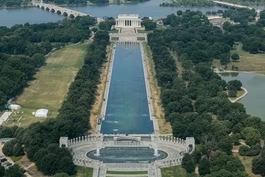
NICK SCHIFRIN: In the day's other headlines: The Lincoln Memorial Reflecting Pool here in Washington is set to undergo more repairs just days ahead of America's 250th anniversary.
That's according to President Trump, who has repeatedly claimed, without evidence, that vandals caused the algae blooms and peeling paint that have plagued the pool since its renovation.
Here's Stephanie Sy.
STEPHANIE SY: Green murky water and floating chunks of paint.
This is the Lincoln Memorial Reflecting Pool just weeks after a renovation project that has cost taxpayers millions of dollars and stirred up political controversy.
DONALD TRUMP, President of the United States: We had vandalism.
STEPHANIE SY: In the Oval Office today, President Trump repeated that vandals are to blame for the damage and said there's photo evidence.
DONALD TRUMP: We have a, I think, 290-, 300-foot slit right through it, probably a box cutter or a knife of some kind.
STEPHANIE SY: Authorities say they have arrested at least five people and handed out citations to several others, among those arrested, former U.S.
Olympian David Hearn, who is facing a destruction of government property charge.
He says he was just touching lining that was already floating in the water.
SARA BRONIN, George Washington University: I don't think it's something that will stand up in court.
STEPHANIE SY: Sara Bronin is a law professor at George Washington University who specializes in historic preservation and property law.
SARA BRONIN: The kinds of activities that the passersby are accused of doing, again, dipping their hands into the water, merely touching some of the material that has fallen off of the bottom of the pool, are really not the kinds of activities that, at least based on my review of case law and understanding of the statute, have ever really been prosecuted.
DONALD TRUMP: It was in terrible shape.
It was filthy dirty.
STEPHANIE SY: The president unveiled plans to clean up and coat the pool's surface in what he called American flag blue earlier this year, estimating it would cost up to $2 million.
Once water started flowing back in, records revealed nearly $15 million were rewarded for the project to companies with only limited experience with federal contracts.
Aerial images of the pool showed a transformation from deep blue to murky green in the days that followed and lining peeling from the floor.
The pool quickly became a spectacle, drawing a handful of self-styled pro-algae demonstrators and many more frustrated taxpayers.
ROBERT DALE, Visitor From Colorado: I want my money back after seeing this.
I think that this is -- it was a huge waste of money to begin with.
And I think our resources could be used a lot better elsewhere.
STEPHANIE SY: Crews have been working to remove the green goop with vacuum pumps and strainers.
STEVE GOODALE, "Swimming Pool Steve": It's called new pond syndrome.
STEPHANIE SY: Pool expert and YouTube personality Steve Goodale, better known as Swimming Pool Steve, says the algae is a typical occurrence for freshly filled ponds.
But the damage to the surface indicates potential issues with the bond layer applied between the old and new finishes.
STEVE GOODALE: If you are deficient or insufficient with your surface preparation of the substrate before you apply this product, man, you are in for a bad time.
And what would that look like if you were to see that?
Well, it would basically look like it would start peeling off in sheets.
STEPHANIE SY: President Trump says the new repairs are set to begin immediately.
For the "PBS News Hour," I'm Stephanie Sy.
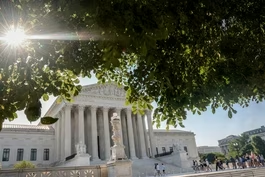
NICK SCHIFRIN: Also today, the Supreme Court reinstated a murder conviction in the case of Etan Patz, the 6-year-old boy who went missing in New York City in 1979.
In a 6-3 decision, the justices reversed a lower court decision that overturned the conviction of Pedro Hernandez, who admitted to the crime and was convicted of kidnapping and murder.
But Hernandez's lawyers have said his confession was due to a mental illness.
Patz vanished while walking to a Manhattan bus stop.
His disappearance helped launch a movement to find missing children and he was among the first to appear on milk cartons.
Across the Midwest, a series of tornadoes claimed at least three lives, leaving homes in tatters and tens of thousands without power.
Eyewitness footage caught the tornadoes tearing through fields and communities in Indiana and Illinois yesterday.
In Sedgwick County, Kansas, a man was killed when his home was blown off its foundation.
Meantime, out West, firefighters are battling a massive wildfire near the town of Eureka, Utah.
All 1,000 residents have been forced to evacuate.
And parts of Sedona, Arizona, were also evacuated as dozens of wildfires raged across the country and across the Southwest under hot and dry conditions.
In Colombia, a Trump-backed political outsider looks set to be the next country's next president, amid a broader wave of far right candidates across Latin America winning elections.
As of now, Abelardo Gabriel de la Espriella holds a razor-thin lead over his progressive opponent with nearly all the votes counted.
The business owner and lawyer has never held office.
Nicknamed The tiger, de la Espriella has promised to crack down on crime and ease business regulations.
Last night, he claimed victory and pledged to govern for all Colombians.
ABELARDO GABRIEL DE LA ESPRIELLA, Colombian Presidential Candidate (through translator): For those who voted for me and for those who chose another candidate, there will be no winners or losers.
There will be no reprisals, no persecution, because in a democracy there are no irreconcilable enemies.
NICK SCHIFRIN: His opponent, Ivan Cepeda, called the count -- quote -- "unofficial and nonbinding" and said he will challenge the results.
In the Democratic Republic of the Congo, authorities say the number of confirmed Ebola cases is now more than 1,000, with at least 254 deaths.
The virus has now spread to a third displacement camp in the east of the country, killing an 18-month-old girl.
Health officials say about 100 people have recovered since the outbreak was declared last month, but they add that contact tracing remains a problem and the peak of the outbreak is still to come.
Turning to the World Cup, Lionel Messi is now the all-time leading scorer in tournament history.
Argentina's superstar overcame a missed penalty kick early on to score his 17th and 18th goals in his team's win over Austria.
The defending champions now advance to the knockout rounds.
One team still aiming to advance, Norway, is looking to ride a wave of fan support, with supporters performing their Viking Row in New York's Times Square.
Norway takes the pitch against Senegal tonight.
On Wall Street today, stocks ended mixed as big tech shares struggled.
The Dow Jones industrial average added nearly 150 points.
The Nasdaq dropped 350 points, or about 1.33 percent.
The S&P 500 also ended lower.
And the music industry lost a titan today.
Clive Davis nurtured artists across nearly every major genre for more than half-a-century.
It was once said Clive Davis lived for 3.5 minutes of magic.
From the debuts of Whitney Houston to Alicia Keys, he shaped and signed superstars, Bruce Springsteen, name-dropped by Aerosmith.
Davis was himself a star, an unparalleled hitmaker.
He rocketed to the top of the industry and stayed there for almost 70 years.
Davis grew up in Brooklyn the son of a traveling tie salesman.
CLIVE DAVIS, Record Producer: Never knew I had ears.
Never knew that I could hear a hit record, never knew that I could discover an artist.
But this is one of the lucky breaks that occur in life.
NICK SCHIFRIN: He got a scholarship to Harvard to become a lawyer and started in Columbia Records' legal department at the age of 28.
He rose to become its president thanks to his -- quote - - "golden ear" and struck gold, embracing the rock 'n' roll revolution, signing artists including Janis Joplin.
CLIVE DAVIS: I mean, it really raised the hair on your arms and sent those proverbial tingles up your spine.
But there are epiphanies that can happen in life that change you.
And this was an epiphany for me.
NICK SCHIFRIN: His career changed throughout, and at times he became a lightning rod.
In the 1970s, Columbia Records fired him and accused him of stealing money.
He was charged on a number of counts and indicted on tax evasion.
He also clashed with some of his artists, but he always said his focus was the songs.
Across genres and decades, he once said: "I don't look for hit records.
I look for stars," Billy Joel, revitalizing the career of Aretha Franklin, and embracing hip-hop and R&B.
CLIVE DAVIS: This was a golden era for the music industry.
It was certainly a golden era for me.
NICK SCHIFRIN: A music titan who helped provide the soundtrack of so many people's lives, Clive Davis was 94 years old.
Still to come on the "News Hour": a new Justice Department memo questions decades of protections for people with disabilities; Tamara Keith and Amy Walter break down the latest political headlines; and the life and legacy of the late Federal Reserve Chairman Alan Greenspan.
NICK SCHIFRIN: A recently released Justice Department memo questions decades of protections for Americans with disabilities.
It's the latest effort by the Trump administration to shift longstanding practices for the disability community.
Ali Rogin has more on potentially landmark changes.
ALI ROGIN: Nick, the new memo is one of several attempts to change services and policies dedicated to people with disabilities.
The DOJ says states aren't required to provide home and community-based services that have long kept disabled Americans out of institutions if they would benefit from these other services.
And as the administration seeks to shutter the Department of Education, it's moving key responsibilities to agencies which disability advocates say are less equipped to handle them.
For perspective on what these actions mean for the disability community, I'm joined by Maria Town.
She's president and CEO of the American Association of People With Disabilities.
Maria, you are on the move today.
Thank you so much for taking the time to speak with us.
I first want to ask about this DOJ memo which really provides a new interpretation of these existing laws and a Supreme Court decision that reaffirmed what we have understood to this point to be the rights afforded to people with disabilities.
Can you just walk us through what those existing statutes are?
MARIA TOWN, President and CEO, American Association of People with Disabilities: So, in the Americans With Disabilities Act, which turns 36 six next month, there is an integration mandate.
And the Olmstead decision is a Supreme Court decision that turns 27 years old today that affirmed the integration mandate in the Americans With Disabilities Act.
The Olmstead decision stated that people with disabilities had to be served in the most integrated setting whenever possible.
What this means in practice is that states cannot forcibly institutionalize people with disabilities, whether that be in nursing homes, state psychiatric facilities, or in other institutional settings.
And so this memo from the Department of Justice, which says that Olmstead is not enforceable, completely goes against all previous legal precedent.
And it also goes against the will of Congress and the will of the Supreme Court.
ALI ROGIN: So if states no longer feel obligated because of this DOJ legal opinion, which we should mention is not a law, but could have far-reaching implications anyway, if states don't feel obligated to provide these services to people who would benefit from them, rather than go into an institution, what does that mean for the people who rely on home and community-based services?
MARIA TOWN: This means that people's ability to live in their homes and in their communities and with their families and friends that they love is in jeopardy.
If states decide not to follow decades of legal precedent and existing civil rights, it means that people with disabilities may be forced into institutions, instead of being provided with services that allow them to thrive in their communities.
It may also mean that people's health suffers.
And in the worst-case scenario, it means people will die.
We know that people with disabilities and older adults have better outcomes and live longer lives when they are served in the community and not in institutions.
So this could have extremely dire consequences for many people and their families across the country.
ALI ROGIN: Separately, Maria, the administration is taking steps to move oversight with special education from the Department of Education to HHS.
Here is what Education Secretary Linda McMahon said recently about these changes -- quote -- "By closely partnering with HHS, we will align federal services to improve academic outcomes, strengthen access to programs and information, and support people with disabilities so they can gain self-sufficiency, life tools and meaningful employment that they need to succeed in their lives."
How does your group see it?
MARIA TOWN: This move basically re-medicalizes the education of students with disabilities.
Putting special education in education asserts that students with disabilities have a chance at mainstream curriculum, at developing critical thinking skills, and in participating in the classroom, mainstream classrooms with their non-disabled peers.
We see this as a resegregation of students with disabilities, when, literally for the past 50 years, the standard has been to serve students with disabilities in the least restrictive environment and to ensure that students with disabilities have a free and appropriate public education.
We are concerned that the public education students with disabilities will receive will no longer be appropriate because it will no longer be a meaningful education.
ALI ROGIN: When we see the government focusing on changes to policies and services that affect children and adults with disabilities, what are the stakes for the wider disability community here?
MARIA TOWN: These changes, both the change in education coupled with the DOJ memo, basically put our nation back at least 50 years, if not more.
We are worried that we will see the progress that's been made on disability rights and on the quality of life of disabled people, whether they're young or old, erode very, very quickly, and that hard-fought progress will be lost.
ALI ROGIN: Maria Town, president and CEO of the American Association of People With Disabilities, thank you so much.
MARIA TOWN: Thank you.
NICK SCHIFRIN: The war in Iran has opened new cracks in President Trump's relationship with GOP leaders on Capitol Hill, and Democrats face their own family feud this week as New York's primaries pit progressives against moderates.
Here to reflect on that and the Reflecting Pool is our Politics Monday duo, Amy Walter of The Cook Political Report With Amy Walter and Tamara Keith of NPR.
Thanks, guys.
Welcome back.
AMY WALTER, The Cook Political Report: Hello.
NICK SCHIFRIN: Tam, let me start with you.
You have got high-profile Republican allies questioning the Iran memo of understanding, say it's weak.
And there's also spy power negotiations at a standstill.
Is this a GOP Conference now pushing back or not?
TAMARA KEITH, National Public Radio: I think that we need to wait a little while to see whether they are rhetorically pushing back or whether they're actually going to take votes or do more substantive things to push back on the president.
They certainly have -- some of them have certainly expressed displeasure with the Iran deal, with President Trump, like, temporarily pulling his nomination for the director of national intelligence or telling him not to show up for his confirmation hearing.
There is a big well of frustration with Republicans towards the president.
There's a big well of frustration from the president towards Republicans, insisting that they do all kinds of things to pass the SAVE America Act... TAMARA KEITH: ... which is a measure that would require voter I.D., proof of citizenship, and also would really limit mail ballot, mail voting, which a lot of Republicans actually like.
He's putting a lot of pressure on Senate Republicans.
He's actually headed up to the Hill this week to meet with some of these Senate Republicans.
It's just not clear that they can give him what he wants, but it's also not clear how hard they're ultimately going to push back against him.
NICK SCHIFRIN: Amy, I wonder how much political pressure there is from people, so to speak.
Let's look at the polls.
AMY WALTER: The people.
NICK SCHIFRIN: The people.
"PBS News Hour"/NPR/Marist poll released last week found the president with the lowest approval rating of his second term, 36 percent, only 33 percent approving of his handling of the economy, a new low for him as president.
And 78 percent of Americans say gas prices are straining their household budget.
How much of this is actual pressure?
AMY WALTER: So, here's where this Republican rift is really interesting.
As we have been discussing and you know very well, there's definitely a rift ideologically on Capitol Hill between those maybe who are more hawkish, who would like to see the United States continue down the path they were going on militarily and others who did not want to see that.
But, fundamentally, politically, if you're a Republican up for reelection in a tough district, here's a number you have been seeing since the war started.
The president's handling of the economy, the net unfavorable has gone up by about 10 points.
His net unfavorable on inflation has gone up close to 20 points.
That is a problem for you as a Republican running for reelection.
So this war ending, theoretically, is going to help bring those numbers back to hopefully a reasonable place if you're a Republican running for reelection.
But the challenge right now for Republicans in the sort of intraparty challenge, beyond this question of how hard do they push back Donald Trump, who still remains the kingmaker in the party, but is the lack of enthusiasm among the base.
And the one thing in that Marist poll that I looked at is people who identify as Republican, how strongly do they approve of Trump versus how many are just like, yes, he's OK, he's fine, I approve.
The strongly approved number since a year ago at this time among Republicans has dropped like close to 12 points on net.
And so what you're seeing, is Republicans aren't abandoning Donald Trump, but they're just not as enthusiastic about him, which means they may not be as enthusiastic to show up to vote.
NICK SCHIFRIN: Let's talk about Democratic primaries tomorrow.
Maryland, Utah hold primaries tomorrow.
South Carolina hold its primary run-off.
But most election watchers will be focused on New York, where New York City Mayor Zohran Mamdani is backing challengers against incumbent Democrats he sees as too moderate.
Amy, which races are you watching most closely?
AMY WALTER: Well, let's start with this.
Yes, it's New York.
I love the people of New York, but it is a very small segment of the electorate.
Now, no doubt, I think the national attention is going to be on Mamdani and whether he can use what he has right now, which is considerable political clout within the -- New York City's progressive movement, to get his preferred candidates over the line.
I'm intrigued by a couple of things.
The first is there's basically an A.I.
versus A.I.
battle taking place in one of the districts in Manhattan, Upper West, Upper East Side, where the folks from Anthropic who would like to see maybe more regulation are supporting a candidate who while in the state legislature actually passed some A.I.
regulation.
The folks at OpenAI don't really like the legislation that he passed and so they're spending against him, millions and millions of dollars for one seat in Congress.
The second thing I would say, there's a lot of talk about whether Mamdani succeeds.
What does this mean for the Democratic socialist movement?
Does this mean the party now, the Democratic Party, has moved so far left?
The race I think that's going to tell us much more about that is not happening until August.
And that's in Michigan, where a much more progressive candidate, sort of in the mold of some of these candidates that Mamdani is supporting, is facing off against two more sort of establishment type of Democrats in a swing state, in a state that's going to matter in the next upcoming presidential election as well.
So whether that candidate can win a primary and whether that candidate can win a general election will tell us a lot more about the strength of that wing of the party, the Mamdani wing or the Bernie wing than what's happening in New York.
NICK SCHIFRIN: In New York.
NICK SCHIFRIN: And, Tam, let me finally get you on the pool.
So the president seems... TAMARA KEITH: Why, thank you.
The president seems increasingly frustrated, shall we say, by his struggle to clean the pool, to convince the public that it was in fact saboteurs who created all that algae and all of the paint crusting.
Do these claims, do these arguments still land with the supporters?
TAMARA KEITH: Yes, and I will not be here to truth on or fact-check on epoxy and how it works, because that is not my expertise.
What I will say is that this Reflecting Pool has turned into yet another fight over Donald Trump.
And he made the pool about himself.
It is one of many projects that he has pushed through ahead of America 250.
He has put so much focus on it, so much, calling people into the Oval Office to show charts of the pool next to giant skyscrapers to say how big it is and on and on and on and all of these TRUTH Social posts and all of this.
That he's drawing so much attention to it, and it does raise the question, like, what about those kitchen table issues that Senate Republicans want to talk about, and this housing bill that has bipartisan support and just passed the Senate that could be something that they could run on?
AMY WALTER: Or talk about, which he has not talked about at all, right?
Yes.
TAMARA KEITH: Right, other than the pool.
TAMARA KEITH: Anything but the pool.
NICK SCHIFRIN: I have a feeling the pool debate will continue.
(LAUGHTER) NICK SCHIFRIN: Tamara Keith, Amy Walter, thanks, as always.
Appreciate it.
TAMARA KEITH: You're welcome.
AMY WALTER: You're welcome, Nick.
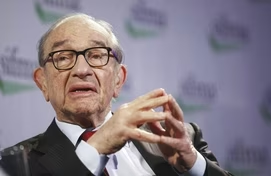
NICK SCHIFRIN: Today, the former Chairman of the Federal Reserve Alan Greenspan died from complications of Parkinson's at the age of 100.
Greenspan was widely considered the most powerful chair in modern times, serving for nearly two decades and largely presiding over a period of long prosperity.
He was frequently credited for helping manage inflation and foster growth.
But his strong beliefs in the free market and less regulation came under sharp criticism during the financial crisis.
Paul Solman has our remembrance.
PAUL SOLMAN: Alan Greenspan born in New York City in 1926, he told Jim Lehrer in 2007 that he was a whiz with numbers from the beginning.
ALAN GREENSPAN, Former Federal Reserve Chairman: The math was a big deal when I was very young and my mother used to parade me out.
She would have me add 45 and 162 in my head.
And I was a kid.
And... JIM LEHRER, Co-Founder and Former Anchor, "PBS NewsHour": You were just being kind of there to show off for.
ALAN GREENSPAN: Showoff.
JIM LEHRER: Yes.
Yes.
Yes.
ALAN GREENSPAN: I was a prop for parties.
JIM LEHRER: You were, yes.
PAUL SOLMAN: But Greenspan's first career was in music, studying at Juilliard and playing jazz professionally.
It wasn't long, though, before he gave up gig work to go back to numbers.
ALAN GREENSPAN: The best economic decision I ever made in my life was to decide to leave the music business and go into economics.
PAUL SOLMAN: Young economist Greenspan was soon drawn to Ayn Rand, fierce opponent of government regulation.
AYN RAND, Writer and Philosopher: Each man must live as an end in himself and follow his own rational self-interest.
PAUL SOLMAN: The author of "The Fountainhead" and "Atlas Shrugged" became Greenspan's mentor.
SEBASTIAN MALLABY, Author, "The Man Who Knew: The Life and Times of Alan Greenspan": He was almost a quasi-son, I would say.
PAUL SOLMAN: Sebastian Mallaby wrote a biography of Greenspan, "The Man Who Knew."
SEBASTIAN MALLABY: His roots were in the extreme libertarian anti-government circles.
And it's remarkable, therefore, that he spent most of his career very successfully in power, in politics, in Washington, and doing all the things that a libertarian might appall.
PAUL SOLMAN: Greenspan got into politics as an adviser to the 1968 Richard Nixon campaign, chaired the Council of Economic Advisers under President Ford, was a member of President Ronald Reagan's economic policy board.
GEORGE H.W.
BUSH, Former President of the United States: I, Alan Greenspan... ALAN GREENSPAN: I, Alan Greenspan... PAUL SOLMAN: And, in 1987, he became chairman of the Federal Reserve.
RONALD REAGAN, Former President of the United States: Chairman Greenspan will bring all his skill to bear upon the task of promoting our continued economic growth while keeping inflation low.
PAUL SOLMAN: He went on to serve five terms under four different presidents, trusted by Republicans and Democrats alike.
SEBASTIAN MALLABY: He just had this ability to go into a room in a one-on-one meeting, spout a bunch of very obscure data, and make the other person feel that the only way they could understand this stuff is they ask for his advice.
PAUL SOLMAN: Just two months after he became Fed chair, the stock market crashed by over 22 percent in one day, October 19, 1987.
SEBASTIAN MALLABY: And he issued a statement saying that the Fed would do what it took effectively to stabilize the markets, and that was enough to get the markets to bounce back.
PAUL SOLMAN: Whenever the stock market threatened to plunge again, says Mallaby: SEBASTIAN MALLABY: Greenspan seemed to pop up, say something which stabilized everybody's nerves, offer maybe to cut interest rates, and then that would make the markets go up again.
PAUL SOLMAN: Greenspan was credited with steering the Fed through two recessions.
For stabilizing global markets in the late 90s, he was lionized and praised for intervening again after September 11.
And, in fact, Greenspan's reign coincided with the longest economic expansion in U.S.
history, prompting the title maestro of the U.S.
economy.
SEBASTIAN MALLABY: He really was in a way that I think it's hard to imagine today a sort of technocrat hero.
PAUL SOLMAN: In one widely noted speech, Greenspan worried openly about the stock market overheating.
ALAN GREENSPAN: How do we know when irrational exuberance has unduly escalated asset values, which then become subject to unexpected and prolonged contractions?
PAUL SOLMAN: But, more typically, he kept markets up, though using opaque language to explain himself, especially when asked a question he didn't want to answer.
SEBASTIAN MALLABY: And so he would let his sentence sort of go around with multiple subclauses, and it would just be incomprehensible.
It was a tactic and a very successful one.
PAUL SOLMAN: No wonder his testimony before Congress could be hard to follow.
ALAN GREENSPAN: We, at the Federal Reserve, recognizing the powerful forces of productivity growth and global restraint on inflation, have not perceived to date the need to tighten policy in response to strong demand beyond what has occurred through falling inflation's upward pressure on the real federal funds rate and the modest increase in the nominal rate.
PAUL SOLMAN: As Greenspan later told Jim Lehrer: ALAN GREENSPAN: One of the problems that surprised me when I got into public life was that open, clear talk is -- often creates problems.
PAUL SOLMAN: In 2007, there were serious worries about a financial bubble.
Greenspan's response?
ALAN GREENSPAN: When you get bubbles like this, there is no way of diffusing them until the speculative fever breaks on its own.
PAUL SOLMAN: Soon after came the 2008 financial collapse, and Greenspan's reputation quickly reversed.
He was widely criticized for having allowed the housing bubble.
SEBASTIAN MALLABY: You know, financial bubbles are super disruptive, and to ignore them is a big mistake.
And Greenspan made that mistake.
And that is where I fault him.
PAUL SOLMAN: But when he appeared before a House committee in 2008, Greenspan sort of admitted that he'd put too much trust in markets to self-correct.
ALAN GREENSPAN: Those of us who have looked to the self-interest of lending institutions to protect shareholders' equity, myself especially, are in a state of shocked disbelief.
PAUL SOLMAN: For much of his tenure, Greenspan presided over a rapidly changing economy, one transformed by technology and globalization, but it was all part of a business he never tired of.
ALAN GREENSPAN: I have been an economist since the latter part of the 1940s.
And that's my profession.
I love it.
PAUL SOLMAN: Alan Greenspan is survived by his wife of 29 years, journalist Andrea Mitchell.
For the "PBS News Hour," Paul Solman.
NICK SCHIFRIN: Finally from us: melting ice.
The world's glaciers are receding at an alarming rate, losing more than a trillion tons of ice a year.
It's fueled in part by climate change and is driving sea levels higher, which could threaten coastal communities around the world.
Special correspondent Ben Tracy of Climate Central found a man who, alongside his family, has seen the melt firsthand every year for nearly half-a-century.
BEN TRACY: But it is stunningly beautiful out here.
MAURI PELTO, Glaciologist, Nichols College: This one, two miles we have done so far today, I mean, that was fun.
BEN TRACY: I'm not complaining.
I'm happy to take a walk in a glacier any day.
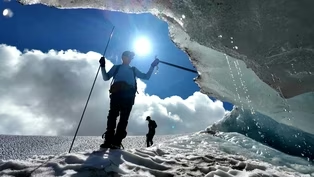
In the rugged North Cascade Mountains of Washington state... MAURI PELTO: ... my life has been shaped by this ice.
BEN TRACY: ... no one likely knows this glacier better than Mauri Pelto.
MAURI PELTO: We got 6,000 measurements on this glacier.
BEN TRACY: You have 6,000 measurements on this one glacier?
MAURI PELTO: Yes, at least.
BEN TRACY: Wow.
For more than 40 years, Pelto, a glaciologist, has returned to this remote wilderness, the crunch of footsteps in the snow now rivaled by the sounds of melting ice.
MAURI PELTO: It's always melting off.
The crevasses are changing.
We could hear the water flowing under our feet.
BEN TRACY: Yes, I mean, just standing here, you can hear it just running under our feet.
BEN TRACY: Pelto founded the North Cascades Glacier Climate Project in 1984 as a grad student.
He vowed to measure these glaciers every summer for 50 years.
So how deep is that?
MAURI PELTO: This is 9.5 feet.
So now we just do this over and over again all day long.
BEN TRACY: This is year 42.
How old were you when you decided to do 50 years of this?
MAURI PELTO: I was 22.
BEN TRACY: Twenty-two.
How old are you now?
MAURI PELTO: Sixty-three.
BEN TRACY: In that time, the glaciers have changed more than he has, shrinking by 40 percent.
Some have disappeared.
Pelto's work has been featured by NASA and fed into a worldwide glacier database.
So, of the 47 that you have studied and returned to over and over again, how many are gone?
MAURI PELTO: Twelve of them.
BEN TRACY: Twelve?
MAURI PELTO: Yes, and nine of them just in the last five years.
BEN TRACY: Wow.
Climate scientists say warmer summers and drier winters driven by our burning of fossil fuels are accelerating the loss.
Seven of the 10 worst years for glacier melt worldwide have happened since 2010, according to Climate Central.
Or just ask Mauri Pelto where the ice used to be.
MAURI PELTO: Almost 50 feet above my head just a decade ago.
BEN TRACY: A decade ago, this glacier would have been 50 feet above your head?
MAURI PELTO: Yes.
BEN TRACY: That much has been lost?
MAURI PELTO: Yes.
BEN TRACY: Glaciers are Earth's water towers, storing 70 percent of the fresh water supply, vital for drinking, farming and the health of many ecosystems.
As they melt, sea levels are rising and coastal flooding is getting worse.
MAURI PELTO: We're on Ptarmigan Ridge.
And that's a ridge that extends most away from Mount Shuksan to Mount Baker that we're looking at.
BEN TRACY: That is spectacular scenery up there.
MAURI PELTO: It is.
It's the highest mountain in the North Cascades.
BEN TRACY: On his annual treks to Mount Baker... MAURI PELTO: ... it feels like home.
BEN TRACY: ... Pelto has hiked nearly 6,000 miles and slept 800 nights in a tent.
MAURI PELTO: This is our kitchen.
We got our living rooms.
We got our picture window.
It's also one of those places that's really special to us as a family.
BEN TRACY: His son Ben, daughter Jill and now his 9-month old granddaughter Wren have joined him in the field.
JILL PELTO, Artist: Two feet.
MAURI PELTO: Two feet.
BEN TRACY: Jill Pelto has spent 17 summers by her dad's side.
MAURI PELTO: I get some measurements of the GPS along the blue ice.
BEN TRACY: But she doesn't just collect data.
As the project's art director, she paints it.
So these measurements that you and your dad are taking out here, eventually, some of those data points will go into your art.
JILL PELTO: Yes, exactly.
Data is a story about something in the real world, and that story has meaning and emotion.
And that's what I'm trying to bring into my art.
BEN TRACY: Her watercolor paintings are more than just beautiful landscapes.
They reveal the science.
Look closely and you see a bar graph of glacier decline in the North Cascades.
One piece showing temperature rise and ice loss made the cover of "TIME" magazine.
JILL PELTO: I think sometimes, when people see data, there's kind of this instant reaction.
And so it's not like the data is any different in my art.
But something about that combination maybe gets people to kind of put down that wall of like, oh, I can't understand this or this is not something I'm interested in.
BEN TRACY: The average person is not going to read a scientific report.
BEN TRACY: But they will see a painting.
JILL PELTO: Yes.
BEN TRACY: And it does impact you in a different way.
JILL PELTO: Yes, definitely.
BEN TRACY: Her art has given her dad a new way to share the story he's been recording for the past 42 years.
MAURI PELTO: There's nothing left of the glacier that was around that cave.
JILL PELTO: No.
BEN TRACY: What has this been like for the two of you to do this together?
I imagine something like this has to change your relationship in some way.
MAURI PELTO: We do it so seamlessly at this point, sometimes, I don't know what -- where I start and... (LAUGHTER) BEN TRACY: It feels like you're one team out here?
MAURI PELTO: Yes.
JILL PELTO: This bigger project, it just means so much to us and has shaped our lives.
So, sharing that every year is, yes, beyond special.
MAURI PELTO: Tomorrow, we go to the Rainbow Glacier.
BEN TRACY: And now Mauri Pelto has just eight summers left to fulfill his 50-year promise.
What do you think it's going to be like that first year you don't come out here?
MAURI PELTO: I don't know.
I can't remember what it was like to not come out here.
This landscape has been shaped by ice.
And so to understand the landscape and the ice, you really have to walk across it.
BEN TRACY: For the "PBS News Hour," I'm Ben Tracy with Climate Central.
NICK SCHIFRIN: And that is the "News Hour" for tonight.
I'm Nick Schifrin.
I hope you had a good day.
On behalf of the entire "News Hour" team, thanks for joining us.
Beset by algae, Reflecting Pool set to undergo more repairs
Video has Closed Captions
Plagued by algae and peeling paint, Reflecting Pool set to undergo more repairs (3m 31s)

DOJ memo questions protections for people with disabilities
Video has Closed Captions
New Justice Department memo questions decades of protections for people with disabilities (5m 49s)
The legacy of Alan Greenspan, 'maestro' of the U.S. economy
Video has Closed Captions
Remembering the legacy of Alan Greenspan, 'maestro' of the U.S. economy (6m 39s)

Music industry titan and hitmaker Clive Davis dies at 94
Video has Closed Captions
Music industry titan Clive Davis, who turned artists into stars across genres, dies at 94 (3m 21s)
News Wrap: SCOTUS reinstates murder conviction in Patz case
Video has Closed Captions
News Wrap: Supreme Court reinstates murder conviction in Etan Patz case (6m 52s)
Scientist tracks melting glaciers for nearly half a century
Video has Closed Captions
The scientist and his family tracking melting glaciers for nearly half a century (6m 11s)

Tamara Keith and Amy Walter on GOP’s new rifts over Iran
Video has Closed Captions
Tamara Keith and Amy Walter on new rifts between Trump and GOP leaders over Iran (8m 7s)

UK’s Starmer resigns, succumbing to political pressure
Video has Closed Captions
Starmer resigns as UK’s prime minister, succumbing to political pressure (3m 40s)
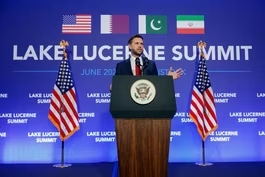
Vance touts progress in Iran talks as U.S. pauses sanctions
Video has Closed Captions
Vance touts progress in Iran talks as U.S. temporarily lifts oil sanctions (4m 21s)
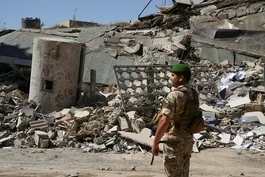
What the Iran talks mean for Lebanon and regional conflict
Video has Closed Captions
Two views on what the latest Iran talks mean for Lebanon and regional conflict (7m 55s)
Providing Support for PBS.org
Learn Moreabout PBS online sponsorship New Episode
- News and Public Affairs

Today's top journalists discuss Washington's current political events and public affairs.

- News and Public Affairs

FRONTLINE is investigative journalism that questions, explains and changes our world.
 New Episode
 New Episode
 New Episode
 New Episode
 New Episode

 New Episode
 New Episode
 New Episode
Support for PBS provided by:
Major corporate funding for the PBS News Hour is provided by BDO, BNSF, Consumer Cellular, American Cruise Lines, and Raymond James. Funding for the PBS NewsHour Weekend is provided by...