
June 11, 2024 - PBS NewsHour full episode
6/11/2024 | 57m 46sVideo has Closed Captions
June 11, 2024 - PBS NewsHour full episode
June 11, 2024 - PBS NewsHour full episode
Problems playing video? | Closed Captioning Feedback
Problems playing video? | Closed Captioning Feedback
Major corporate funding for the PBS News Hour is provided by BDO, BNSF, Consumer Cellular, American Cruise Lines, and Raymond James. Funding for the PBS NewsHour Weekend is provided by...
Support provided by:

June 11, 2024 - PBS NewsHour full episode
6/11/2024 | 57m 46sVideo has Closed Captions
June 11, 2024 - PBS NewsHour full episode
Problems playing video? | Closed Captioning Feedback
How to Watch PBS News Hour
PBS News Hour is available to stream on pbs.org and the free PBS App, available on iPhone, Apple TV, Android TV, Android smartphones, Amazon Fire TV, Amazon Fire Tablet, Roku, Samsung Smart TV, and Vizio.
Providing Support for PBS.org
Learn Moreabout PBS online sponsorshipGEOFF BENNETT: Good evening.
I'm Geoff Bennett.
AMNA NAWAZ: And I'm Amna Nawaz.
On the "NewsHour" tonight: Hunter Biden is found guilty of all three felony counts in his federal gun trial.
GEOFF BENNETT: Hamas responds to the latest Israeli hostage deal proposal, as the humanitarian situation in Gaza worsens.
AMNA NAWAZ: And a ballot measure in North Dakota seeks to block people over the age of 80 from representing the state in Congress.
JARED HENDRIX, Chairman, Retire Congress North Dakota: There is a lot of wisdom that comes with age.
But, of course, there's a limit to where we all face a decline of some kind at some point.
And so we wanted to try to find the right balance.
(BREAK) AMNA NAWAZ: Welcome to the "PBS NewsHour."
Another first in our country's history.
The child of a president was convicted today on three felony charges.
Joined by family and the first lady, Hunter Biden attended federal court in Delaware to hear the jury hand down a guilty verdict in the trial around his illegal gun possession.
GEOFF BENNETT: The jury found Hunter Biden guilty on two counts of making false statements regarding his drug use when filling out paperwork to purchase a firearm and guilty on one count of illegal possession of a firearm by a drug user or addict.
The jury deliberated for just under three hours.
Special counsel David Weiss, who prosecuted the case, spoke about the verdict earlier today.
DAVID WEISS, Special Counsel: Ultimately this case was not just about addiction, a disease that haunts families across the United States, including Hunter Biden's.
This case was about the illegal choices the defendant made while in the throes of addiction.
No one in this country is above the law.
Everyone must be accountable for their actions, even this defendant.
However, Hunter Biden should be no more accountable than any other citizen convicted of this same conduct.
AMNA NAWAZ: Hunter Biden released a statement after the verdict, saying -- quote -- "I am more grateful today for the love and support I experienced this last week from Melissa, my family, my friends, and my community than I am disappointed by the outcome.
Recovery is possible by the grace of God, and I am blessed to experience that gift one day at a time."
GEOFF BENNETT: NPR justice correspondent Ryan Lucas has been in the courtroom throughout the trial, and he joins us now.
So, Ryan, help us understand how the jury arrived at convictions on all three counts, because Hunter Biden's lawyers argued that he didn't knowingly violate the law because he wasn't actively abusing drugs at the time he filled out that form and purchased the firearm.
RYAN LUCAS, Justice Correspondent, NPR: Right.
Well, remember, this case all revolves around a gun that Hunter Biden bought in October of 2018 that he owned for 11 days, before it was disposed of in a trash can.
And so what prosecutors did is, they presented text messages that Hunter sent from 2015 through 2019 in which he talks about his drug use, in which he talks about buying drugs.
They also presented Hunter's own memoir in which he talks about his drug use, his downward spiral into addiction to crack cocaine, all establishing for the jury that Hunter was indeed addicted to drugs.
And then what they did is, they also brought in witnesses.
There were a couple of witnesses, in particular, that drew the jury's attention, I think.
There were three women who Hunter was romantically involved with at one point or another, his ex-wife, Kathleen Buhle, and ex-girlfriend, Zoe Kestan, and then Hallie Biden, who is Hunter's brother's -- late brother's widow.
And Kestan and Hallie Biden, in particular, testified to Hunter Biden's drug use in the period in question.
Kestan even talked about being with Hunter when he was cooking his own crack.
Jurors also heard from the gun store salesman who sold Hunter the gun.
They saw the form that Hunter filled out when he bought the gun, including the question that asked whether you are a user of unlawful substances.
And so I think all of that evidence together convinced the jury that the government had met its burden of proof beyond a reasonable doubt.
Now, Hunter Biden's attorney, Abbe Lowell, certainly tried to poke holes in the government's case, saying that they hadn't produced evidence that Hunter was using drugs at the time that he bought and owned the gun.
He tried on other grounds as well.
But, ultimately, as we see with this verdict today, it wasn't enough to convince the jury.
GEOFF BENNETT: Two of the gun counts carry a prison term as long as 10 years.
Another is punishable by as many as five years.
President Biden has already ruled out a pardon in this case.
Give us a sense of what information the judge will weigh as she considers sentencing.
RYAN LUCAS: Well, this sentencing is totally up to Judge Maryellen Noreika.
She was a Trump appointee.
She kept this trial moving swiftly, I will say.
Now, yes, the maximum sentence is a possible 25 years.
But Judge Noreika has discretion.
She will take into consideration the guidelines, guidelines sentencing.
Hunter Biden has no prior criminal history.
That will certainly weigh in his favor.
Judge Noreika can also take into consideration the fact that Hunter Biden is no longer an addict.
He's no longer addicted to crack cocaine.
She can take into consideration that he's not deemed a danger to the community.
So those are things that she can take into consideration when she considers a sentence.
The sentencing guidelines, from talking to former prosecutors, would appear to be somewhere between six and 21 months.
It's going to depend on exactly how it's calculated.
But she has a lot of possibilities in how ultimately she will decide to sentence this.
And, again, it is in her hands, that decision.
GEOFF BENNETT: And, Ryan, in the 30 seconds we have left, Hunter Biden scheduled to face a jury in Los Angeles in September on tax charges.
Is that right?
RYAN LUCAS: That's right.
There are nine counts in that in that tax case.
That case was also brought by special counsel David Weiss.
It's a case that Hunter originally was supposed to go to trial on just a couple weeks from now, in -- June 20.
It got pushed back to September.
So while one trial may be behind Hunter Biden, he's got another one in a couple months.
GEOFF BENNETT: That is NPR's Ryan Lucas.
Ryan, thanks so much.
RYAN LUCAS: Thank you.
GEOFF BENNETT: The verdict in the Hunter Biden case comes in the middle of his father's presidential reelection campaign and just two weeks after the presumptive Republican nominee, Donald Trump, was found guilty on 34 felony counts in his hush money criminal case.
AMNA NAWAZ: To unpack what all of this means politically, we're joined now by our White House correspondent, Laura Barron-Lopez.
Laura, let's start with President Biden.
Have we heard anything in the way of a response from him publicly?
And, also, what are you hearing from people close to him?
LAURA BARRON-LOPEZ: We have a response from President Biden.
He issued a statement today that reiterates much of his past comments on the matter.
In a statement, President Biden said that - - quote -- "I will accept the outcome of this case and will continue to respect the judicial process as Hunter considers an appeal.
Jill and I will always be there for Hunter and the rest of our family with our love and support.
Nothing will ever change that."
I spoke to a Democratic lawmaker close to the president, Amna, and they said that, essentially, President Biden has approached this as -- in two distinct roles, as a father who is trying to support his son and comfort his son and make sure that he continues on the path of recovery, but also as a president who needs to respect the judicial system, respect the rule of law and show that he is not involved in this whatsoever and this is an independent matter.
And then I also spoke to a longtime aide to President Biden, former aide, who said that this has -- this been weighing on President Biden, as well as Jill Biden, when it comes to the fact that it could have an impact, this verdict could have an impact on Hunter Biden specifically, and whether or not he is able to maintain his recovery.
There's concern about a potential relapse.
And so Jill Biden was there at the courtroom -- in the courtroom for much of the trial, showing not just a public display, but trying to show Hunter that she was there for him personally.
AMNA NAWAZ: What about the response from former President Trump, from Republican lawmakers, many of whom we saw decry the justice system after former President Trump's conviction?
What have we heard today?
LAURA BARRON-LOPEZ: A campaign spokesperson for President Trump issued a statement, saying -- quote -- "This trial has been nothing more than a distraction from the real crimes of the Biden crime family.
Biden's reign over the Biden family criminal empire is all coming to an end on November 5," again repeating baseless accusations against President Biden, claiming that he was involved in his son's business dealings overseas, which there has been no evidence to support those claims from President -- from former President Trump, as well as other Republicans.
It's important to note, Amna, the difference between the way Republicans reacted to the verdict in Trump's New York case versus the way Democrats have reacted to the Hunter Biden verdict.
And that's that Republicans called the system rigged when the verdict came down and said that they ultimately thought that there was a conspiracy theory.
Democrats, by comparison, have said that the judicial process needs to be respected.
AMNA NAWAZ: Laura, what about in -- what are you seeing in your reporting in terms of how voters are watching this trial, whether it matters to them?
LAURA BARRON-LOPEZ: Multiple Democratic lawmakers and pollsters I spoke to said that they don't think this is going to have an impact.
Biden's campaign doesn't think that this will have a seismic impact on the 2024 election.
When it comes to voters, they -- the ones that I have talked to, as well as the ones that I have witnessed in focus groups, they don't connect Hunter Biden's actions to President Biden.
Oftentimes, they will say things like, Hunter isn't president, or they will express sympathy for Hunter's addiction history and say that they have also experienced drug addiction in their family.
And so polling bears this out as well, Amna, which is that a majority of voters in polls have said that this doesn't impact who they decide to vote for, for president.
AMNA NAWAZ: Our White House correspondent, Laura Barron-Lopez.
Laura, thank you.
LAURA BARRON-LOPEZ: Thank you.
AMNA NAWAZ: In the day's other headlines: Just hours after his son Hunter was convicted on gun-related charges, President Biden addressed gun safety in a Washington speech today.
The president is looking to draw a line between himself and his rival, Donald Trump, on the issue of gun control ahead of the November election.
At an every Everytown for Gun Safety Action Fund event, Biden took aim at Trump's lack of action the issue when the former president was in office.
JOE BIDEN, President of the United States: More children are killed in America by guns than cancer and car accidents combined.
My predecessor told the NRA Convention recently he's proud that -- quote -- "I did nothing" on guns when I was president.
And by doing nothing, he made the situation considerably worse.
AMNA NAWAZ: For his part, Trump has vowed to roll back any gun control advances made during Biden's presidency.
The president of Malawi confirmed today that his vice president died in a military plane crash along with nine others.
Authorities say Saulos Chilima's flight departed the capital of Lilongwe yesterday morning.
The plane disappeared after it was unable to land at Mzuzu International Airport amid bad weather.
The president announced on state TV today that the aircraft's wreckage was found in thick forests with no survivors.
Chilima was first elected vice president in 2014.
He was 51 years old.
Ukrainian President Volodymyr Zelenskyy drummed up military and financial support from European leaders today at the start of a two-day conference in Berlin.
Host nation Germany promised to give Kyiv new air defense systems.
And Italy pledged $150 million to rebuild Ukraine's energy infrastructure, often targeted in Russian strikes.
The World Bank estimates that Ukraine will need $500 billion over 10 years to rebuild.
German Chancellor Olaf Scholz played up Ukraine's bid for E.U.
membership in making his pitch to the conference for more aid.
OLAF SCHOLZ, German Chancellor (through translator): The reconstruction of the country will require massive investment.
As a reminder, we are talking about the reconstruction of a future member state of the European Union.
AMNA NAWAZ: All this comes ahead of an international peace conference in Switzerland this weekend.
Nearly 90 countries are set to attend.
Russia was not invited.
China has arrested a suspect in the stabbing of four Americans on Monday in what police believe was a random attack.
Officials say the 55 - year-old suspect attacked the victims after colliding with them in a public park.
Their injuries are not life-threatening.
A Chinese tourist was also wounded in the attack.
The victims were instructors from Iowa's Cornell College who were teaching at a Chinese university in Jilin.
China's Foreign Ministry said the incident wouldn't affect exchanges between the two countries.
LIN JIAN, Chinese Foreign Ministry Spokesperson (through translator): Engaging in U.S.-China people-to-people exchanges is in line with both sides' interests.
China has always taken effective measures and will continue to take such measures to earnestly protect the safety of all foreigners in China.
AMNA NAWAZ: The U.S. State Department says it's in touch with local authorities about the attack and is monitoring the situation.
A federal judge ruled that the Florida law restricting gender-affirming medical care is unconstitutional.
The 2023 law blocked transgender minors from receiving treatment like puberty blockers and hormones.
It also limited the options for transgender adults to be treated.
Senior Judge Robert Hinkle wrote: "Transgender opponents are not free to discriminate against transgender individuals just for being transgender."
Governor Ron DeSantis said his office will appeal the decision.
Johnson & Johnson has agreed to pay $700 million to settle an investigation by 42 states into its marketing of baby powder and other talc-based products.
The deal resolves charges that the company told consumers the products were safe while knowing they had links to cancer.
In a statement, Colorado's attorney general, who is among the plaintiffs, said -- quote -- "Today's settlement sends a message that we will hold companies accountable for their deceptive and harmful conduct."
Johnson & Johnson did not admit to any wrongdoing.
And on Wall Street today, stocks ended mixed ahead of Wednesday's inflation data and Federal Reserve meeting.
The Dow Jones industrial average lost 120 points to close at 38747.
The Nasdaq added 151 points to close at a new record.
The S&P 500 also ended at an all-time high.
And a staple of the American summer is losing a key ingredient this year.
Joey Chestnut will not be competing at the Nathan's Hot Dog Eating Contest on July 4.
The 16-time champion found himself at odds with event organizers over his decision to endorse the Impossible line of vegan meat products.
In a statement, Major League Eating said -- quote - - "We are devastated to learn that Joey Chestnut has chosen to represent a rival brand."
MLE also called Chestnut -- quote -- "an American hero" and said they would welcome him back if he drops his other endorsement deal.
Still to come on the "NewsHour": President Biden courts Black voters as polls show support slipping in this key voting bloc; outbreaks of bird flu at dozens of dairy farms raise concerns the virus could spread more widely to humans; and despite a major U.S. manufacturing push for semiconductors, companies struggle to find workers to build them.
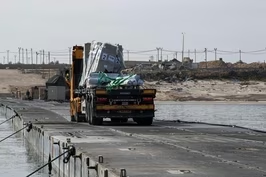
GEOFF BENNETT: Hamas formally responded to an Israeli-backed cease-fire proposal, but did not fully approve it, mediators announced today.
AMNA NAWAZ: Hamas' reply comes 11 days after President Biden revealed the three-phase cease-fire proposal that would begin with a temporary cease-fire.
Nick Schifrin is here now.
He's been following all of this.
So, Nick, what do we know about Hamas' reply?
NICK SCHIFRIN: A regional official, Amna, tonight tells me that Hamas' reply was -- quote -- "positive."
And Hamas and the militant group, Palestinian Islamic Jihad have released a statement tonight saying -- quote -- "The Palestinian delegation voiced willingness to deal positively in order to reach an agreement."
But it also described the -- quote -- "necessity of completely stopping the ongoing aggression against Gaza and the withdrawal of Israeli forces from the entire Gaza Strip."
And that suggests that Hamas' demanding the text matches what they are demanding in public, a permanent guaranteed cease-fire.
The deal only requires Israel to commit to a temporary cease-fire that would continue as long as the two sides are negotiating.
So, as John Kirby, the National Security Council spokesman, said today, it is positive that Hamas has formally responded.
It's not clear that it's enough to bridge the two sides' gap.
GEOFF BENNETT: And, Nick, what has Israel said in response?
NICK SCHIFRIN: Well, today, Secretary of State Antony Blinken said that Prime Minister Benjamin Netanyahu committed to this deal.
It is, of course, an Israeli-backed deal.
But Netanyahu continues in public to vow to destroy Hamas militarily.
U.S. officials remain concerned, Geoff, that both sides are more interested in blaming the other for the failure of these talks than they are for actually making progress.
But U.S. mediation will continue, U.S. diplomatic pressure will continue, because, frankly, U.S. officials think this is really the only way to end the war that has devastated so much of Gaza.
Today, the U.S. committed another $404 million in humanitarian assistance, despite so many limitations on aid delivery that have left Gazans largely on their own.
Her stage is Gaza's ruins, and her audience is Gaza's displaced children.
RAHAF NASSER, Medical Student: I lost all my memories, all my childhood toys in my home, so I borrowed my father's friend's guitar to continue to deliver my message to the world.
NICK SCHIFRIN: Before the war, 19-year-old Rahaf Nasser was studying medicine.
Now she tries to heal with music.
RAHAF NASSER: Our children love to live, love to be alive, to play with each other.
Here, we cannot do anything of that.
They cannot do anything of that.
They just want peace.
ANTONY BLINKEN, U.S. Secretary of State: There is no time to waste, given the hell that hundreds of thousands of Palestinians are enduring every single day.
NICK SCHIFRIN: Today, Secretary of State Antony Blinken addressed a conference designed to surge aid to Gaza.
Martin Griffiths is the U.N.'s humanitarian coordinator.
MARTIN GRIFFITHS, U.N. Undersecretary-General for Humanitarian Affairs and Emergency Relief Coordinator: There was a unanimous horror at the vast toll of death, injury, destruction, displacement, serial displacement, trauma and deprivation suffered by the people of Gaza in just nine months.
NICK SCHIFRIN: And the most vulnerable are Gaza's youngest.
At this makeshift school in Central Gaza, they learn to live.
But, in Southern Gaza, UNICEF says nearly 3,000 are at risk of dying, and across Gaza, 90 percent lack enough food.
Israel has opened the southern crossing Kerem Shalom, and hundreds of Israeli-sponsored trucks are entering.
But U.S. and Israeli officials say distribution inside Gaza is limited because there aren't enough trucks, and the Rafah Crossing remains closed, with aid trucks backed up in Egypt.
And so, at already overwhelmed hospitals, there's a shortage of generators and fuel to provide power and supplies to save the city.
And to discuss the medical crisis, as well as the overall humanitarian situation in Gaza, I'm joined by Avril Benoit, chief executive officer of Doctors Without Borders USA.
Avril Benoit, thank you very much.
Welcome back to the "NewsHour."
After this past Saturday's rescue of four Israeli hostages that Hamas says killed more than 270 people, about 700 patients arrived in the Al-Aqsa Hospital, where you have staff.
Your team was working there.
Who did they treat and what were their injuries?
AVRIL BENOIT, Executive Director, Doctors Without Borders USA: The injuries were horrific.
At Al-Aqsa Hospital, yes, there were 420 severely wounded that came in, dismemberments, severe trauma.
You had a lot of open fractures, shrapnel wounds, as you would expect, a lot of burn injuries, a lot arriving who were already dead wrapped in blankets, in plastic, 190 in that one day alone were brought to the hospital and confirmed as dead on arrival.
NICK SCHIFRIN: You have some 400 Palestinian and expat doctors, nurses and staff in Gaza.
Are they able, at this point, to deliver the health care that they want?
AVRIL BENOIT: No, certainly not.
And there isn't a humanitarian who will tell you that anything is near being acceptable.
And when we think back to the orders from the International Court of Justice back in January imploring and insisting that Israel make sure that humanitarian aid could reach people in order to prevent conditions of genocide, we have not really seen an improvement and, at various times such as since the beginning of June, a deterioration.
Unfortunately also is that these mass casualty influxes where you have got hundreds of people coming into a hospital, even a well-equipped major hospital in the United States that's properly staffed, has all that it needs, has electricity, clean water for cleaning up and so on, even they would struggle with the number of patients.
NICK SCHIFRIN: Hundreds of trucks are getting in to Southern Gaza via Kerem Shalom, as well as into Northern Gaza, half of which are facilitated by Israel itself.
And what U.S. officials and Israeli officials I talked to say is that the big problem is the lack of trucks that can actually distribute all of that aid inside of Gaza.
Is that something that you are specifically seeing, that some of this aid is arriving to the edge of Gaza, but not able to be distributed inside?
AVRIL BENOIT: Without a doubt.
You have got the shortage of fuel, which is a serious impediment for even the truck drivers that are willing to take the risks of going through so many volatile checkpoints, where anything can happen.
Sometimes, the violence is unpredictable.
And where there is a lack of respect for the delivery of humanitarian aid, the indiscriminate violence, the targeted violence against humanitarians, it's -- it makes for really difficult conditions, and it doesn't help to be blamed then by the Israeli propaganda saying, well, look, the humanitarians already been doing their job.
Well, ultimately, all the belligerents are responsible for creating conditions that would allow humanitarian aid to come in, in accordance with humanitarian law.
And that's just not what we're seeing.
NICK SCHIFRIN: When you refer to belligerents, are you speaking about the Israelis, Hamas, or both?
AVRIL BENOIT: Well, you're speaking of both.
And anyone that is carrying a gun essentially that's engaged in this war, when we call for a cease-fire, when we call for respect of civilian spaces, it is imploring all the fighting parties, the warring parties to respect the call for cease-fires.
NICK SCHIFRIN: Israeli and U.S. officials consistently say that they see Hamas fighters operating from U.N. schools, even the hospitals that we have been talking about.
Have you seen Hamas fighters use these hospitals as any kind of command-and-control or the source of fire at Israeli forces?
AVRIL BENOIT: We keep hearing these allegations, without much to substantiate them, in terms of our own experience of the hospitals where we're supporting.
These are sometimes vast structures.
They do have tunnels underneath for clinicians, for health care workers who are dealing with hundreds of patients.
What we see are just hospitals that are full of patients.
And a reminder to all those who justify these massacres, these attacks on civilian infrastructures on the basis that the space was militarized, civilian spaces are being militarized by all sides in this, both sides in this.
And it's not acceptable to then suggest that the protection of civilians, which is enshrined in the Geneva Conventions, doesn't apply because you might have something going on in the vicinity that is not under the control of those who are running the hospitals, for example.
There seems to be a disregard for civilians in this conflict that is shocking.
And we would just remind all the belligerents that they should respect those spaces, not attack them, stay clear of them, so that they can deliver the aid that people need.
NICK SCHIFRIN: Avril Benoit, chief executive officer of Doctors Without Borders USA, thank you very much.
AVRIL BENOIT: You're welcome.
AMNA NAWAZ: Primary voters in Maine, Nevada, North Dakota, and South Carolina will set their party's respective lineups for November's general election tonight.
But in one of those states, voters may also amend their Constitution to keep certain candidates off the ballot and out of Washington.
Lisa Desjardins explains.
LISA DESJARDINS: Across North Dakota's wide landscape, an unusual test of democracy's boundaries, on Tuesday's primary ballot, a potential age limit for the state's members of Congress.
JARED HENDRIX, Chairman, Retire Congress North Dakota: On every campaign, you're going to have, obviously, direct-mail postcards.
LISA DESJARDINS: Political consultant Jared Hendrix is leading the effort.
JARED HENDRIX: We do think that there is a lot of wisdom that comes with age.
But, of course, there's a limit, to where we all face a decline of some kind at some point.
And so we wanted to try to find the right balance.
We thought 80 was the balance.
LISA DESJARDINS: The result is Measure 1, an amendment to the state constitution which says members of Congress cannot be over 80 before the end of their term, meaning, to run for a full term.
A U.S. Senate candidate can be no more than 75 and a House candidate no more than 79.
To get it on the ballot, Hendrix, who is also running as a Republican for the state legislature, and others gathered and submitted more than 40,000 signatures.
How did you choose the age?
JARED HENDRIX: The reason we picked the age of 80 was simply that the support is so overwhelming at that point.
Some of the first people I talked to when I decided to take it on are my parents.
They're in their early 80s.
And I asked my dad: "How do you feel about this?
Am I crazy?"
And he said: "Son, at my age, I have got no business being in Congress."
LISA DESJARDINS: National polls show broad concern about age.
In a recent Pew Research Center survey, a whopping 79 percent overall, with little partisan divide, backed age limits for federal office.
One factor may be the presidential candidates.
In a February ABC News/Ipsos poll, nearly 60 percent said that both President Biden, age 81, and former President Trump, who turns 78 this week, are too old for another term as president.
Measure 1 in North Dakota does not apply to presidential candidates.
Hendrix says that was a practical legal choice.
But the candidates themselves have acknowledged age concerns.
QUESTION: Something the special counsel said in his description, you are a well-meaning elderly man with a poor memory.
JOE BIDEN, President of the United States: I'm a well-meaning, I'm an elderly man, and I know what the hell I'm doing.
DONALD TRUMP, Former President of the United States (R) and Current U.S. Presidential Candidate: I said to the doctor, who was Dr. Ronny Jackson, I said, is there some kind of a test, an acuity test?
And he said, there actually is.
And I got a perfect mark.
FMR.
SEN. STROM THURMOND (R-SC): There is nothing which compares to serving here.
LISA DESJARDINS: Aging in Congress is nothing new.
Former South Carolina Senator Strom Thurmond served beyond his 100th birthday.
But the U.S. Senate in particular is getting older as a group.
Current Iowa Senator Chuck Grassley is 90 years old, and 21 senators and representatives are in their 80s.
North Dakota's congressional delegation is relatively young in comparison, 67, 63 and 47.
JARED HENDRIX: We didn't want it to be targeting our current members.
It wasn't about any individual.
It's about the principle of the issue.
When people say that it's not a problem here, my response is, well, it's not a problem here yet.
DAVE PETERSEN, North Dakota Voter: I did vote against it.
JO PETERSEN, North Dakota Voter: And I voted for it.
LISA DESJARDINS: In Grafton, North Dakota, Dave and Joe Petersen are in their 70s.
They're very active.
She chairs the local hospital board, and he's running for a municipal judge.
DAVE PETERSEN: It's probably not as rigorous, for example, as being in Congress or anything like that.
But, yes, I'm older than I was five years ago.
LISA DESJARDINS: They agree on an urgent need for younger candidates, but Dave thinks voters, not a law, should decide about age.
DAVE PETERSEN: I don't think you can automatically say someone because of their age is unable.
It's true, but I think the voters need to decide that.
LISA DESJARDINS: Joe says the current presidential race convinces her otherwise.
JO PETERSEN: I don't know if it should go as far as the voter.
It's a frightening thing to me.
When I look at our two presidential candidates, I'm not sure in my heart if I could vote for either one of them.
And a lot of it has to do with age.
LISA DESJARDINS: While the Petersens are split, Tina Matz and Elizabeth Kensinger, experts with Boston College's Research on Aging Group, are on the same page.
CHRISTINA MATZ, Boston College: Overall, chronological age is not a good proxy for almost anything.
ELIZABETH KENSINGER, Boston College: There's just a fascinating ebb and flow of what we're best at different points in our life, such that a 40-year-old is going to have a different set of strengths and weaknesses than a 60-year-old, than an 80-year-old.
LISA DESJARDINS: Their research suggests older workers can draw on a deeper knowledge base and are generally more emotionally regulated than their younger peers.
Precision memory and processing do slip with advancing age, but Matz and Kensinger argue, symptoms should concern voters, not years.
CHRISTINA MATZ: Age is one of those last isms that still tends to be socially accepted.
And I think we stereotype ourselves in terms of age.
We make jokes about people's age.
And there's not a whole lot of credibility behind it.
LISA DESJARDINS: There is also, of course, a legal question.
Nearly three decades ago, the Supreme Court struck down term limits for federal lawmakers in 23 states.
In its 5-4 decision, the court determined that states could not impose stricter qualifications than the U.S. Constitution.
Legal experts we spoke with about the North Dakota case are skeptical of its courtroom chances.
JARED HENDRIX: Certainly not naive.
I mean, I suspect it would be challenged legally.
But I think it's a great question to ask.
Do we have a right as states to apply additional qualifications?
And we hope the courts would rule that way, but we will see what they do.
LISA DESJARDINS: Whether this survives a court challenge or not, the idea of an age limit for elected officials is broadly popular and bipartisan and increasingly a topic of conversation, not just in North Dakota.
For the "PBS NewsHour," I'm Lisa Desjardins.
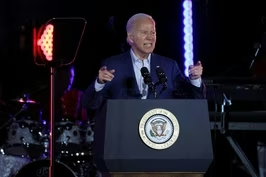
GEOFF BENNETT: The Biden campaign says it's going all in to shore up support among Black voters.
That's with polls showing him underperforming with the key Democratic constituency that helped deliver him the Democratic nomination and the White House in 2020.
President Biden and Vice President Kamala Harris hosted a Juneteenth celebration at the White House last night.
The president promoted his record to Black voters, while painting a contrast with right-wing Republicans.
JOE BIDEN, President of the United States: They're all ghosts in new garments trying to take us back.
Well, there are -- taking away your freedoms, making it hard for Black people to vote or have your vote counted, closing doors of opportunity, attacking the values of diversity, equity and inclusion.
GEOFF BENNETT: It's all unfolding as the Trump campaign tries to make inroads with Black men in particular ahead of November.
We're joined now by Emory University Professor Andra Gillespie, whose work covers African American politics.
It's so great to have you here.
ANDRA GILLESPIE, Emory University: Thank you.
GEOFF BENNETT: And starting with the caveat that the Black community is no more monolithic than any other community, what's your assessment of the Biden campaign's messaging to Black voters in particular, both in terms of what they're actually saying and the degree to which it's penetrating?
ANDRA GILLESPIE: Well, African Americans have complained for a long time that the Democratic Party takes them for granted.
So, because this group has historically voted for about 90 percent Democratic in the last 60 years, there's sometimes a tendency to ignore Black voters, to have very shallow interactions with them in late October before an election season.
And Black voters have been demanding attention to their issues and actually outreaching their communities that's meaningful.
The Biden campaign has tried to do that, so we have seen them engage earlier.
There have been questions about the modalities of this type of contact.
So is it the right type of contact?
And is it reaching all Black communities?
Perhaps, once upon a time, you could make a church visit or you could make certain types of overtures to Black communities that would be wide-reaching.
But the diversity of the African American community necessitates that you have a multifaceted approach and that you have multiple messages to reach the very types of Black voters and all of their concerns.
GEOFF BENNETT: As we mentioned, there are these polls that show President Biden losing support among Black voters.
The Biden campaign says that this narrative of this Black exodus is overblown and that the Biden campaign says that they have an infrastructure in place to keep Black voters on their side, effectively, that would not necessarily lend an opening to Donald Trump.
How worried should the Biden campaign be?
ANDRA GILLESPIE: Well, there are two sides to this.
On the one side, I think the Biden campaign is correct.
There's been a lot of national attention on survey subsamples of African American voters where we're talking about 100 to 300 hundred Black voters.
So we're talking about huge margins of error and very, very noisy data.
So just because you have a survey where there's a subsample of 200 Black voters who might say that 30 percent of them are voting for Donald Trump doesn't necessarily reflect to the larger African American community.
There needs to be more surveys with larger sample sizes that are nationally representative of Blacks to be more accurate.
Pew recently released one.
The number was at 18 percent, which is something that Democrats would be concerned about, but they can rebound from that.
They can do outreach in these communities.
And so I think the question is, do you sit on your laurels?
No Democratic campaign wants to get 77 percent of the African American vote, when they're used to getting 90 percent of the vote.
How do you get from 77 percent to 90 percent?
Part of that is outreach.
Part of that is recognizing that you still have time to invest in these communities.
And it's, how are you going to be responsive in terms of crafting a message that is actually going to resonate with these voters?
GEOFF BENNETT: Let's talk about Donald Trump because he is also trying to appeal to Black voters.
He held a rally in the Bronx, New York, late last month, and he touted his hard-line immigration proposals.
Here's a bit of what he had to say.
DONALD TRUMP, Former President of the United States (R) and Current U.S. Presidential Candidate: African Americans are getting slaughtered.
Hispanic Americans are getting slaughtered.
And these millions and millions of people that are coming into our country, the biggest impact and the biggest negative impact is against our Black population and our Hispanic population, who are losing their jobs, losing their housing, losing everything they can lose.
GEOFF BENNETT: More recently, he has talked about his criminal indictments, his felony conviction, and has said that would be in some way appealing to Black voters, which a lot of people saw as offensive on its face.
What do you make of his approach?
ANDRA GILLESPIE: He sometimes pulls on threads that are accurate within African American communities, but then he usually takes them out of context, and so that he's missing an opportunity to actually effectively message to Black communities.
So, on immigration, there are African Americans who have concerns about undocumented immigration.
My friend Neon Bicardi (ph), at the University of Maryland wrote a great book about this, right?
But their reasons for opposing immigration are not the same reasons that whites oppose immigration.
And so you have to be really sensitive to the message and not paint with a broad brush.
The concerns that Trump is trying to raise about criminal justice reform are so personalized to himself that it ignores the larger structural problems that he could address and use his own story to talk about effectively.
But he's not doing that, right?
He's not talking about the things that he did do during his term as president in terms of the FIRST STEP Act, in terms of trying to sort of dismantle certain types of structural aspects of the criminal justice system.
That would actually be a more effective message that he seems to be incapable of doing.
Instead, he plays to tropes, and they end up being offensive and turning off more voters than they will attract.
GEOFF BENNETT: What about Black men, in particular, this narrative, this notion that Black men are somehow peeling away from President Biden and sort of turning toward Donald Trump?
Is that real?
Is there polling to back that up?
ANDRA GILLESPIE: Again, context is important here.
There has long been a gender gap in African American communities.
In an article I co-wrote with friend Nadia Brown at Georgetown, we can trace it back.
We traced it back to 1972.
The only time where you don't really see a gender gap is in the 2008 election with Barack Obama.
So while the gender gap kind of ebbs and flows and it gets bigger over time, it's always been there.
Black women have been more Democratic than their Black male counterparts for the last 50 years.
So, one, he's already playing the kind of natural tendencies in African American voting behavior.
It is true that Republicans have tried to reach out to African American men to try to peel off support.
And there is the possibility that Trump might actually be effective in being able to have some success at the margins.
But this does not constitute, as of right now, a sea change or a realignment.
It's going to take decades of incremental, consistent erosion in Black support overall for us to say that we're seeing a realignment of Black voters.
GEOFF BENNETT: Andra Gillespie, thanks so much for that context.
We appreciate it.
ANDRA GILLESPIE: Thank you.
Thank you.
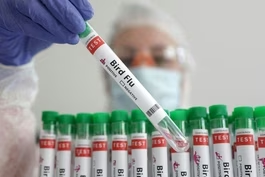
GEOFF BENNETT: The H5N1 virus, also known as bird flu, is spreading rapidly among dairy cows.
It's been found in over 85 herds across 12 states.
At least three farmworkers have now been sickened by the virus.
And while public health officials say the risks to humans remain low, concerns are growing.
William Brangham has more.
WILLIAM BRANGHAM: So, how serious is this threat?
And are we doing enough to keep our eyes on this evolving virus?
To answer that, we are joined by Rick Bright.
He's the former head of BARDA, which is the U.S. government's lead agency for developing countermeasures for public health emergencies.
Rick Bright, thank you so much for being here.
You have called this a -- quote -- "dangerous inflection point" that we are in right now.
And you recently wrote -- quote -- "that if we keep ignoring the warning signs, we have only ourselves to blame."
What are the warning signs that you're seeing right now?
And how are we ignoring them?
DR. RICK BRIGHT, Former Director, Biomedical Advanced Research and Development Authority: Well, William, thanks for bringing more attention to this crisis, this situation.
We're seeing more and more animals, mammals, in particular, infected with this virus, and, clearly, sustainability to infect dairy cattle and spread from cow to cow.
And we know that people are really in close contact with these mammals.
And the more mammals are infected, the more contact we have with them, the more risk we have of infecting people.
And we're starting to see that it happened over the last couple of months with three human cases.
WILLIAM BRANGHAM: So we have seen these several farmworkers that you mentioned.
The CDC mentioned that this most recent farmworker, the one in Michigan, exhibited somewhat different symptoms than the others had.
Why is that particularly troubling?
RICK BRIGHT: Well, it's really important to understand that, to spread this virus efficiently from person to person, it's going to have to get in the respiratory tract.
And this latest infection in this patient showed that the patient had respiratory symptoms, meaning he was coughing, for example.
The two prior cases only had an eye infection.
It's much harder to spread a virus from an eye infection than it is from a respiratory infection, when you're coughing.
And so that is really an important development causing great concern.
WILLIAM BRANGHAM: And we have not yet seen any transmission from a human to a human.
All these cases have thus far been one or more animals to one human, correct?
RICK BRIGHT: Well, William, that's where I'm really concerned.
When I talk about we're not doing enough about it is, we really don't know how many humans have been infected with this virus.
And, today, there's been very limited to almost no serology testing done among any of the cases, the close contacts on the farm or their family members.
So it's really hard for us to know how many people have been exposed, and if there really is any human-to-human transmission or not.
WILLIAM BRANGHAM: And how do you explain that?
Why is it -- given that there are certainly enough researchers like yourself within the federal government who understand the potential here, why isn't that we're not doing more testing?
RICK BRIGHT: Well, we're finding that it's not always a case of not having enough tests in this situation.
But we have tests at the CDC, for example.
But the problem is getting access to the workers to test them.
So there are a number of issues and barriers that we're encountering.
And some of those have to do with the work force itself.
A large part of the work force on the dairy farms are undocumented immigrants.
And there's concern among those workers about being tracked or traced by the government.
And they might have to face immigration issues.
There are also concerns of the farmers and the people who own the farms, if the federal government or even state government were to come onto the farm, find a widespread outbreak in animals or people, have to shut down the farm, perhaps lose their work force and lose their income.
And there's not enough incentives to really break through those barriers right now.
WILLIAM BRANGHAM: And what would those incentives be?
I mean, I understand the farmer not wanting to have a scarlet letter put on their herd or on their farm.
And I understand what you're saying about the workers as well.
But how do we incentivize people to do the right thing to keep us all safe?
RICK BRIGHT: We're going to have to put some measures in place to ensure that the workers who get tested have the right care that they need, the right health care, because many of them don't have health insurance.
If they lose work because they're sick and we want them to not go back into that environment, then there should be compensation for sick leave and for those lost wages.
If a farmer has to put down a cow or keep more cows out of the commission longer, instead of putting them back on the milking line while they might still be infected, then we have to compensate the farmers for the loss of that cow or, for the loss of that milk production.
WILLIAM BRANGHAM: So the government says that the milk supply is safe, that pasteurization kills the virus.
They say that the human cases we have seen don't indicate that the threat to us as humans is severe.
How worried are you that this could become the next pandemic?
RICK BRIGHT: Well, I'm more worried right now, William, about the information and the data that we're missing than the data that we have.
So if you just looked on the surface - - and that's really all we're seeing right now -- there may not be too many immediate flares of concern of a forest fire or so.
But if you look beneath that surface, if we do more testing, we might see that this virus is changing in remarkable ways that would give it an advantage if it were to really infect people and transmit easily person to person.
Since we're being blindfolded in this battle right now, I'm really concerned that the virus is winning the game and getting ahead of us.
WILLIAM BRANGHAM: All right, Rick Bright, the CEO of Bright Global Health, thank you so much for being here.
RICK BRIGHT: Thank you, William.
AMNA NAWAZ: The CHIPS Act passed in 2022 has led to a surge in funding for semiconductor manufacturing in the U.S. and a real demand for qualified workers.
These chips power everything from our phones and cars to advanced fighter jets and artificial intelligence.
Now some colleges and universities are trying to help fill those jobs and create the work force of the future.
Stephanie Sy has the story for our series Rethinking College.
STEPHANIE SY: Before becoming a manufacturing technician at intel's campus in Chandler, Arizona, Tarji Borders didn't even know what a semiconductor was.
TARJI BORDERS, Manufacturing Technician, Intel: I had no idea.
All I knew was chips.
STEPHANIE SY: Borders had a background in software development, but after a year of being unemployed, the single mom was looking for new opportunities.
TARJI BORDERS: I saw the advertisement, Fresh Start, semiconductor program, specifically for women.
STEPHANIE SY: It was for a two-week crash course in becoming one of the technicians responsible for the machines that make chips, a partnership between a local community college and a nonprofit, Fresh Start Women's Foundation.
TARJI BORDERS: And so, in two weeks, if you can go from unemployed trying to raise a family to employed, it really is a life changer.
STEPHANIE SY: After the intensive training program, she got a job at Intel on the night shift, allowing her to balance parenting and work.
Semiconductor techs make on average about $48,000 a year, according to the Bureau of Labor Statistics.
TARJI BORDERS: For a lot of people who may not have degrees or may not have a lot of experience, work experience, or maybe somebody that just wants to change careers, that opportunity is there in the semiconductor industry, because it doesn't really matter what your background, is.
If you're willing to work and learn the basics, you can get work.
STEPHANIE SY: One industry report predicts 115,000 additional semiconductor jobs will be added nationwide by 2030.
But based on current degree completion rates, more than half of those jobs, including most of the technical roles, risk going unfilled.
We recently obtained limited access to the sprawling manufacturing facility built by Taiwan Semiconductor Manufacturing Company, or TSMC, in Phoenix.
It will eventually have three factories, or fabs, producing semiconductors.
Greg Jackson is director of facility operations.
GREG JACKSON, Taiwan Semiconductor Manufacturing Company: We have high-paying jobs that are extremely interesting.
The manufacturing side of it is not what you would have seen 30 or 40 years ago from the term manufacturing.
This is not put peg in hole, move product down the line.
There's a lot of advanced skills that come in place to not just operate facilities, but operate the manufacturing side of it as well.
STEPHANIE SY: At Intel, Cindi Harper, vice president of talent planning and acquisition, says the company has invested hundreds of millions of dollars into work force development over the last five years.
CINDI HARPER, Vice President of Talent Planning and Acquisition, Intel: Across Arizona, New Mexico, Oregon and Ohio, that will create about 10,000 jobs for Intel.
STEPHANIE SY: OK. CINDI HARPER: And a majority of those are all in the factory; 70 percent of our factories are technicians.
That is the bread and butter of Intel.
STEPHANIE SY: Here at Rio Salado College in Tempe, it's the last day of the microelectronics and nano manufacturing certificate program.
The course is specifically designed for veterans, and it's free, only 12 weeks long.
For graduates like former Army avionics mechanic Daniel Moreno, it's a quick path into the semiconductor industry.
DANIEL MORENO, U.S. Army Veteran: I have already applied out to Intel and then my next one, of course, is all the big manufacturers.
STEPHANIE SY: Rick Vaughn, faculty chair of STEM initiatives, says the community college offers a low barrier to entry into the field, but he says, until recently, semiconductors jobs have flown under the radar.
RICK VAUGHN, Rio Salado College: When you say, I can go work at Google or I can go work at Microsoft -- my daughter works at Microsoft -- you know, that's a tangible thing, and they see other people working in that industry.
So I think we need to change that a little bit by giving them role models, tours, opening the doors a little bit to... STEPHANIE SY: You got to make semiconductors sexy somehow.
RICK VAUGHN: Right, exactly.
STEPHANIE SY: To fill the massive need for technicians, experts say the industry also needs to train and recruit a diverse applicant pool, more women, and underrepresented racial groups.
Two-thirds of the students in the Maricopa Community College system's semiconductor programs' are people of color, helped by Rio Salado's college without walls motto, which combines online with in-person instruction.
RICK VAUGHN: The more that you can meet the student where they're at to give them those flexible learning opportunities, the better you are to appeal to not just the general population, but specifically to those diverse populations.
STEPHANIE SY: Jessica Hoover immigrated from Ecuador.
She recently completed the introduction to semiconductor manufacturing certificate at Rio Salado.
So this is a microchip that you made.
JESSICA HOOVER, Student: We created it in the lab.
I am from a different country.
And it's so difficult sometimes to find these kind of opportunities.
Step by step, was great.
This is like the magic starts from here.
STEPHANIE SY: The labs where the magic actually happens are a quick drive away at Arizona State University.
Trevor Thornton is an electrical engineering professor here.
TREVOR THORNTON, Arizona State University: We're facing a shortfall of 50,000, 70,000 semiconductor engineers and technicians.
So even a school like ASU, if we carry on with our traditional approach, 7,000 students graduating isn't going to make a very big impact if you need 50,000 or 70,000.
STEPHANIE SY: So what are you doing to change your approach?
TREVOR THORNTON: We found we have had the biggest impact if we work with community colleges.
STEPHANIE SY: ASU provides the advanced labs community colleges can't afford.
This research lab allows students, and for a day, our "NewsHour" team, the chance to experience working in a so-called clean room.
The bunny suit protects equipment and materials from dust.
Here at the nanofab clean room at ASU, students have the opportunity to handle the actual raw materials that go into making semiconductor chips.
The vast majority of chips start with a single crystal of silicon, not unlike this.
So this is called the clean room.
TREVOR THORNTON: That's right.
And this is where we take those wafers, and we bring them in here to finish the manufacturing process.
STEPHANIE SY: Whether the area's training programs have scaled up quickly enough to meet the demand for labor remains a big question.
Eventually, TSMC will need 6,000 workers to operate their three fabs.
Greg Jackson says they're piloting the state's first registered apprenticeship in semiconductors to build their own pipeline.
GREG JACKSON: The apprenticeship will reach into those high schools and bring in people from all those different pathways that may not have ever thought about being in the semiconductor industry.
STEPHANIE SY: Competing for skilled workers has been described in the region as a sort of arms race, but it's also a renaissance, not only for the U.S. semiconductor industry, but for people like Tarji Borders.
TARJI BORDERS: My 9-year-old was on the phone with one of her friends, and I heard her say: "You know, your phone and your computer?
My mom makes the chips."
It just warmed my heart because she was so proud to tell her friend about what her mom does.
So that was really cool.
STEPHANIE SY: Borders is now working toward a master's degree and hopes to one day become a manufacturing engineer.
For the "PBS NewsHour," I'm Stephanie Sy in Chandler, Arizona.
AMNA NAWAZ: And, remember, there's always a lot more online, including this Instagram story about a project that aims to decode the communication of whales with the help from A.I.
GEOFF BENNETT: And join us again here tomorrow night, when Judy Woodruff travels to Pennsylvania to hear from people with opposing points of view on the Israel-Hamas war.
And that is the "NewsHour" for tonight.
I'm Geoff Bennett.
AMNA NAWAZ: And I'm Amna Nawaz.
On behalf of the entire "NewsHour" team, thank you for joining us.

Arizona building workforce to manufacture semiconductors
Video has Closed Captions
How Arizona is building the workforce to manufacture semiconductors in the U.S. (8m 4s)
Biden courts Black voters as polls show support slipping
Video has Closed Captions
Biden concentrates on Black voters as polls show some support slipping to Trump (6m 57s)
Bird flu outbreak at dairy farms continue to raise concerns
Video has Closed Captions
Bird flu outbreak at dairy farms continue to raise concerns about virus spreading (5m 52s)
Hamas responds to cease-fire proposal as Gaza crisis worsens
Video has Closed Captions
Hamas seeks changes to cease-fire proposal as Gaza humanitarian crisis worsens (9m 35s)
N.D. proposal would set age limit for Congress members
Video has Closed Captions
North Dakota ballot measure would block people over 80 from representing state in Congress (6m 18s)
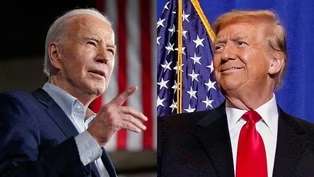
Political impact of convictions against Trump, Hunter Biden
Video has Closed Captions
The political impact of convictions against Trump and Hunter Biden (4m 1s)
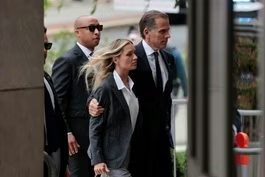
What guidelines suggest for Hunter Biden's sentencing
Video has Closed Captions
What federal guidelines suggest for Hunter Biden's sentencing (5m 40s)
Providing Support for PBS.org
Learn Moreabout PBS online sponsorship
- News and Public Affairs

FRONTLINE is investigative journalism that questions, explains and changes our world.

- News and Public Affairs

Amanpour and Company features conversations with leaders and decision makers.












Support for PBS provided by:
Major corporate funding for the PBS News Hour is provided by BDO, BNSF, Consumer Cellular, American Cruise Lines, and Raymond James. Funding for the PBS NewsHour Weekend is provided by...