
July 21, 2026 - PBS News Hour full episode
7/21/2026 | 57m 46sVideo has Closed Captions
July 21, 2026 - PBS News Hour full episode
July 21, 2026 - PBS News Hour full episode
Problems playing video? | Closed Captioning Feedback
Problems playing video? | Closed Captioning Feedback
Major corporate funding for the PBS News Hour is provided by BDO, BNSF, Consumer Cellular, American Cruise Lines, and Raymond James. Funding for the PBS NewsHour Weekend is provided by...
July 21, 2026 - PBS News Hour full episode
7/21/2026 | 57m 46sVideo has Closed Captions
July 21, 2026 - PBS News Hour full episode
Problems playing video? | Closed Captioning Feedback
Where to Watch PBS News Hour
PBS News Hour is available to stream on pbs.org and the PBS app.
Providing Support for PBS.org
Learn Moreabout PBS online sponsorshipAMNA NAWAZ: Good evening.
I'm Amna Nawaz.
GEOFF BENNETT: And I'm Geoff Bennett.
On the "News Hour" tonight: Military leadership faces congressional scrutiny over the ongoing war against Iran and over the cost to the U.S.
and global economies.
AMNA NAWAZ: A deal to end the long history of conflicts with Israel faces opposition in the devastated villages of Southern Lebanon.
GEOFF BENNETT: And we report from Janesville, Wisconsin, a city that became a symbol of the 2008 economic crisis and is now at the center of the debate over the massive data centers powering artificial intelligence.
PRESCOTT BALCH, Caledonia, Wisconsin, Resident: The risk is if something happens with that revenue stream, it's the current residents that end up having to pick up the tab on short notice.
(BREAK) GEOFF BENNETT: Welcome to the "News Hour."
Today, the president's top military advisers were on Capitol Hill to make the case for the war in Iran and additional money to fund the Pentagon.
AMNA NAWAZ: Secretary of Defense Pete Hegseth and Joint Chiefs Chairman General Dan Caine argued for an additional $67 billion, what Hegseth called an urgent and necessary injection of funds.
Nick Schifrin has been tracking this all, and he joins us now.
So, Nick, what did Hegseth and Caine say about why those funds are needed, and how did senators respond?
NICK SCHIFRIN: Hegseth and Caine requested the additional money to restock weapons that have been used against Iran and to avoid budget shortfalls.
And there are apparently military shortfalls right now.
Subcommittee Chairwoman Susan Collins of Maine said that there were -- quote - - "near-term solvency challenges" in some of the military services.
So the Pentagon says this money is especially needed, especially after the war in Iran, which Hegseth said cost $37.5 billion up until today.
That's up from $29 billion, their last estimate.
But, frankly, 37.5 is probably an undercount itself.
Democrats questioned their request.
They said that many of the weapons requested today had already been requested by the Pentagon and that the money was earmarked, frankly, for administration priorities that had nothing to do with Iran, as Americans' prices were rising.
So take a listen to New York Democrat Kirsten Gillibrand.
SEN.
KIRSTEN GILLIBRAND (D-NY): You are asking for unlimited money for bombs, when people can't feed their families, and I don't know how this administration intends to defend those decisions to the American people.
PETE HEGSETH, U.S.
Defense Secretary: Not unlimited bombs, Senator.
I'm asking for the right bombs at the right time to ensure we can deter our adversaries into the future, and that's why this is a generational investment.
And it was the previous administration that didn't fund this department?
SEN.
KIRSTEN GILLIBRAND: Secretary Hegseth, the reason why people are so upset, the reason why they are so upset with you and this administration is because the words you have used in the past don't add up.
NICK SCHIFRIN: Republicans argued, Amna, that the war in Iran is necessary and that if the U.S.
were to pull back right now, Iran would charge tolls in the Strait of Hormuz and likely reconstitute its nuclear program.
So take a listen to South Dakota Republican Mike Rounds.
SEN.
MIKE ROUNDS (R-SD): I think the decision to take out Iran's nuclear program and their missile production capacity was the right one, and it should have been done a long time ago.
But when the president did that, we also assumed that there would be risk involved.
NICK SCHIFRIN: And, on that point today, the Pentagon identified that Sergeant Michael Swinton, 30 years old from Fayetteville, North Carolina, was killed over the weekend in Iraq, in addition to two other Americans killed in Jordan, 1st Lieutenant 25-year-old Tyler James Feehan Private 19-year-old Isabella Gonzales.
AMNA NAWAZ: Nick, as we have been reporting, the service members were killed as that war with Iran has essentially restarted now.
Where is it now?
Is it just continuing to escalate?
NICK SCHIFRIN: It's definitely expanding, the war.
The U.S.
has finished its 10th straight night of strikes, not only on military targets, but also, on infrastructure targets, including bridges, across Southwest Iran.
And Iran attacked in the last 24 hours three tankers transiting the Strait of Hormuz, but also civilian targets inside of the Gulf allies along the Persian Gulf, including Kuwait.
A desalinization plant was struck, you see it there, multiple times in a row.
Kuwait needs that plant in order to have water for its population.
Now, that said, both sides are saying diplomacy is still open.
We saw Iranian officials in Pakistan, one of the mediators, of course.
But, today, President Trump took a dim view toward diplomacy.
DONALD TRUMP, President of the United States: I will tell you, they want to desperately meet.
And until they're ready to meet in a meaningful way, we have no interest in even... NICK SCHIFRIN: No interest in stopping.
No interest in diplomacy, what he finished there.
Another threat is the Iranian-backed Houthis in Yemen, and this is another example of the war expanding.
They are now threatening to close the Bab al-Mandab, do you see that, 1,200 miles to the southwest of the Strait of Hormuz.
The Bab al-Mandab is the gateway to the Red Sea.
Today, President Trump referenced a previous U.S.
military campaign against the Houthis and said it could be repeated.
DONALD TRUMP: That was about 45 days of very powerful action we took against the Houthis, and we have had no problem with the Houthis.
They have had no problem with us for a long period of time, including during this conflict.
I think that if there is something like that, we will just have to take care of business.
NICK SCHIFRIN: Now, today, the Houthis did claim that they warned six ships heading toward the Bab al-Mandab and that those ships rerouted themselves.
It's not clear that's true.
But even the threat, Amna, of the Houthis closing the Bab al-Mandab will force ships not to try and go there.
And if the Strait of Hormuz and the Bab al-Mandab are both closed, it is clear that prices around the world will increase if that happens, especially gas prices here at home.
AMNA NAWAZ: All right, Nick Schifrin beginning our coverage tonight.
Nick, thank you.
NICK SCHIFRIN: Thank you.
GEOFF BENNETT: In the day's other headlines: Millions of Americans along the Gulf Coast are bracing for Tropical Storm Bertha.
In Mississippi and Louisiana, people filled sandbags to keep out the rain and high surf that's expected.
The swirling storm is churning off the coast of Florida and Alabama.
It's expected to weaken as it makes its way slowly toward land and west toward Texas, bringing heavy rain and the chance of coastal flooding.
Tropical storm watches and warnings are in effect from Florida to Central Louisiana.
Meantime, severe thunderstorms will bring more heavy rain, flash floods, and even tornadoes to parts of the Ohio Valley, mid-Atlantic, and Northeast throughout tonight.
In Ukraine, President Volodymyr Zelenskyy fired the commander in chief of Ukraine's armed forces in what's the latest shakeup of his top military ranks.
The dismissal of General Oleksandr Syrskyi came just days after Zelenskyy fired the country's defense minister, who was largely credited with implementing drone technology in Ukraine's war against Russia.
(CHANTING) GEOFF BENNETT: That firing sparked mass protests in Kyiv and across Ukraine.
Today, President Zelenskyy sought to ease tensions, saying all sides are working toward the same goal.
VOLODYMYR ZELENSKYY, Ukrainian President (through translator): We all want the same thing, to defeat the enemy and create conditions on the front line and through pressure on Russia that would allow us to force Russia into peace.
Ukraine must emerge from the situation stronger, and it will be harder for Russia.
GEOFF BENNETT: Earlier today, officials in the southern city of Zaporizhzhia said a Russian guided bomb attack killed at least three people and injured more than a dozen.
New Jersey's governor said today that more than 6,000 noncitizens were registered to vote in that state in 2023 and 2024, and that fewer than 400 of those actually cast a ballot.
At a press conference, Governor Mikie Sherrill cited a software glitch at New Jersey's motor vehicle system and announced a full investigation.
GOV.
MIKIE SHERRILL (D-NJ): This failure didn't occur under my watch, but accountability starts now.
Because the people of New Jersey shouldn't have to wait a year for a problem to get solved or two years to learn it even happened.
GEOFF BENNETT: Sherrill says the individuals were mistakenly added when they registered either for a driver's license or a state I.D.
The White House quickly seized on the New Jersey revelations to bolster President Trump's broader push to overhaul the nation's election laws.
Former President Joe Biden lost a legal bid to block the release of audio recordings and transcripts of interviews with his longtime ghostwriter that were used in special counsel Robert Hur's investigation into Biden's handling of classified documents.
Biden's lawyers argued the 2016 and 2017 conversations were candid and intended to remain private.
But in a 2-1 ruling, the panel found the public interest in releasing the redacted materials outweighed any remaining privacy concerns.
The court suspended its decision until August 3, giving Biden's team time to consider another appeal.
On Capitol Hill today, a top Smithsonian official pushed back against Republican criticism over how the institution tells the nation's history, which included this exchange on exhibits related to gender and equality.
REP.
NANCY MACE (R-SC): What is a woman, Dr, Hartig?
ANTHEA HARTIG, Elizabeth MacMillan Director, Smithsonian National Museum of American History: As a director and as a historian, it's not my opportunity... REP.
NANCY MACE: You sexualized the American History Museum.
So this is a fair question.
What is a woman?
ANTHEA HARTIG: We strive to represent and not... GEOFF BENNETT: Appearing before a House Oversight subcommittee, the director of the National Museum of American History, Anthea Hartig, defended the Smithsonian's collections, exhibits, and programming.
Hartig was named in a scathing White House report earlier this month accusing the museum of what it called extreme political activism.
Hartig countered that the institution, as she put it, does not take sides in America's political debates.
ANTHEA HARTIG: When historians talk about reframing a traditional narrative, we don't mean erasing it.
We mean adding the evidence, the voices, the objects that earlier tellings left out so that more Americans can see themselves reflected in the national story.
GEOFF BENNETT: Several Democrats at the hearing defended the Smithsonian and criticized what they called attempts by the Trump administration to rewrite moments of history in its museums.
The Justice Department is investigating whether scholarships at Harvard University funded by Chinese donors favor foreign students.
It's the latest inquiry the Trump administration has levied against the Ivy League school.
The DOJ announced the probe yesterday, citing concerns about possible discrimination against American students.
It did not specify which scholarship programs are under review.
In a statement, Harvard said it -- quote -- "does not unlawfully discriminate on the basis of race, ethnicity, or national origin in allocating financial aid."
France is now the latest country to pass a sweeping social media ban for children under the age of 15.
The measure, which also bans the use of cell phones in high schools, passed in both chambers of France's Parliament.
France joins a growing list of countries implementing or considering such bans, including Australia, Greece, and the U.K.
On Wall Street today, a rebound in A.I.
stocks drove the markets higher.
The Dow Jones industrial average added nearly 400 points on the day.
The Nasdaq rose more than 1 percent.
The S&P 500 also ended with a solid gain.
Still to come on the "News Hour": President Trump's latest tariffs heighten tensions between the U.S.
and Canada; one of the survivors of Jeffrey Epstein's abuse discusses a recent meeting with the acting attorney general; and renowned actor and playwright Anna Deavere Smith's latest work examines her own family history.
AMNA NAWAZ: When Lebanon's president, Joseph Aoun, met President Trump at the White House today, it was the first such visit by a Lebanese head of state in nearly two decades.
It comes after Lebanon and Israel resumed diplomatic relations under the auspices of the Trump administration, signing a trilateral agreement last month meant to end a long history of wars.
But, as special correspondent Simona Foltyn reports from Southern Lebanon, the deal is facing stiff opposition.
SIMONA FOLTYN: The Lebanese government has agreed to make peace with Israel, but there's little hope for that here among the ruins of a war that has yet to stop.
We're in Nabatieh, once a bustling commercial town, now devastated by Israel's punishing aerial campaign.
MOHAMMED AWADA, Nabatieh, Lebanon, Resident (through translator): The shops are all gone, and Nabatieh, as you see, is mostly destroyed.
With these strikes, they set us back 10, 15, 20 years for Nabatieh to return to what it once was.
SIMONA FOLTYN: Israeli troops have occupied the hills southeast of Nabatieh.
Even as talks with Israel continue, the fear of renewed escalation hangs in the air.
With shovels and bare hands, Mohammed, his son Hadi and a nephew are trying to salvage what's left of their shop in the old market.
Like much of the city, the Ottoman era buildings lie in ruins.
HADI MOHAMMED, Nabatieh, Lebanon, Resident (through translator): Israel are criminals who like to destroy.
They don't want us to have a good country.
SIMONA FOLTYN: Many here do still support Hezbollah, in spite of the group's decision to reenter the regional war last March in support of its ally Iran.
Mohammed is against Lebanon's deal with Israel, which he sees as a capitulation to Israeli and U.S.
demands.
MOHAMMED AWADA (through translator): This agreement protects them more than it protects us.
It's more in their than in our interests.
They are playing games.
Why haven't they withdrawn?
What is their intention?
Is their intention to take the south?
SIMONA FOLTYN: Israel currently occupies a six-mile strip all along its border with Lebanon demarcated by a Yellow Line similar to Gaza.
This area accounts for roughly 7 percent of Lebanon's territory.
As per the agreement signed on June 26, the Lebanese government must first disarm Hezbollah, and only then will there be a -- quote - - "progressive redeployment" of Israeli troops.
In Washington, the deal has been hailed as a success.
NADA HAMADEH MOAWAD, Lebanese Ambassador to the United States: The trilateral framework we signed today is a first step on the road to restoring Lebanese sovereignty and territorial integrity, securing a permanent and final cessation of hostilities, enabling our people to go back to their land.
SIMONA FOLTYN: But not much is left to return to.
Israel has continued to raze border villages to create a depopulated buffer zone.
Rights groups say such systematic demolitions could amount to war crimes.
Israeli attacks have killed dozens of people since the agreement was signed, according to Lebanon's Health Ministry.
Esperanza Ghandour, a beloved kindergarten principal, is one of them.
This is her when the kindergarten celebrated Lebanese Army Day, and here she is during last year's Christmas party.
She was killed on July 6 while on a quick trip to check on her house near Nabatieh.
Her husband, Wissam Kanso, explains what happened.
WISSAM KANSO, Husband of Israeli Strike Victim (through translator): Esperanza was driving.
Her mother was next to her.
The maid and the plumber were sitting in the back.
The strike came from here directly at my wife.
SIMONA FOLTYN: None of the car's four occupants survived.
Given Israel's advanced surveillance capabilities, Wissam finds it difficult to believe that a strike was a mistake.
WISSAM KANSO (through translator): The Israeli enemy knows every needle on the ground.
They know her car.
They know her plate number.
They have the phone numbers.
They have all the information.
SIMONA FOLTYN: Wissam feels that Lebanon's deal with Israel has come at the expense of justice for victims like his wife.
WISSAM KANSO (through translator): We haven't heard any condemnation for the killings, not from the president of the republic, not from the prime minister, nor from any official in this government.
SIMONA FOLTYN: To better understand why the school principal might have been targeted, we drove towards the strike location.
Only a few cars make the perilous journey this close to Israel's Yellow Line.
In describing the incident, the Israeli military said it had struck a vehicle that was approaching what it calls a security zone, posing a threat to its forces.
This is where Esperanza Ghandour was hit by an Israeli drone while on her way back from her village driving away from the front line.
So it's difficult to imagine how she would have been perceived as a threat to Israeli forces, who are stationed over there.
At the entrance to the village flanked by billboards of Hezbollah's past and present leaders, we met the mayor of Nabatieh al-Fawqa.
ZAIN GHANDOUR, Mayor of Nabatieh al-Fawqa, Lebanon (through translator): Her house is about 400 yards away from here on the main road.
SIMONA FOLTYN: Zain Ghandour believes Esperanza's killing was intentional.
ZAIN GHANDOUR (through translator): It's clear that this is a message to every civilian who wants to go to this area that they will target him.
She wasn't just a school principal.
She was a symbol of patriotism, a symbol of resisting the occupation, a symbol of dignity and steadfastness and clinging to the land.
SIMONA FOLTYN: The municipality has now erected a symbolic barrier to signal to civilians that it's not safe to go any further.
Inquisitive young men on motorcycles occasionally whiz by.
Hezbollah, like Israel, keeps a close eye on this area.
The village sits at the foot of the strategic Ali al-Taher Ridge, an embattled hilltop the Israeli military has yet to fully capture.
Why have the people of Nabatieh al-Fawqa not returned home until now despite the cease-fire?
ZAIN GHANDOUR (through translator): This is the crux of the matter.
There is no occupation here, and the people are supposed to go back.
But the Israeli enemy is occupying these areas through the media and through fire from the sky.
SIMONA FOLTYN: The villages adjacent to the occupation zone have become a no-man's land with no people and no state.
ZAIN GHANDOUR (through translator): The Lebanese state should take the political decision for the Lebanese army to deploy to the heart of the whole village to make people feel safe that the state is present.
SIMONA FOLTYN: We traveled further south to the village of Froun.
It lies in one of two areas designated as so-called pilot zones.
The Lebanese Army is building up a presence here.
This is one of the new Lebanese army positions that have been established to implement the Israel-Lebanon framework agreement and to ensure disarmament of Hezbollah in areas that the Israeli army is not occupying.
Once Israel is satisfied with this process, it should redeploy from Lebanese territory.
But the agreement doesn't mention the word withdrawal, nor does it stipulate a timeline for it, raising fears of an indefinite Israeli occupation.
To people here, it seems as though Israel wants the Lebanese army to finish its job and disarm Hezbollah in areas it could not seize.
The Israeli army is based on the other side of the valley, about 2.5 miles away.
HASSAN BAZZI, Mayor of Froun, Lebanon (through translator): They chose Froun as a pilot zone because of the stupidity of the Lebanese state.
SIMONA FOLTYN: Hassan Bazzi is the mayor here.
HASSAN BAZZI (through translator): Israel is inside the Yellow Line, but they chose areas adjacent to the Yellow Line, which Israel couldn't take during the war, so they're trying to take during the cease-fire.
SIMONA FOLTYN: The mayor says there's no Hezbollah military infrastructure left in the village.
But the group is deeply embedded in the social fabric of the south.
Hezbollah's yellow flags are firmly planted in the ruins, a message that it's here to stay with or without weapons.
Posters thank fighters for their sacrifice.
ZEINAB SHHADI, Froun, Lebanon, Resident (through translator): Those young men protected us.
If it weren't for them, Israel would have taken Froun and destroyed it like the other villages.
SIMONA FOLTYN: More than 200 homes in this village alone, including Zeinab's, were destroyed in Israeli strikes.
This house belongs to one of her relatives.
ZEINAB SHHADI (through translator): My house was destroyed.
During the 2006 war, it was also destroyed.
We then bought another piece of land and built another house.
We were so happy.
Then this war came, and it was destroyed again.
SIMONA FOLTYN: So little is left of the village this war around that it's difficult to imagine how people can rebuild again.
To many here, Lebanon's agreement with Israel feels not like a path to peace, but surrender.
For the "PBS News Hour," I'm Simona Foltyn in Southern Lebanon.
GEOFF BENNETT: The Trump administration is imposing a new round of tariffs on Canada, accusing the country of unfairly discriminating against American autos, dairy products, and alcohol.
The 50 percent tariffs would cover some $20 billion worth of Canadian imports on goods ranging from cement to hockey sticks.
They're set to take effect in 30 days.
In the Oval Office today, President Trump defended the move.
DONALD TRUMP, President of the United States: Canada has been very, very tough on us over the years, for many years, and no other president's done anything about it.
I love Canada.
I love the people of Canada.
Many friends that live in Canada.
But their leadership from Trudeau to the current leadership, I mean, in all fairness to them, they need us to survive.
Without us, there's no way they can survive.
GEOFF BENNETT: Canadian Prime Minister Mark Carney pledged to intensify talks with the U.S.
in the coming weeks in hopes of reaching a deal.
We're joined now by Natasha Sarin, co-founder of the Yale Budget Lab.
Welcome back to the program.
NATASHA SARIN, President, Budget Lab at Yale University: Thanks for having me.
GEOFF BENNETT: So how significant would these tariffs be, these 50 percent tariffs be, if they take effect in 30 days, not just for Canada, but for U.S.
businesses and consumers?
NATASHA SARIN: Yes, the important thing to understand about these tariffs, to put them in some context, is, they cover about 5 percent of imports from Canada.
And so they're hugely important to the particular product lines that we're talking about here.
My colleagues at the Budget Lab estimate that's about 550 of them, things like dairy, alcohol, hockey sticks, as you mentioned.
But in the aggregate picture of our trading relationship with Canada, this is one particular sliver.
It would drive up the effective tariff rate with Canada quite significantly, in part because the tariffs are being levied at such a high rate.
You're talking about on a narrow base of products a 50 percent tariff.
That is very consequential, but it's not covering the swathe of everything that we're importing from Canada.
GEOFF BENNETT: So this high tariff rate on a narrow base of products, is there reason to believe that these tariffs never take effect, that this is all just designed to negotiate a deal?
NATASHA SARIN: It's -- the effective tariff rate, in the U.S.
has changed some 60-plus times in the second Trump administration, and that's just counting tariffs that actually went into effect, not the fact that there -- we have seen a lot of announcements about future activities with respect to our trading partners that were ultimately rolled back or changed in the process of negotiating.
And so, obviously, this is a very active and live conversation.
Obviously, the administration was very clear about giving themselves a delay of 30 days with respect to the implementation of these tariffs in order to continue talks with Canada.
But I think, in some sense, one shouldn't take comfort in the fact that you might not actually see tariffs at this level on these swathe of products implemented, because the volatility of the trading environment, the fact that if you are someone who is importing some of these goods from Canada, you have no idea essentially what the trading environment is under which you're going to be bringing goods into this country in just a few weeks, makes it really, really challenging to try and run businesses and really, really difficult from the perspective of the American consumer, who is seeing as a result of this volatility an increase in the prices that they're paying.
GEOFF BENNETT: When the administration says that Canada has unfairly discriminated against American products, that's the argument they're making, how strong is that case?
NATASHA SARIN: One thing that I think it's really important to sort of clarify a bit is the timing of the alleged inappropriate practices on behalf of Canada with respect to our products.
A lot of what is happening in this context is, there's frustration in the United States or amongst some administration officials that Canada has actually retaliated to increased tariffs by us on Canadian imports over the course of the last year-and-a-half.
And so a lot of the practices you're talking about, particularly in sectors like alcohol, they are about retaliatory measures that were taken once the United States undertook this trade war.
And so it seems a little sort of hard to make the argument that we're -- as a result of the fact that there have been prior tariffs that we have levied against them that have prompted these retaliatory actions, you're then going to see another swathe of tariffs instituted.
And that makes it challenging because it's kind of like a never-ending cycle with respect to escalation in ways that make it difficult to see what the path forward actually is.
GEOFF BENNETT: Challenging and confusing, to be sure.
There are viewers who will watch this conversation, and they might wonder, didn't the U.S.
Supreme Court strike down the Trump administration's tariff regime?
And they would be right.
So what's the... NATASHA SARIN: They would.
GEOFF BENNETT: Yes.
So what's the legal authority that the administration is using for this?
NATASHA SARIN: That's such a good question.
And the way I have been describing the nature of the administration's actions in the aftermath of the Supreme Court decision in February is that they're certainly in keeping with the text of the ruling since the case was about one particular authority, the International Emergency Economic Powers Act, that the administration was using to impose these broad-based tariffs.
But they're not in keeping with kind of the spirit of that ruling, which made clear that the power to tax and impose these types of wide-ranging tariffs on allies and adversaries alike is a power that rests with Congress, and Congress alone.
And so, ultimately, we are going to see these new authorities that the administration is deploying to kind of patchwork together its old trading practices, we are going to see those legally challenged.
And a bunch of those cases are already making their way up to the Supreme Court.
And, ultimately, it'll be for the court to rule and decide whether or not that type of broad-based power exists from these other laws.
But I speculate that their answer is unlikely to be yes, given that this set of authorities sits with Congress.
GEOFF BENNETT: Natasha Sarin, co-founder of the Yale Budget Lab, always good to speak with you.
Thanks.
NATASHA SARIN: Thanks so much.
AMNA NAWAZ: A.I.
is fueling stock market highs, economic growth, and a construction boom across the country.
But it's also igniting fierce local debates about the benefits, the costs, and in many cases whether the data centers that power A.I.
should be built at all.
Economics correspondent Paul Solman looks at how one of those battles is playing out in the Midwest right now.
GEORGE CULLEN, Co-President, JP Cullen: Just right there is the Cozy Inn.
PAUL SOLMAN: George Cullen has been in Janesville, Wisconsin, for quite a while.
GEORGE CULLEN: Which is the oldest continuously owned Chinese restaurant in America.
PAUL SOLMAN: In all of America?
GEORGE CULLEN: In all of America.
PAUL SOLMAN: The family construction business JP Cullen has worked on some of Wisconsin's most famous structures.
GEORGE CULLEN: We have been here for six generations and have been proudly building here all that time.
In fact, we built the original tractor factory that was then turned into being the GM site.
PAUL SOLMAN: Once the economic cornerstone of Janesville, the giant GM plant, in its heyday employing 7,000 people.
But when the plant idled in 2008, unemployment soared to 13 percent, and the town became a nonpartisan symbol of the Great Recession.
BARACK OBAMA, Former President of the United States: The promise of Janesville has been the promise of America.
DONALD TRUMP, President of the United States: Hello, Janesville, and hello, Wisconsin.
We love Wisconsin.
PAUL SOLMAN: Even I was dispatched to the plant to cover the economic catastrophe.
But almost a decade later, says Cullen who also heads Janesville's Chamber of Commerce: GEORGE CULLEN: Amazingly, we have replaced the number of jobs since that GM plant closed.
It was hard and it took a lot of time, but we do have positive momentum here.
PAUL SOLMAN: Positive momentum that could finally revive 250 acres of empty lot, where GM's plant used to sit, and possibly revive the city's budget with a data center.
GEORGE CULLEN: There's nothing there.
Our taxes are not being offset by a large user providing their property taxes.
Those property taxes will help our schools, help our technical college, and help our city.
PAUL SOLMAN: What was your initial reaction when you heard a data center might go there?
GEORGE CULLEN: With that site having sat empty as long as it has, the positive nature that somebody was interested to put a new building on that site.
PAUL SOLMAN: That's good?
GEORGE CULLEN: That's a positive.
PAUL SOLMAN: Especially since no one would fork out some $30 million to clean up the contaminated site once GM's plant was demolished eight years ago.
Then, last year, a Colorado-based developer offered to buy the lot, remediate, and build an $8 billion data center campus.
GARRIK HARWICK, IBEW Local 890: I think if there's an opportunity to bring some industry back that could really add to the tax base and employ a bunch of people, I'd love to see that being used.
PAUL SOLMAN: Electrician Garrik Harwick IS a business manager for IBEW Local 890.
With data centers blooming nationwide, unions are reporting new significant demand for their members.
Janesville's data center proposal came with the promise of hundreds of permanent jobs and at least 13,000 during construction, a major plus.
GARRIK HARWICK: It could be Joe the plumber up the street that gets a job because this comes here.
And that kid goes to school with your kid, and it just affects the whole community.
PAUL SOLMAN: And then, of course, there's the case for data centers in general.
DONALD TRUMP: My administration will use every tool at our disposal to ensure that the United States can build and maintain the largest, most powerful, and most advanced A.I.
infrastructure anywhere on the planet.
PAUL SOLMAN: So last year, an executive order to fast-track environmental reviews and return sites like GM Janesville to -- quote -- "productive use as expeditiously as possible" -- unquote.
But now, given the nationwide groundswell against data centers, you're not going to be surprised to hear that some in Janesville aren't sold.
RAY JEWELL, Pastor, Afton Community Church: I'm not against economic development.
I just want it to be reasonable, thought out, done in a way that is not going to put people in danger and harm the environment.
You see the power plant there.
PAUL SOLMAN: Pastor Ray Jewell lives less than a mile from the site, where his dad worked for 30 years.
Among his concerns, excessive water use, noise, and light pollution.
RAY JEWELL: This is right in the middle of a residential area.
PAUL SOLMAN: And, of course, he's worried about energy prices.
The nation's largest electrical grid operator recently announced it will add more than $6 billion in costs to consumers over the next three years because of power demand from data centers.
While the developer in Janesville declined an on-camera interview, it vowed the data center would minimize its impact on residents and the environment.
Jewell is, well, skeptical.
RAY JEWELL: What's existing now across the country, they can't prove it.
PAUL SOLMAN: So he's part of what's become a wave of data center opposition.
According to a recent Gallup poll, 70 percent of Americans oppose the construction of an A.I.
data center in their community.
JAEL HOLZMAN, Heatmap News: There's something about A.I.
and its involvement, its impacts on people's employment prospects in the future, as well as the way they see the world in general, that has people especially riled up about these projects.
PAUL SOLMAN: Jael Holzman reports on the A.I.
data center backlash for climate Web site Heatmap.
It's a uniquely unifying topic, she says, bringing together both those on the left... REP.
ALEXANDRIA OCASIO-CORTEZ (D-NY): While the American people are suffering, big tech continues to demand more, more data centers, more energy, more data collection, more American jobs replaced by A.I., all on the feet of the American people.
PAUL SOLMAN: ... and on the right, Tucker Carlson, for example.
TUCKER CARLSON, Conservative Commentator: The future that A.I.
promises is worse for the overwhelming majority of the people, but it empowers and enriches a tiny percentage of the population.
Like, that's so crazy.
JAEL HOLZMAN: There are so many political constituencies, movements that have found common cause here, as well as the climate movement.
And so, altogether, you have honestly a pretty cosmic gumbo of politics.
PAUL SOLMAN: According to a recent report by Data Center Watch, opponents delayed or blocked at least 75 projects worth $130 billion across the country in the first three months of this year alone.
PRESCOTT BALCH, Caledonia, Wisconsin, Resident: We organized around a set of arguments that ultimately convinced Microsoft, in this case, and our village board to say, no thanks.
PAUL SOLMAN: Former bank executive Prescott Balch came out of retirement when Microsoft offered to build a data center in his small Wisconsin town, Caledonia.
Were you leery of data center development at first?
PRESCOTT BALCH: I was not.
In fact, if anything, I'm on the opposite side.
I made a healthy living using them.
I would be hypocritical to say that we should stop building them now that I'm retired.
PAUL SOLMAN: The state of Wisconsin passed a sales tax break in 2023 to lure data centers and enhance economic development.
But having now crunched the numbers for many projects, Balch says the promised windfall isn't nearly what it seems.
Moreover, small communities might be betting on a bubble.
PRESCOTT BALCH: The volatility of the industry, the fact that it likes to disrupt itself all the time, that it's constantly changing, the risk is, if something happens with that revenue stream, it's the current residents that end up having to pick up the tab on short notice.
PAUL SOLMAN: Balch's skepticism has resonated in Janesville.
This spring, two opponents of the data center were elected to its City Council, which promptly ended the agreement with a developer.
Even the Chamber of Commerce withdrew its support.
PRESCOTT BALCH: I think the mere scale of them, particularly in smaller communities, has woken people up.
If it's something that big and that grand and that impactful, you have an obligation as civic leaders to step back and say, we are going to bring the community along to get them to agree that this is the right idea, or we're not going to do it.
PAUL SOLMAN: The developer, however, says it's hoping to revive the project.
But Janesville has stalled the deal for now, still looking for an economic engine to drive its future and clean up those 250 acres.
Data center cash seemed an offer a city just can't refuse.
Turns out some can.
For the "PBS News Hour," Paul Solman in Janesville, Wisconsin.
GEOFF BENNETT: The U.S.
Senate is weighing President Trump's nomination of acting Attorney General Todd Blanche to lead the Justice Department, as questions continue over the administration's handling of legal investigations into sex offender Jeffrey Epstein.
It comes days after Blanche met privately with several survivors of Epstein's abuse.
Our justice correspondent, Ali Rogin, spoke with a survivor who attended that meeting.
ALI ROGIN: Geoff, the meeting came as Blanche works to win Senate confirmation while facing continued questions about the Justice Department's handling of the Epstein case.
Politico is reporting today the White House is now actively lobbying two Republican senators seen as potential holdouts, Thom Tillis and John Cornyn, to support the nomination.
A group of survivors who met with Blanche Thursday wrote an open letter to those senators today, urging them to vote against Blanche, calling their meeting with him -- quote -- "an hour of deflection, interruption, and gaslighting."
Joining me now is Liz Stein, one of the survivors who met with Blanche on Thursday.
Liz, thank you so much for being here.
Welcome back to the "News Hour."
LIZ STEIN, Jeffrey Epstein Survivor: Thanks for having me.
ALI ROGIN: This meeting came on the urging of Senator Tillis, who said it was a condition of his yes-vote.
What was the takeaway for yourself and your fellow survivors?
LIZ STEIN: Well, I think that when Senator Tillis asked Todd Blanche to meet with us, I think that he wanted it to be a substantive meeting, and that's not what it was at all.
I don't know if we had extremely high hopes going into the meeting, but we really met Todd Blanche in hopes to work with him.
We have been more than willing to work with the Department of Justice.
We have been requesting meetings for months with Todd Blanche and the Department of Justice, and we have gotten nowhere until last week.
And it feels to us that it was a bit of a performative move so he could check a box for his promotion.
ALI ROGIN: Can you expand on that a little bit?
What about it made you come away with that impression?
LIZ STEIN: Well, like I said, we went into the meeting really in earnest looking to work with Todd Blanche in the Department of Justice.
We went into the meeting with an agenda, questions that we had that we wanted answered.
And when we got into the meeting, we didn't receive any answers to any of the questions that we were asking.
He talked around the subjects that we were trying to press him on, and we couldn't really get him to commit to anything.
I think that if Todd Blanche even offered us the slightest bit of an olive branch, we would have been satisfied with that, but it just felt like more of the same over and over again.
Earlier this year, when Pam Bondi testified and refused to acknowledge that we were in the room, that sent a really strong message to us about what the DOJ thinks of us as victims of crime, and our meeting with Blanche only reiterated those feelings for me.
ALI ROGIN: What were some of the questions or the action items that you came in with that you felt went unanswered or unacknowledged?
LIZ STEIN: We couldn't get a real clear answer on the redaction process, how it was handled, why we saw over and over survivors' names and information being released, while we simultaneously were seeing perpetrators' information redacted.
We did find out from Todd Blanche that there were over 800 individuals who were reviewing these files, but they were reviewing them for redactions only.
They were not looking for additional investigative leads.
They weren't looking to put pieces of the puzzle together.
They were merely just looking at names.
That's concerning to us.
There were 800 eyes on these files, and they were doing nothing but just looking for redactions, instead of information?
Feels like a waste of time.
ALI ROGIN: You and your fellow survivors have called for the Department of Justice to follow up on the investigative leads revealed in these documents.
Did acting Attorney General Blanche acknowledge that at all?
Was there any movement on that?
LIZ STEIN: There wasn't.
And that, I think, was really concerning to us, because, when we look at the Epstein files, we can see investigative leads on almost every page, but the DOJ isn't interested.
And I need people to remember that there's been so much political emotion infused into what is a case about sex trafficking.
This is a crime.
And it's beyond concerning that our Department of Justice doesn't want to follow investigative leads in what is quite possibly the largest international sex trafficking ring we have ever seen.
ALI ROGIN: Given how badly this meeting went, according to the recounting of yourself and your fellow survivors, do you think Senator Tillis' vote should be conditioned on more than the fact that the meeting took place?
LIZ STEIN: I think that Tillis wanted us to have a substantive meeting with Todd Blanche, and that's not what happened.
And Senator Tillis is a businessman, right?
And if he was looking at the Department of Justice the way that he would look at any other business enterprise, Todd Blanche has not shown the leadership to be the head of the Department of Justice.
And I think that Senator Tillis and Cornyn really need to consider what Todd Blanche's record has been in regards to the Epstein case and how we were treated by the Department of Justice just last week.
ALI ROGIN: If Todd Blanche is confirmed as attorney general, how do you hope the DOJ proceeds when it comes to Epstein?
LIZ STEIN: We have heard Todd Blanche say over and over and over again that there are no investigative leads, that, for as much as the Epstein saga has been a part of culture in the past year, it shouldn't be part of anything going forward.
In the release of these files, there were survivors who were Jane Does and had never, ever thought that they would ever have to be public.
Yet they were thrown into the spotlight.
People that they work with friends, family are now reading the most intimate details of these women's lives.
There's one survivor named Roza who came out and testified publicly in Palm Beach and said that she had been exposed more than 500 times.
I don't know how anyone could look at that as a mistake.
The Department of Justice is really not treating us with respect that crime victims should be treated, and it begs the question why.
ALI ROGIN: Liz Stein, survivor and advocate, thank you so much for joining us.
LIZ STEIN: Thanks.
AMNA NAWAZ: Anna Deavere Smith is well known for her acting in films and TV, including on "The West Wing" and "Nurse Jackie."
She's also made an impact as a playwright, creating her own style of theatrical dramas that explore aspects of American life.
Now she's doing something new, looking back at her own family history.
Senior arts correspondent Jeffrey Brown met with Smith recently in Philadelphia for our arts and culture series, Canvas.
ACTOR: You must sit perfectly seated.
JEFFREY BROWN: A photograph for the 1843 wedding of Basil and Mary Biggs, real-life figures who lived in Maryland and later Gettysburg, Pennsylvania.
ACTOR: I'm getting married to a wonderful girl.
That makes me smile.
JEFFREY BROWN: Now imagined for the theater by their great-great-granddaughter, Anna Deavere Smith.
ANNA DEAVERE SMITH, Playwright and Actress: Because this is the one about my family.
JEFFREY BROWN: A renowned playwright and actor of our time... HENRY LOUIS GATES JR., Harvard University: Of all the stories that we uncovered, we saved the most remarkable one for last.
JEFFREY BROWN: ... who learned of the extraordinary life of Basil Biggs, including his work on the Underground Railroad, on an episode of "Finding Your Roots," the PBS program hosted by Henry Louis Gates Jr.
ANNA DEAVERE SMITH: While slavery existed, he was an active agent in the Underground Railroad, helping fugitives to freedom.
Oh, this is amazing.
This man was amazing.
I knew this from the minute that Henry Louis Gates told me the story and showed me the picture.
I knew that this was the -- an important piece of the puzzle I needed to understand my stake in the country.
JEFFREY BROWN: Your own stake.
ANNA DEAVERE SMITH: My own stake in the country.
So these are some of the kinds of things... JEFFREY BROWN: Making sense of her country has been Smith's long-running project.
ANNA DEAVERE SMITH: ... that qualify slavery as the most outrageous crime.
JEFFREY BROWN: But typically through the words and voices of others, as she's helped pioneer a style of documentary theater that has explored traumas and social issues in American life in works such as 1992's "Fires in the Mirror."
ANNA DEAVERE SMITH: And people would say to me, gee, I like your new haircut.
And I'd have to say, it's not mine.
Yes, when I first heard about this case... JEFFREY BROWN: And "Twilight: Los Angeles" the next year.
Both focused on riots in major American cities, for which she interviewed real protagonists and then portrayed them, taking on a wide variety of personas in a one-woman show.
ANNA DEAVERE SMITH: And if I had to choose between argue with people by my hairstyle or giving James Brown that one tribute he asked... The work that I got known for was work about looking at moments of disarray.
And when you look at those kind of issues, number one, nobody agrees, and I love that.
That's dramatic.
Nobody agrees.
And, two, there's no one answer.
So this work was about trying to make sense by putting the pieces together.
JEFFREY BROWN: In 2015, we watched her in action as she researched and talked to residents of her hometown of Baltimore for a show titled "Notes From the Field"... ANNA DEAVERE SMITH: You put leg shackles on a man who can barely walk?
JEFFREY BROWN: ... about how students of color from poor communities are often funneled into the criminal justice system, known as the school-to-prison pipeline.
ANNA DEAVERE SMITH: I made a decision to go on the road, as I call it, to search for American character.
And so that was going to, in particular, cause me to, well, chase that which I'm not.
JEFFREY BROWN: But why?
Tell me why.
What has been the goal in that?
ANNA DEAVERE SMITH: The goal was to come close to strangers quickly in order to try to touch the American spirit.
I knew -- I felt I had to go outside of my metaphoric home, outside of what I knew to understand a country so vast as ours.
JEFFREY BROWN: In her new play, "Basil Biggs," she's done something different.
We recently joined Smith for a workshop production at Philadelphia's Wilma Theater, a work in progress put on as part of a citywide arts festival called What Now.
For Smith, what now involves looking hard at what then for the mixed-race son of a slave owner and enslaved woman now living as a freeman with his family and working as a veterinarian.
ACTOR: You rock that baby like (INAUDIBLE) ACTRESS: I swear it can make sense.
ANNA DEAVERE SMITH: I'm trying to figure out who he was because he didn't read or write.
So, given the fact that what I have trained myself to do is to study words and language to find identity, here, I have no words.
JEFFREY BROWN: What she did have, photographs of Basil Biggs and his family, archives describing life in Gettysburg at the time, and a record of another astounding aspect of Biggs' life revealed on "Finding Your Roots" and also portrayed in the play.
After the Battle of Gettysburg, he disinterred the Union dead for reburial in a new cemetery ahead of Abraham Lincoln's famous address delivered on November 19, 1863.
Most important, Smith says, she was able to visit the actual farm and homes where Biggs and his family lived.
ANNA DEAVERE SMITH: So this gave me a sense of place.
And it turned out that the sense of place was as grounding as words had been before.
JEFFREY BROWN: Really?
ANNA DEAVERE SMITH: Yes.
JEFFREY BROWN: So, place meaning what you see, what you smell, what you -- the wind in your... ANNA DEAVERE SMITH: And in my sense of belonging in it, in belonging in the story myself, that the fact that myself belonged -- and I haven't thought about this until talking to you, but that myself belonged in this story, that I could believe myself in this story, because I was in the house and in the barn and on the creek, helped me begin to imagine this man, Basil Biggs.
JEFFREY BROWN: What did it teach you about yourself or what did it -- made you think about yourself today as an American today?
ANNA DEAVERE SMITH: I know why I care.
I know.
And I can't give you the words for it, but in a kind of intuitive way, I know why I care about America, because, for one thing, my great-great-grandfather cared enough about America that he wanted these soldiers to have a decent burial.
JEFFREY BROWN: The play takes its characters and us up to 1872.
The civil war is over, but the struggles continue.
JEFFREY BROWN: Including the new presence of the Ku Klux Klan.
ANNA DEAVERE SMITH: The audience is left with a rebel yell, and I hope they are there for going to think about the work we have to do now before we can sing the songs about everything's going to be all right, because we all know it's not all right.
JEFFREY BROWN: It's an ambiguous ending for Anna Deavere Smith's great-great-grandfather and for the country down to today.
For the "PBS News Hour," I'm Jeffrey Brown at the Wilma Theater in Philadelphia.
AMNA NAWAZ: And that is the "News Hour" for tonight.
I'm Amna Nawaz.
GEOFF BENNETT: And I'm Geoff Bennett.
For all of us here at the "News Hour," thanks for spending part of your evening with us.
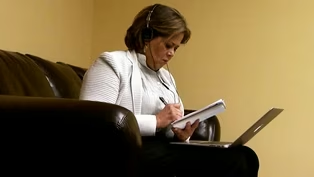 New
NewAnna Deavere Smith brings her family's history to the stage
Video has Closed Captions
Anna Deavere Smith brings her family's history to the stage in 'Basil Biggs' (7m 22s)
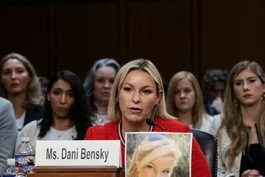 New
NewEpstein survivor calls Blanche meeting 'a performative move'
Video has Closed Captions
Epstein survivor criticizes Blanche, calls meeting 'a performative move' (7m 14s)
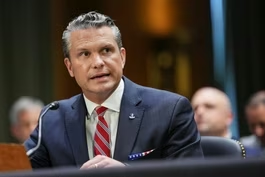 New
NewHegseth says Iran war has cost $37.5B so far
Video has Closed Captions
Hegseth says Iran war has cost $37.5B so far and Pentagon needs $67B to restock arms (5m 20s)
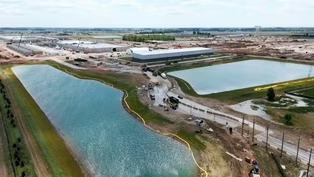 New
NewJanesville becomes battleground in AI data center debate
Video has Closed Captions
Janesville, once a symbol of the Great Recession, becomes AI data center battleground (8m 45s)
 New
NewLebanese skeptical of Israel agreement as violence continues
Video has Closed Captions
Southern Lebanese skeptical of Israel agreement as violence continues (9m 20s)
 New
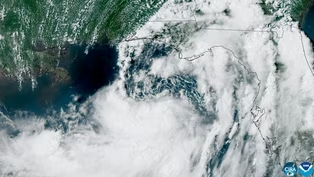
NewNews Wrap: Gulf Coast prepares for Tropical Storm Bertha
Video has Closed Captions
News Wrap: Gulf Coast prepares for Tropical Storm Bertha (6m 20s)
 New
NewTrump raises tensions with Canada by announcing new tariffs
Video has Closed Captions
Trump raises tensions with Canada by announcing new 50% tariffs (6m 48s)
Providing Support for PBS.org
Learn Moreabout PBS online sponsorship New Episode
- News and Public Affairs

Today's top journalists discuss Washington's current political events and public affairs.

- News and Public Affairs

FRONTLINE is investigative journalism that questions, explains and changes our world.
 New Episode
 New Episode
 New Episode
 New Episode
 New Episode

 New Episode
 New Episode
 New Episode
Support for PBS provided by:
Major corporate funding for the PBS News Hour is provided by BDO, BNSF, Consumer Cellular, American Cruise Lines, and Raymond James. Funding for the PBS NewsHour Weekend is provided by...