Virginia Home Grown
Crops of West Africa
Clip: Season 26 Episode 4 | 7m 46sVideo has Closed Captions
Meet a farmer connecting her community with food
Randy Battle visits Esther Manor Farm in Beaverdam with Patience Fielding to learn how crops from West Africa can be grown in Central Virginia. Featured on VHG episode 2604, June 2026.
Problems playing video? | Closed Captioning Feedback
Problems playing video? | Closed Captioning Feedback
Virginia Home Grown is a local public television program presented by VPM
Virginia Home Grown
Crops of West Africa
Clip: Season 26 Episode 4 | 7m 46sVideo has Closed Captions
Randy Battle visits Esther Manor Farm in Beaverdam with Patience Fielding to learn how crops from West Africa can be grown in Central Virginia. Featured on VHG episode 2604, June 2026.
Problems playing video? | Closed Captioning Feedback
Where to Watch Virginia Home Grown
Virginia Home Grown is available to stream on pbs.org and the PBS app.
Providing Support for PBS.org
Learn Moreabout PBS online sponsorship>>Esther Manor Farm, I named it after my mother, Esther.
The values I now have, the values of hard work, patience, giving back, I got that from her.
My grandmother also, (speaking in a foreign language), is somebody who I learned how to farm from.
Her farm, her place was a place of safety, a place of abundance.
And so I wanted to honor my ancestors and the women who came before me.
>>Well, they did a great job instilling this craft in you.
How did you get started?
>>So we started during the pandemic.
As you know, during the pandemic, we had food shortage.
And we wanted to grow crops that are native to Africa, because the crops we grow are not found in regular, mainstream shops.
So we grow crops like African garden egg.
>>African garden egg- >>African garden egg.
>>What a strange name.
>>I know, it's if you can see here, you have some crops, it's round.
I think it's in the eggplant family.
>>Okay.
>>But you have varieties of them that are green.
Some of them are white, and we eat them in stews.
We eat them raw.
We eat them, we serve them sometimes in countries like Nigeria when people visit, you serve with peanut butter as a sign of welcome.
We also have bitter leaf.
Bitter leaf is a staple in Cameroon and Nigeria.
In Cameroon, there's a popular dish called Ndole.
It's made with peanuts, beef, dried fish.
It's very, it's a staple in Cameroon, very tasty, very delicious, like a national dish.
And so bitter leaf is the main vegetable that is used.
And so lots of Cameroonians in the United States, they rely on bitter leaf.
We also have peppers.
If you notice, in Cameroon and most African countries, we eat spicy and hot.
>>Okay.
>>No meal is complete without peppers, and so here, I have a variety of peppers: Scotch bonnet, habanero, bell peppers.
Because every meal is so spicy.
>>Right.
>>And we also have okra.
>>Okay.
>>And again, okra is a staple in Africa.
We eat okra with fufu.
We prepare that sometimes with egusi.
Sometimes it's used as a thickener.
We also have my favorite: njama njama.
It's what my grandmother, (speaking in a foreign language), that's what she ate every single day with fufu.
>>Njama njama.
>>Njama njama, but my grandmother would make that with fufu and we would eat that.
It was so, so healthy.
And so that's a favorite.
So in that corner right there, they're still growing.
They haven't come up yet, but that's a area for njama njama.
So we want to create a space for food, for African food, not just for Africans, but for our community.
We wanna share this with members of our community just for healthy food.
>>Now, it's interesting that these plants are mostly native in Africa.
>>Mm-hmm.
>>Now, how does it vary as far as the climate and growing conditions compared to being here versus Cameroon?
>>The summer months are very similar.
The weather and the temperatures are very similar to Cameroon.
That's why they survive in these temperatures.
So in Cameroon, we just have two seasons: the rainy season and the dry season.
Right here we have four seasons.
So spring up until November is kinda very similar to Cameroon weather, and the soil is also very similar.
So we amend the soil using compost, and that's what makes it easy to grow, right?
Soil here was very clay.
Then we used compost to amend the soil so it's very similar to the soil in Cameroon where they grow.
And that's why you can have such healthy crops, because it's very similar to the countries of origin in terms of the temperature and the soil.
>>So they feel right at home?
>>They feel right at home in Virginia.
>>That's awesome.
(Patience laughing) Now, what are some things that maybe you have tried to grow that didn't do so well here on the farm?
>>Didn't do so well, so when we started, I was just trying a lot of crops.
And one crop that we had was fluted pumpkin.
What happened was, the deer loved it more than we could.
So by the time it came to harvesting, it had all been eaten up by the deer.
In Africa, it grows in the forest, lots of shade, so we have to find shady areas where to grow them.
We have a huge market of people who consume fluted pumpkin, and so that's one crop that is really desired by people from Africa.
>>And not only is this just for people who eat all African food.
This is for the community.
This is for people of all ages, race.
You guys are open to all types of people.
>>Absolutely.
I mean, food is the great connector, and we want to use food to connect with all people, people from all backgrounds, all abilities, all races.
And we do that by, we invite people to come in and tour the farm, look at the crops.
Every October, we have a farm-to-table.
We prepare the food from the land.
We have a big old giant party in back.
We celebrate, we have music, we have drums.
We invite everybody because we want to share this with our community.
Even though I'm from Cameroon, America is now my home, and I consider, "What can I give back?
How can I build?
How can I give back to my community something that is unique and to me and to Africa and to Cameroon?"
And so these crops is what's unique.
And so I wanna bring that to my community, not just in Beaverdam, but in Virginia and in the USA.
And so we invite everybody to come visit, to come taste, to come have some of this foods, which is so nutritive.
>>And that's the good thing.
You are giving so much to the community.
How can the community give back to you?
Volunteering or how does that work?
>>Great, and we would love to have volunteers.
As you well know, Randy, farming is hard.
>>Yes, it absolutely is, and it takes patience.
>>Lots of patience.
It does.
>>(laughing) You have the perfect name.
>>It does, (laughing) yes, I do.
This past year, we've been very fortunate to have volunteers from various organizations, community foundation, Randolph-Macon sends students, Shalom Farms sends volunteers.
So they've been able to come in and help us and do this work.
So we're very grateful, but you know it doesn't end there.
Every season demands a different kind of labor.
So right now, we're finished planting.
We're gonna need volunteers to help weed, because we do not use any pesticides or herbicides.
Everything is natural.
So we hand weed, because we eat from this farm, and so we wanna make sure that what we give our community's also healthy.
So we need volunteers.
>>Now, where do you see this going in the future?
>>In the future, I just want to build my community.
Having that connection with people is so healing, and it's the natural way we're born to be, to connect through food.
And I want to offer this space as a space (rhythmic music) to grow food, a space where everybody sees themself, people of all abilities.
And in addition, I grow other herbs, so that even if you cannot identify with some of the crops, I mean you can pick a pepper, a bell pepper, some herbs.
You can do tea.
So I want this space to be for us all, a space to come together, celebrate, grow food, and just be a healthy community.
>>Oh, that's awesome.
Thank you so much for having us, Patience.
It's been a great day.
And I have enjoyed everything about this farm.
It feels peaceful and we were so glad to be here.
>>Thank you, thank you, my pleasure.
>>Thank you.
>>Thank you.
Video has Closed Captions
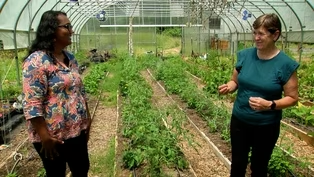
Clip: S26 Ep4 | 7m 55s | Learn how crops from India grow in Central Virginia (7m 55s)
Video has Closed Captions
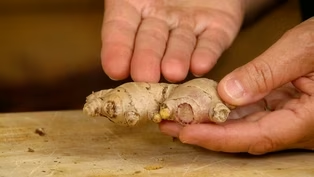
Clip: S26 Ep4 | 5m 12s | Learn tips to grow ginger in a container (5m 12s)
Video has Closed Captions
Clip: S26 Ep4 | 3m 8s | Discover how saving seeds carries on cultural traditions (3m 8s)
Video has Closed Captions
Clip: S26 Ep4 | 6m 10s | Get tips for growing plants from seed (6m 10s)
Video has Closed Captions
Clip: S26 Ep4 | 3m 16s | Set your garden up for success when trying to grow new plants (3m 16s)
Providing Support for PBS.org
Learn Moreabout PBS online sponsorship

- Home and How To

Hit the road in a classic car for a tour through Great Britain with two antiques experts.
 New Episode





 New Episode




Support for PBS provided by:
Virginia Home Grown is a local public television program presented by VPM