
A Mosque on the Prairies
A Lebanese homesteader recalls the building of one of the first mosques on the Great Plains.
From
A Mosque on the Prairies
Episode 4 | 24m 45sVideo has Closed Captions
A Lebanese homesteader recalls the building of one of the first mosques on the Great Plains.
A 1930s oral history from a Lebanese homesteader recalls the building of one of the first mosques on the Great Plains.
From
Problems playing video? | Closed Captioning Feedback
Problems playing video? | Closed Captioning Feedback
A Mosque on the Prairies
Episode 4 | 24m 45sVideo has Closed Captions
A 1930s oral history from a Lebanese homesteader recalls the building of one of the first mosques on the Great Plains.
From
Problems playing video? | Closed Captioning Feedback
Where to Watch American Muslims: A History Revealed
American Muslims: A History Revealed is available to stream on pbs.org and the PBS app.
Providing Support for PBS.org
Learn Moreabout PBS online sponsorship♪♪ [Ismail] It's a simple wooden door.
It's a perfect metaphor.
It's like a doorway to the past.
But some doors can take you places you'd never expect.
I didn't even know my family had been Muslim.
And so I called my grandma and I said, "What is this about a mosque?"
And she said, "Oh, didn't you know about that?"
And I said, "No, I didn't know about that."
Nobody ever told me.
[Ismail] On the plains of North Dakota, I found a story about a group of people who were pioneers in more ways than one.
You can be driving past this plot on the highway, and it just looks like a little slice of America.
But for someone like me who's a Muslim American, this is so much more significant.
The farmers who settled this land were Muslim from present-day Lebanon.
They brought their faith with them.
[Curtis] In order to be a good American in the Midwest, you need to have a religious congregation.
Everybody has one, and so they build theirs and add it to the tapestry of the Dakotas.
[Ismail] So there was a mosque in North Dakota.
-Can we talk about that?
-Yeah.
Because I can't even picture one.
They would need their faith.
Many Arabic-speaking immigrants were being turned away because they were undesirable immigrants for racial reasons.
[Hassan] Are they going to assimilate or are they going to become American?
Or will they remain these outsiders with their strange religious practices?
[Ismail] That simple wooden door is all that's left of the mosque.
But it connects past and present and gives me a whole new way of seeing the story of American Muslims and the history of the American Midwest.
I'm one of three journalists following a trail.
There was one of the founding fathers imagining Muslim Americans.
Absolutely.
[Ismail] Each of us exploring a defining moment in American history.
-Strong words.
-[Langbart] Very powerful words.
He wanted this mosque here in the US.
[Khan] They were all so proud of it.
[Ismail] Tracing the legacy that's coming back into view.
There's never been an America without Muslims.
[Abdullah] This is not a foreign story.
It's a part of the American story.
♪♪ ♪♪ [Ismail] At the turn of the 20th century, immigration was transforming the United States.
Millions of people crossed oceans and borders, pulled by the promise of freedom, of land, of work.
Among them were thousands of Arabic-speaking migrants from the Eastern Mediterranean.
Most were Christian, but some were Muslim.
Many settled where America already felt crowded, in cities like New York, Boston and Chicago.
Others followed the pull of industry to the Ford factories of Detroit.
But a smaller number went somewhere else, further west, onto the Great Plains.
To places deep in the open prairie.
Places like Ross, North Dakota.
Today, Ross is quiet.
Fewer than a hundred people, mainly white, mainly Christian.
But in the early 1900s, this was home to a Muslim community of farmers from present-day Lebanon, then part of Greater Syria within the Ottoman Empire.
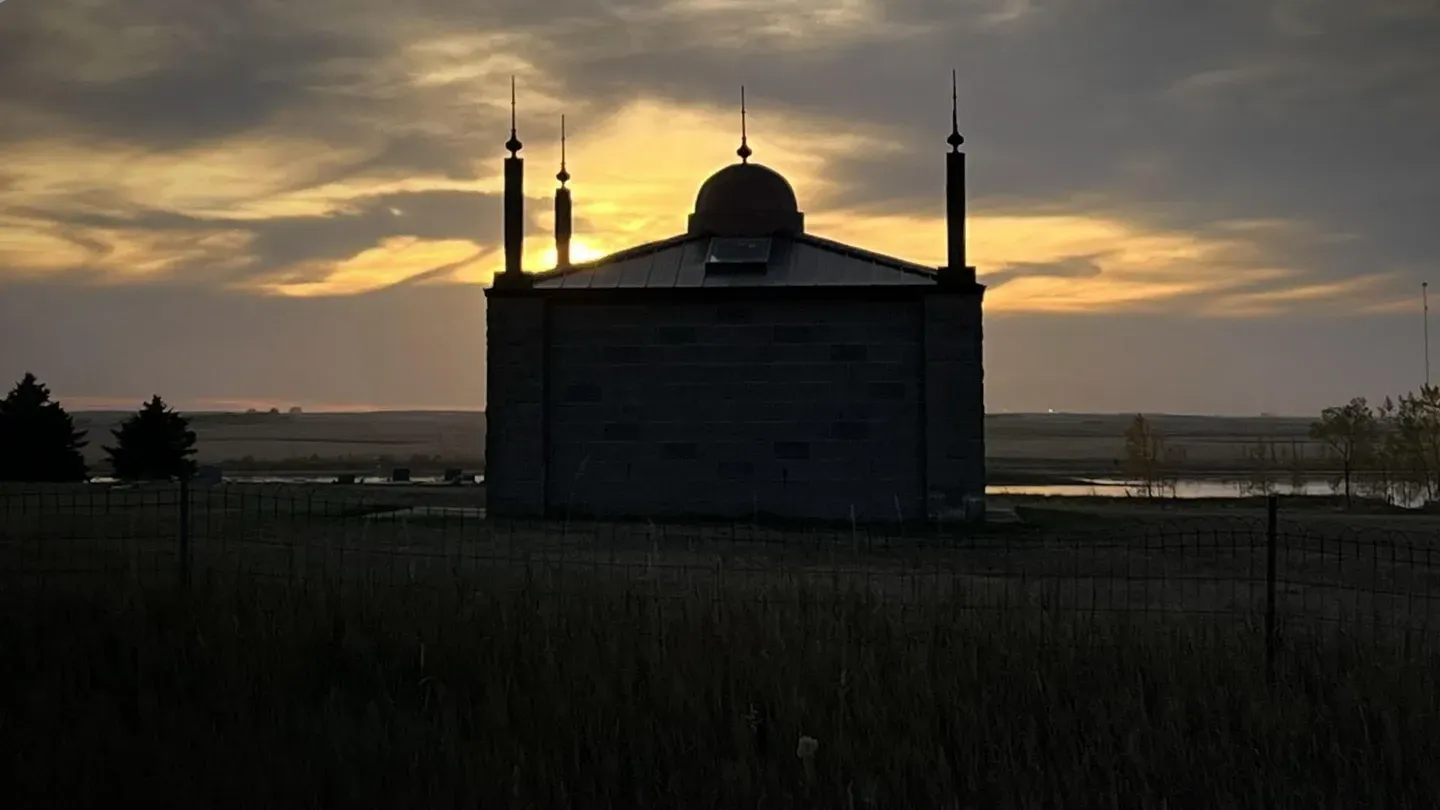
They built a mosque, one of the first built as a mosque in the United States.
Yeah, I see here we have the Abdallah family.
They must have made that journey.
And we have the Sam Jaha and family.
And he also made the journey.
Born 1892.
[Mattson] This is my family down here.
My great-grandparents are back here.
[Ismail] May God rest their souls.
Nicole Mattson's ancestors were part of the Muslim community that took root here in the early 1900s.
Do you come here a lot?
You know, I don't come that often.
And in fact, I didn't even know about any of this history.
I learned about it in college.
I was assigned to write a research paper.
I could pick any ethnic group in America.
I chose Lebanese Americans.
So I went to the library.
I checked out all the books on Lebanese Americans.
And I'm reading this book, and it's quoting my Aunt Lila about the mosque.
-[laughs] No way.
-Yeah.
And I said, "Wait, a mosque?"
I didn't know there was a mosque anywhere.
I didn't even know my family had been Muslim.
And so I called my grandma and I said, "What is this about a mosque?"
And she said, "Oh, didn't you know about that?"
And I said, "No, I didn't know about that."
Nobody ever told me.
[Ismail] Fortunately, for descendants like Nicole, the story of the mosque and the community that built it survives in the archives of the State Historical Society of North Dakota and the transcript of an interview conducted in the 1930s.
[Walker] We have a folder that's just marked Syrians right here.
Here is Mrs.
Mary Juma's interview.
[Ismail] Mary Juma and her husband, Hassen, were the first members of the community to arrive in Ross in 1902.
"If I had my life to live over, I would come to America sooner than I did.
I would have liked to visit the people..." It's Mary's story, but versions of it played out all across Ross and in Arab American families throughout the Midwest.
It begins with Mary and her husband leaving Lebanon's Wadi El Beqa, or Beqaa Valley, farmland tucked between mountain ranges 30 miles east of Beirut.
Do we know anything about why they left the Beqaa Valley?
[Curtis] There was push and pull.
People's livelihoods were changing.
The Ottoman Empire was modernizing.
There were economic displacements going on.
Jobs were disappearing.
What's happening in Lebanon can't be really separated from what's happening in the United States at the same time.
In the late 1880s, the US is coming out of a depression and there's a demand for more workers.
So one of the things that's happening in Lebanon is promotional activity to recruit workers.
What they are hearing is the story of the land of opportunity, of this American dream where you can build this life that maybe was not available back home.
[Ismail] "People in our vicinity were migrating to America and kept writing back about the riches in America..." [Juma] Everyone wanted to move, and we were a family of the many that contemplated leaving.
A big farewell party was given in our honor.
It was a sad farewell.
We left two daughters in the old country with relatives.
[Curtis] Their plan, like a lot of people, was, we're gonna make a bunch of money quick, and we're gonna go back home to our kids.
It didn't turn out that way.
[Juma] We went to Beirut and caught a boat to France.
It took us about three weeks to travel through France.
It took us three more weeks to come from France to Montreal, Canada.
[Hassan] The journey people took typically involved three or four legs, and it was about a 20 to 30-day journey.
We do know that most of them traveled in steerage, which was below deck, of course.
Often three bunks.
It was the cheapest ticket they could get.
Around the time that Mary and Hassen came to the United States, many Arabic-speaking immigrants were being turned away putatively because of an eye disease.
Trachoma.
But oftentimes just because they were undesirable immigrants for racial reasons.
It was easier to enter the United States on the northern border sometimes than it was to get in through New York.
And that's what they did.
[Juma] We moved further inland and started to travel over that country with a horse and cart as peddlers.
[Curtis] So they start out in Canada.
Then they go, around 1901, to Nebraska.
And they pedal through Nebraska.
[Ismail] Pedaling is just hustling.
-It's hustling.
You bet.
-It's like buying and selling.
[Hassan] I think there's a pejorative association with pedaling as itinerancy.
On the other hand, I think in Arab American cultural history, we look at it as being quite often it's associated with pioneering, determination to survive and get by in a difficult world.
As an immigrant, that actually helped to build the commercial routes of the modern United States.
So the peddlers were always looking for places where people might have money, but nothing available to them.
There were no corner stores.
So the idea is that that would take you westward.
[Juma] In 1902, we came to western North Dakota.
It was at the time when there was an influx of people to take homesteads, and we decided to try homesteading, too.
♪♪ [Alhassen] The Homesteading Act provided for 160 acres, if agreed upon, to cultivate this agricultural land If you lived on it for about five years.
It was this promise of land and promise of a dream, to be able to feel stable and settled.
The catch was that it had just been taken away from Native Americans ten years prior to the time when they're giving it out to anyone who's willing to settle it.
[Ismail] Western North Dakota was the homeland of the Mandan, Hidatsa and Arikara nations.
By the 1880s, the US government had forced them onto a reservation.
Much of their land was seized, divided and opened to homesteaders.
[Hassan] Homesteading was a policy of colonial settlement.
[Alhassen] The key was that the people you sent out there didn't really understand that they were the agents.
These migrants became buffers between the US government and the populations they were displacing.
[Hassan] Arab-speaking immigrants at the turn of the century actually were caught up in this racial conflict.
[Ismail] But this land wasn't open to everyone.
To claim a homestead, you had to be a US citizen, or at least file to become one.
To apply for US citizenship in the early 1900s, you had to qualify as a free white person or be of African nativity or African descent.
For families like the Jumas, that raised a real question.
The issue was naturalization, and could you be a US citizen if you were Muslim and if your first language was Arabic?
It didn't always line up to skin color.
Race wasn't-- Didn't function in that way because in some cases, Syrians were struck down because they were considered parasitic peddlers.
And that was not what a free white person would do.
[Ismail] But in the early 1900s, the rules were arbitrary, enforced by local judges.
Public records from 1902 show Mary's husband applying for citizenship and being granted a parcel of land he had five years to improve.
[Curtis] Mary and Hassen are part of dozens of Muslims who are settling in this country, oftentimes along the Great Northern Railway, which has four trains in and out of a town called Ross, which would become one of the most important Muslim towns in America in the early 1900s.
♪♪ [Juma] We started clearing the land immediately.
Within a year we had a horse, plow, disk, drag and drill.
We also had some cattle and chickens.
[camera shutters clicking] [Ismail] You know, it's one thing to read about Mary Juma.
It's another thing entirely to show up and see where she homesteaded, you know.
You can be driving past this plot on the highway, and it just looks like a little slice of America.
[train whistle blares] But for someone like me who's a Muslim American, this is so much more significant.
It's hard to imagine what this would have felt like for the Jumas.
Summers here can be unforgiving.
Winters drag on for months.
Bitter cold.
Frostbite and hypothermia would have been real risks.
[Hassan] Conditions would have been very rudimentary in terms of infrastructure and what was available to them to heat their homes.
They don't have electricity.
They don't have, you know, running water.
I mean, you got to cut wood.
I mean, an extremely difficult rural life.
[Ismail] Six years after arriving in Ross, the Jumas receive the patent for their land.
After Hassen's citizenship had been approved.
Okay, so they were able to get some land.
Does that mean that they more or less succeeded in presenting as white?
Yeah.
They succeeded.
I have Hassen Juma's certificate of naturalization.
He becomes a naturalized US citizen.
[Ismail] On the fifth day of April in the year of the Lord, 1907.
Wow.
[Curtis] You know, this is a really important date because in 1908 and 1909, the Secretary of Commerce and Labor will tell local judges not to naturalize Syrians because they're actually Asian or Oriental or Asiatic, they would say the term, and not white.
What's interesting is that a lot of the local judges refused to cooperate with the federal authority on this.
-Really?
-Yeah.
Because for 20 years, these people have been-- Have established themselves in places like Cedar Rapids, in Ross, North Dakota, in Michigan City, Indiana.
They know these people.
These people are their neighbors.
[Juma] In 1903, my son Charles was born.
He was the first Syrian child to be born in western North Dakota.
We were the first Syrians to homestead in this community.
But soon, many people from that country came to settle here.
[Walker] This is an atlas of Mountrail County from 1917.
The township is on 31.
[Ismail] Wow.
-[Walker] So here is Mary Juma.
-[Ismail] Yup.
Lila.
We have Sade Abdullah.
Hassan Farhat here.
We have Abdulah Omar.
What?
-I have an uncle named Abdullah.
-Oh!
Yeah, I mean, usually now people think, "Oh, when the Abdullahs move in, there goes the neighborhood."
But it seems like they've been there for a while.
[Walker] For sure.
[Ismail] What's curious is that I can only find Mary's name on this map, not Hassen's.
[Curtis] Hassen passed away in 1917, the same year in which this plot map was made.
And some of the women, they were single and owned homesteads.
This was a very hardy group of women.
When Hassen would go peddling, he would leave the farm in Mary's hand.
She had to have a limb amputated.
She had to use a wheelchair.
And she said, "I miss my work inside and outside."
She wanted to be out there on those fields.
She was always a hard worker.
Arab and Muslim women are so often stereotyped as people who are sort of confined to the home, who have less freedom.
These women were the opposite of that stereotype.
[Juma] Our home has always been a gathering place for the Syrian folk.
Not many parties or celebrations were held, except for occasions like a wedding or such.
Before we build our church, the mosque, we held services at the different homes.
We have a month of fasting, after which everyone visits the home of another and there is a lot of feasting.
They're not the majority of the population, but they have a critical mass so that they're visiting each other.
I mean, these Muslims, they're praying together.
They're celebrating Eid together.
Somebody in the community plays their oud.
-[Ismail] No way.
-[Curtis] Yeah.
Somebody is really good at singing.
And during the Prophet's birthday, the Mawlid an-Nabi, somebody is singing nasheeds or praise songs to the prophet.
There is a robust history and life to Arab Muslims in this region, and it's a lot more vibrant and diverse than we imagine it to be.
The Jumas are an illustration of that kind of social life.
[Ismail] There's something very spiritual about being out here that you can really feel, and I can imagine that Mary Juma's attachment to Islam only grew stronger.
Just for seeing the sunset and hearing the birds and... And it's that part of the story that you can't get unless you show up and you walk where she walked.
So there was a mosque in North Dakota.
-Can we talk about that?
-Yeah.
Because I can't even picture one.
There were more Muslims in the Dakotas per capita than any other place in the United States among these Arabic-speaking immigrants.
But this was unique in that it was the only community that built a permanent mosque.
-What did that look like?
-Let me show you know.
You ever seen a mosque like that?
[Ismail] Never.
It's sturdy.
They built it well.
[Curtis] Oh, yeah.
[Ismail] Where I am in New Jersey, there's no purpose-built mosques at all.
The mosque that I used to go to growing up was a commerce building.
This is like an American mosque.
[Alhassen] The Jumas wanted to create a center for community, for cultural community activity.
And the mosque is not just a prayer space.
The mosque is a gathering space.
I think for the non-Muslims, probably it was received both ways.
It was received as a commitment to the community.
These people are here to stay.
We want them to be here.
They're contributing.
We need them.
But for others, it was probably perceived as a concern.
Are they gonna assimilate or become American?
Or will they remain these outsiders with their strange religious practices?
It was also a way of becoming American.
Now, this may surprise people because you think, "Well, isn't assimilation about forgetting that difference?
No, no, no, no.
Especially not in the Midwest.
In order to be a good American in the Midwest, you need to have a religious congregation.
Everybody has one.
Ashkenazi Jews have one.
Sephardic Jews, the Lutherans, the Polish Roman Catholics, you name it.
And so they build theirs and add it to the tapestry of the Dakotas.
[Ismail] That totally changes my idea of what North Dakota might have been like.
People have the wrong idea, in particular about the Midwest.
[Juma] We were always able to make a very good living by farming and raising livestock, until the death of my husband.
Now the Depression has made living hard.
My family worshiped at the original mosque site.
Other families did as well.
They weren't there for all that long.
The Great Depression hit right after they had started construction, and a number of families left the area.
It was really hard living then, and they couldn't make a living here.
So the building fell into disrepair.
And in the 1970s it was torn down.
We have a lot of stories of resilience in Muslim America in the 20th century, but in this case, it was a story of a place that just couldn't sustain a community over the long haul.
They had been brought out there and been given this promise that if you till it deep enough, you'll unlock the moisture.
It was called dry farming.
Well, this land was not meant to be intensively farmed, so it couldn't sustain all these small farms.
[Ismail] They were set up to fail, in a sense.
[Curtis] Absolutely.
[Ismail] Did Mary also leave Ross?
No, no.
She stayed for the rest of her life.
Her death in 1947 coincides with the decline of the community.
[Ismail] The few families who stayed in Ross slowly blended into the wider community until, for some people, like Nicole Mattson, memories of their Muslim roots were all but lost.
It seems like not a lot of people know that there's a mosque here or was a mosque here.
How does that factor into the history of this country?
I think people need to know that Muslim people have been in this country since before it was even a country.
People have really no idea.
They think that Muslims are new and they're the other, when in reality, these were your grandparents' neighbors.
[Ismail] Some of the families who left North Dakota went back to Lebanon.
Others stayed in the United States, building new lives in Arab American neighborhoods across the Midwest.
Many carried pieces of their prairie lives with them.
Some of those pieces are preserved at the Arab American National Museum in Dearborn, Michigan, including what's left of that mosque.
The door.
A treasured reminder of a history that was almost forgotten.
It's a perfect metaphor.
It's like a doorway to the past.
Back in Ross, as descendants like Nicole have reclaimed their past, they've worked hard to make sure it doesn't disappear again.
In 2018, they got the community's cemetery listed on the National Register of Historic Places.
And that wasn't all.
[Mattson] My great-grandmother's dream was to have another mosque built on the site of the original building.
My grandmother and her brother and sisters took on that project, and it took them a fair number of years to get this built.
They did a lot of sourcing of materials from, honestly all over the world.
And finally, they were able to finish it.
But unfortunately, not before my great-grandmother passed away.
So this is the mosque that was built in 2005.
[sighs] You know, I was born here.
I never lived anywhere else.
And it just means so much to me to know that over 100 years ago, there were Muslims here, and they built a mosque.
It feels cool to know that I can come to a place as remote and still find a place to, to pray.
♪♪ [Curtis] It is lazy to think that the rural Midwest has always been white or that its roots are white.
Its roots are multicultural and multi-religious, and if we want to honor the lives of these people, we've got to rewrite our history to include them.
I just can't shake that image of early American settlers playing the oud and singing in Arabic.
And play baseball.
They did both.
[laughs] ♪♪ [announcer] For educational resources, visit "The American Muslims: A History Revealed" collection at PBS LearningMedia.
A Mosque on the Prairies Preview
Preview: Ep4 | 30s | A Lebanese homesteader recalls the building of one of the first mosques on the Great Plains. (30s)
Providing Support for PBS.org
Learn Moreabout PBS online sponsorship














Support for PBS provided by: